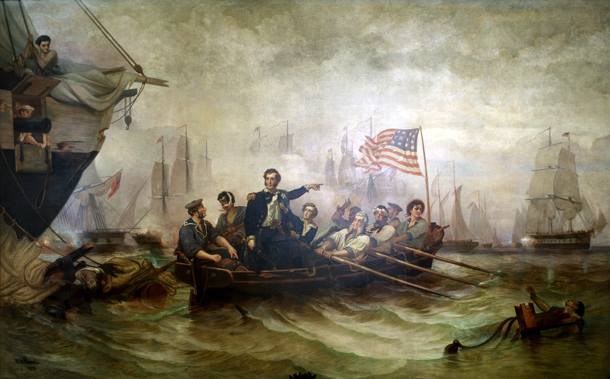
As news arrived in America on February 13, 1815 that the Treaty of Ghent was finalized and that peace between America and Britain was complete, Americans had a complete change of mind. Rather than dwell on the burning of Washington, D.C. or the humiliation of Britain’s invasion, Americans relished the victory of General Andrew Jackson in the Battle of New Orleans and the peace. See Daniel Walker Howe, What Hath God Wrought: The Transformation of America, 1815-1848, 71.
Quickly after the war ended, work began on repairing Washington, D.C., particularly the President’s Mansion. It received a coat of white paint over the stone exterior, hiding the marks left by black smoke, and the moniker the White House was coined. See id. While it would be years before the interior was fully restored, the facade appeared majestic, even just by that thin coat of paint.
Analogously, Americans seemed to put a veneer on the War of 1812, seeing it as a “second war of independence, a vindication of their national identity rather than a revelation of its precariousness.” Id. The historian Bradford Perkins remarked: “Seldom has a nation so successfully practiced self-induced amnesia.” Bradford Perkins, The Creation of a Republican Empire, 1776-1865 (Cambridge, Eng., 1993), 146.
As a collective, Americans had gained self-respect and felt that they earned Europe and Britain’s respect as well. Albert Gallatin, former Secretary of Treasurer and part of the negotiating team for the Treaty of Ghent, remarked that “[t]he war has renewed and reinstated the national feelings and characters which the Revolution had given. The people . . . are more American; they feel and act more as a nation.” Gallatin quoted in Rutland, Presidency of Madison, 188.
President James Madison, as well as the rest of the federal government, could breathe a sigh of relief with the conclusion of the war. With the end of the war came the end of conscription, the end of potential New England secession, and the beginning of financial security for the country. Daniel Walker Howe, What Hath God Wrought: The Transformation of America, 1815-1848, 73.
Americans were quick to revise the narrative of the War of 1812 and were quick to pick themselves up and carry on with their lives. Perhaps the War of 1812 united Americans in a way that they had not felt since the Revolution, evoking those nationalist feelings once again. However, it would also be fair to assume that nationalist feelings generally grow in the wake of periods of tumult. Regardless of the source of these feelings, they inevitably had the effect of bringing Americans together for the time being. While that spirit of unity would not remain for long, Americans would not soon forget the heroes of the war who had fought off the tyrannical Britain once again, particularly General Andrew Jackson.

 Last Best Hope of Earth
Leave a comment