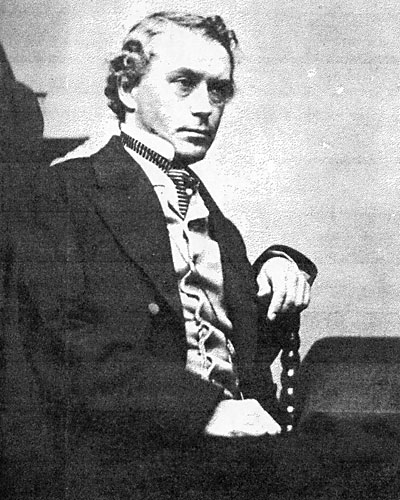
Throughout the months leading up to the firing on Fort Sumter, there was widespread wonder about how the country would react to such a provocation; it was bound to be a cleave dividing the country and also its communities. Generations later—with the accordion of events neatly folded and the result of the war known—it would seem obvious that a swell of patriotism came rose when the rebels fired the first shot in Charleston’s harbor. But in New York, an attorney and diarist, George Templeton Strong, documented that the swell of patriotism in his city was not immediate nor universal—but it was pronounced.
Strong had been a witness to the prologue of the war and knew that it would come at great cost to the country—and change its course. He wrote: “So Civil War is inaugurated at last. God defend the Right.” He continued:
“The Northern backbone is much stiffened already. Many who stood up for ‘Southern rights’ and complained of wrongs done the South now say that, since the South has fired the first gun, they are ready to go all lengths in supporting the government.”
The news also had an impact on the Democrats who had been “Southern and quasi-treasonable in their talk.” With the news confirmed of the fall of Fort Sumter, those Democrats began “denouncing rebellion and declaring themselves ready to go all lengths in upholding government.” It was a remarkable reversal: those same men who had staunchly supported the South now had turned against them—a reversal that likely only the South itself could have caused through its firing on Fort Sumter. Strong wrote: “If this class of men has been secured and converted to loyalty, the gain to the country is worth ten Sumters.”
Even the New York City newspapers were falling in line behind the North—or at least no longer openly supporting the South. The New York Herald was preparing to denounce Jefferson Davis, the Express was still “half traitorous” but “half in favor of energetic action against traitors,” and even the Journal of Commerce and Day-Book—two highly pro-South newspapers of the time—looked to soon become more “cautious in [their] utterance.”
Already, men were assembling in New York—preparing and training for the seemingly imminent fight. On April 15, Strong went to Governor’s Island and saw nearly “three hundred recruits on the Island, mostly quite raw.” There, he spoke to one “honest-looking, simple-minded boy from somewhere near Rochester, probably some farmer’s son,” who told Strong “[h]e had voted for Abe Lincoln, and as there was going to be trouble, he might as well fight for Abe Lincoln.” And so the man enlisted. The new enlistee also told Strong that he “[g]uessed they were going to get some hard knocks when they went down South, but then he had always kind o’ wanted to see the world—that was one reason why he ‘listed.”
The following day, Strong heard—and took heart in the fact—that Major Ambrose Burnside had resigned his treasurer position at the Illinois Central Railroad and “posted down to Rhode Island to assume command of volunteers from the state,” and 2,500 volunteers from Massachusetts were then quartering in Faneuil Hall, “awaiting orders.” Those states, and others comprising the Union, were just then tapping into the reserve of people and resources that would, in short order, serve as a most formidable opposition to those rebels—and much of that formidableness was due to the unity of those people in the Union.
And thus Strong concluded his diary entry: “GOD SAVE THE UNION, AND CONFOUND ITS ENEMIES. AMEN.”
 Last Best Hope of Earth
Leave a comment