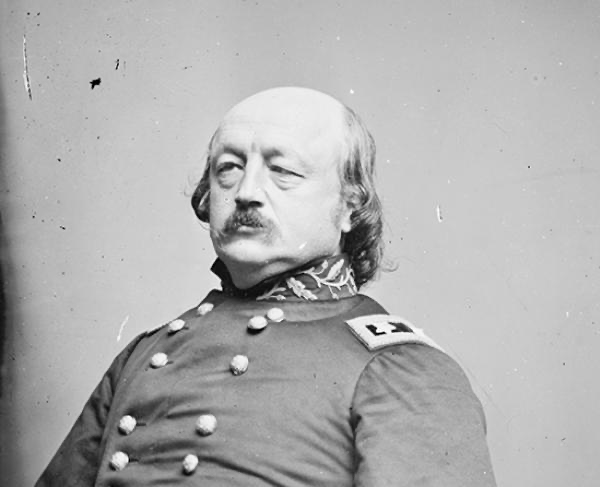
One night in late May 1861, “three negroes”—who said they were field hands, slaves—delivered themselves to the picket line at Fort Monroe in Virginia. Fort Monroe, sat on the peninsula between the York River and James River, had at its helm Brigadier General Benjamin F. Butler. The fugitive slaves had come to the fort to not only escape but to join the Union effort—to offer their skills and services to Butler and his soldiers. With no military policy in place for what to do with such fugitive slaves, it was a situation that raised difficult questions for Butler and the Union—of if, and how, to receive them—and the Confederacy—of how to stop their property and manpower from joining the enemy.
Benjamin F. Butler, a lawyer and politician from Massachusetts, took the matter into his hands as the leader at the fort. Butler and his soldiers separately examined the three fugitives and elicited evidence that the men “were about to be taken to Carolina for the purpose of aiding the secession forces there; that two of them left wives and children (one a free woman) here; [and] that the other had left his master from fear that he would be called upon to take part in the rebel armies.” In fact, there was information coming to Butler at this time that “negroes in this neighborhood are now being employed in the erection of batteries and other works by the rebels which it would be nearly or quite impossible to construct without their labor.”
As for Butler’s quandary, the fugitives “were very serviceable” and could fulfill a need in the fort’s “quartermaster’s department”—if it was lawful to accept them and receive their service. Butler wrote to Lieutenant General Winfield Scott to inquire whether he could avail himself of the men’s services and then send a receipt to their owner—a Colonel Charles K. Mallory—notifying Mallory that Butler had requisitioned them as he would have with “other property of a private citizen which the exigencies of the service seemed to require.” Here, Butler wrote that the fugitives would have fallen into that category of “property that was designed, adapted and about to be used against the United States.”
And so he wrote to General Scott—to seek guidance in this instance as there was not yet a policy “with regard to this species of property.” His question to the general was direct: “Shall they be allowed the use of this property against the United States and we not be allowed its use in aid of the United States?”
There had been talk between Butler and others that perhaps Butler was bound by his “constitutional obligations to deliver up fugitives under the fugitive-slave act.” But he concluded that this act “did not affect a foreign country which Virginia claimed to be and that she must reckon it one of the infelicities of her position that in so far at least she was taken at her word”: with Virginia out of the Union, federal laws no longer applied to it. More than that, absent a pledge to the United States Constitution, those owners were engaged in the secessionist actions of late and not entitled to return of their property, so Butler reasoned.
Reasoning and legalities aside, inaction on this issue was soon to become impossible.
What had started as a trickle turned into a tide. On May 27, 1861, a New-York Times correspondent wrote that the previous day another eight fugitives came to the fort. The fugitive men “told the story that they had left their masters because they believed they were to be sent South,” and one man “stated very frankly that he supposed that the gentlemen in Fortress Monroe were the friends of the colored population.” The man continued, in his “genuine farm-hand dialect”:
“We had heard it since last Fall, that if Lincoln was elected, you would come down and set us free. And the white-folks used to say so, but they don’t talk so now; the colored people have talked it all over; we heard that if we could get in here we should be free, or, at any rate, we should be among friends.”
Then, on May 27, forty seven fugitives came to the fort, “embracing all ages from three months to 85 years” and coming from around the neighborhood but also as far away as near Richmond. There were “half a dozen entire families,” many “good field-hands,” and men who “came and expressed their willingness to enroll in the new corps of ‘Virginia Union Volunteers.’”
The correspondent wrote, of the impending situation, that as “long as only property contraband of war—that is to say, negroes adapted for, and about to be employed in military movement—come into our possession, the question was comparatively simple; it was simply military.” But with a significant number of “women and children” having come as well, “it became a humanitarian question.”
Humanitarian and military questions were arising and would become more troubling as the war unfolded. However, even in these early days of the conflict, the country was changing in irreversible ways: slaves saw windows of opportunity—and took them to escape—and could then see a post-war future of freedom. Fort Monroe was one place where men from the North were witnessing the foreshadowing of that future: seeing men, women, children, and the elderly come to their fort—leaving the familiar, risking everything—to be with, as that one fugitive said, those “gentlemen in Fortress Monroe [who] were the friends of the colored population.”
 Last Best Hope of Earth
Leave a comment