Author: Last Best Hope of Earth

  • Constitution Sunday: Answers to Mason’s “Objections”: “Marcus” [James Iredell] IV

    Answers to Mason’s “Objections”: “Marcus” [James Iredell] IV

    Norfolk and Portsmouth Journal (Virginia), March 12, 1788

    Following are excerpts from James Iredell’s responses to George Mason’s “Objections” to the Constitution:

    VIIIth. Objection. ‘Under their own construction of the general clause at the end of the enumerated powers, the Congress may grant monopolies in trade and commerce, constitute new crimes, inflict unusual and severe punishments, and extend their power as far as they shall think proper (more…)

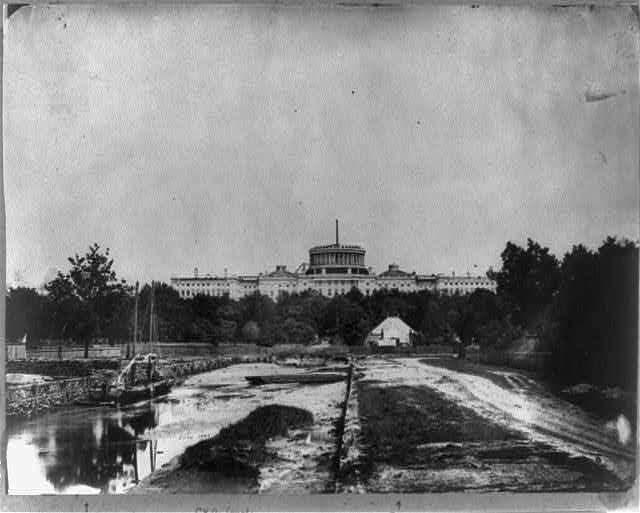
  • The Precursor to the Winter of Secession

    168095
    Washington in 1860. Photographer Unknown.

    Abraham Lincoln’s victory in the Election of 1860 was disconcerting news for the South. It was the most recent event in a string of events that seemingly endangered the southern way of life and the future of the country. At a time when many northerners suspected southern threats of secession were but a bluff, there was evidence that the country had already split and the formalities were soon to follow. (more…)

  • The Election of 1860

    1860photo_uscapitol_washingtoncanalvisiblie
    The United States Capitol in 1860. Courtesy: Library of Congress

    Every presidential election is consequential, but the Election of 1860 would play a significant role in whether the United States would remain one nation. The division of the North and South on the issue of slavery threatened to cause a secession of the South. The result of the election would determine whether that threat would materialize and cause a Second American Revolution. (more…)

  • The Obstinacy of the North and South

    enhanced-28733-1444703692-1
    Construction on the Capitol in 1859. Courtesy: William England, Getty Images.

    By 1859, the northern and southern sections of America had developed different economic systems, cultural norms, and approaches to permitting slavery. Congress and the political parties had been able to overlook those differences for the sake of self-preservation and advancement of the collective agenda. As 1859 concluded and 1860 sprang, Americans understood that the status quo of compromise was not to continue much longer. (more…)

  • The Raid on Harpers Ferry

    82590-004-346616d5
    Depiction of the Raid on Harpers Ferry.

    For the bulk of the early 19th Century, slaveholders in the South had a deep fear that a slave revolt would erupt and metastasize, leading to an eradication of the institution, similar to what happened in Haiti in the first years of the 19th Century. In 1859, John Brown, one of the instigators in Bleeding Kansas, would attempt to lead such a revolt, starting at a federal armory in Harpers Ferry, Virginia. The immediate effects of his raid would pale in comparison to its impact over the course of the following two years. (more…)

  • Constitution Sunday: Answers to Mason’s “Objections”: “Marcus” [James Iredell] II

    Answers to Mason’s “Objections”: “Marcus” [James Iredell] II

    Norfolk and Portsmouth Journal (Virginia), February 27, 1788

    Following are excerpts from James Iredell’s responses to George Mason’s “Objections” to the Constitution:

    IVth. Objection. The Judiciary of the United States is so constructed and extended, as to absorb and destroy the Judiciaries of the several States (more…)

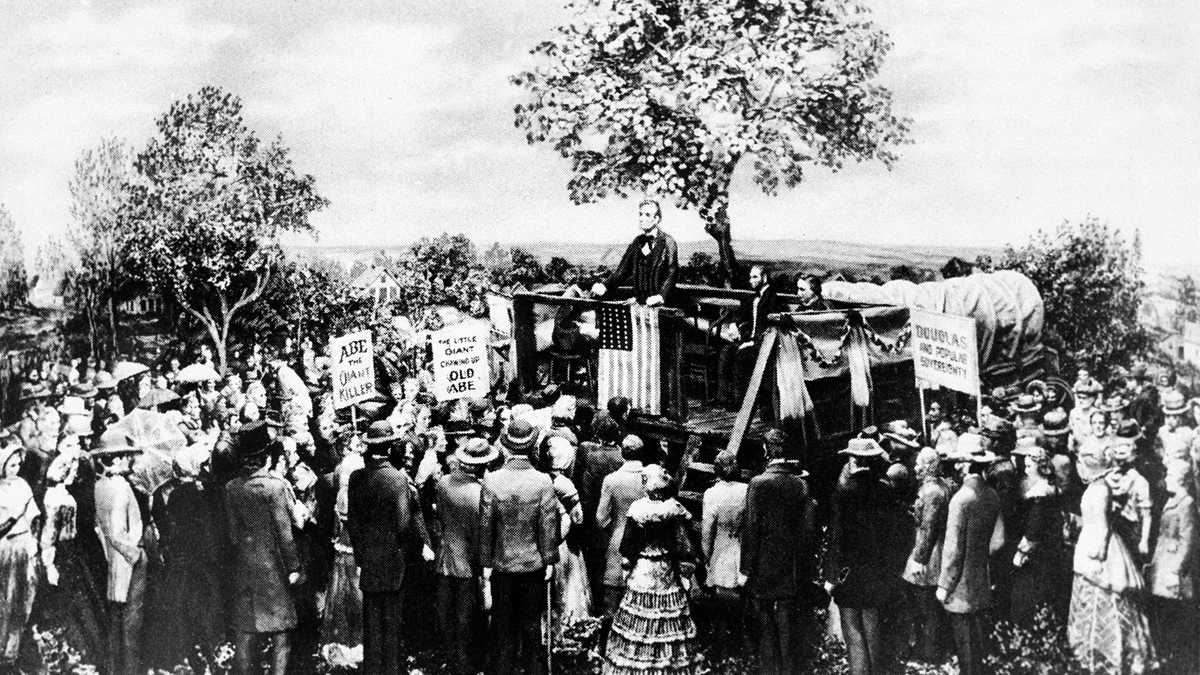
  • The Lincoln-Douglas Debates of 1858

    l_lincoln-douglas_1200x675
    Depiction of the Lincoln-Douglas Debates.

    Senator Stephen Douglas had come into the political spotlight through his work in the Compromise of 1850 and the Kansas-Nebraska Act, which had temporarily held the country together but perpetuated the institution of slavery. Douglas, a Democrat, was a force to be reckoned with for keeping a seat in the United States Senate despite the growing strength of the Republican Party throughout the North and in his home state of Illinois. Throughout 1858, a time when the state legislatures elected senators to the United States Senate, Douglas would have to win the support of the people of Illinois, and the Illinois legislature, by debating the issue of slavery, and the future of the country, with the Republican candidate for the Senate, Abraham Lincoln. See David Potter, The Impending Crisis: America Before the Civil War, 1848-1861, 330-31. (more…)

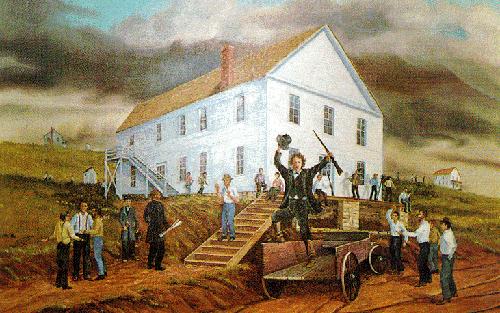
  • The Lecompton Constitution

    lecompton20constitution20hall
    Constitution Hall in Lecompton, Kansas.

    Following the violence in Kansas known as Bleeding Kansas, there was a question of whether the territory would be admitted as a free state or slave state. After taking office in 1857, President James Buchanan appointed Robert J. Walker of Pennsylvania to be governor of Kansas. Governor Walker wrote a letter to President Buchanan, stating “that the actual bona fide residents of the territory of Kansas, by a fair and regular vote, unaffected by fraud or violence, must be permitted, in adopting their State Constitution, to decide for themselves what shall be their social institutions.” Walker to Buchanan, March 26, 1857, in Kansas State Historical Society Transactions, V (1891-1896), 290 (italics in original). Even with such a pronouncement regarding the nature of an election, no one knew how Kansans would vote on the issue of slavery or how soon Kansas would become a state. (more…)

  • A Supreme Court Tragedy: Dred Scott v. Sandford

    05_e
    The Taney Supreme Court.

    In 1857, the United States Supreme Court decided one of the most controversial cases in the history of the country. Just days after James Buchanan began his term as president, Chief Justice Roger Taney wrote the opinion for the Court, ruling that neither slaves nor freedmen could be citizens of the United States. The implications of this decision, and its reasoning, have been analyzed, dissected, and discussed since 1857. While many have concluded it is one of the Supreme Court’s worst decisions, its impact on Antebellum America should not be overlooked.

    (more…)

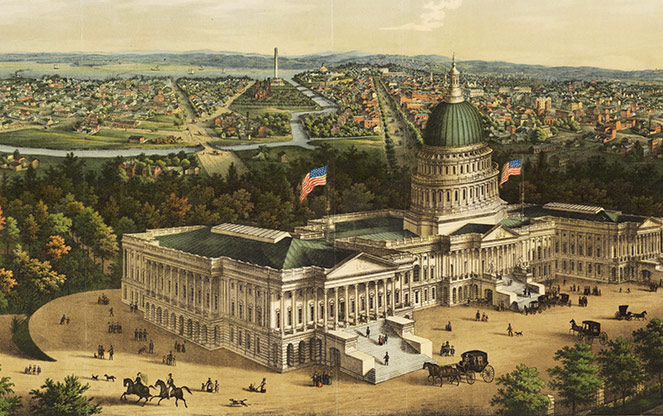
  • The Evolving Political Parties of the 1850s

    panoramic-view-of-washington-city-e-sachse-and-co-1856
    Panoramic View of Washington, DC in 1856. Courtesy: E. Sachse & Co.

    The Democratic Party and Whig Party were the dominant political parties from the early 1830s up until the mid-1850s. Both were institutions in national politics despite not having a coherent national organization by cobbling together a diverse group of states to win elections. While the Democrats had a more populist agenda, the Whigs were more focused on pursuing industrialization and development of the country. See David Potter, The Impending Crisis: America Before the Civil War, 1848-1861, 226. While the Democratic Party would survive to the present day, the Whig Party would not survive the mid-1850s, not as a result of its own ineptness but because of the changing political landscape of that era. (more…)