Author: Last Best Hope of Earth

  • Constitution Sunday: Refutation of the “Federal Farmer”: Timothy Pickering to Charles Tillinghast

    Refutation of the “Federal Farmer”: Timothy Pickering to Charles Tillinghast

    Philadelphia, December 24, 1787

    Following are excerpts from Timothy Pickering’s letter to Charles Tillinghast, refuting the “Federal Farmer”:

    “In respect to the organization of the general government, the federal farmer, as well as other opposers, object to (more…)

  • The Legacy of the Whig Party

    clay44b
    The New York Tribune, a Whig Newspaper, Endorsing its Candidates.

    Following the Election of 1840, members of the Whig Party must have been optimistic about their future. They likely imagined that the dominance of the Jacksonian Democrats could be replicated within the ranks of the Whigs and supplant the Democrats. It was not to be, however.

    (more…)

  • The Censure of John Quincy Adams

    220px-john_quincy_adams
    John Quincy Adams.

    In 1842, John Quincy Adams presented to the House of Representatives a petition from 42 residents of Haverhill, Massachusetts, requesting that the Union be dissolved. Daniel Walker Howe, What Hath God Wrought: Transformation of America, 1815-1848, 610. Henry Wise, Congressman from Virginia, “demanded the former president be censured.” Id.

    (more…)

  • The Progress of Women in the 1830s and 1840s

    dix-dorothea-loc
    Dorothea Dix.

    Around the 1830s and 1840s, individuals who suffered from mental illness were treated as criminals, regardless of whether they had actually committed a crime. See Daniel Walker Howe, What Hath God Wrought: Transformation of America, 1815-1848, 604. Dorothea Dix sought to change that.

    (more…)

  • Lincoln the Teetotaler

    underhill-old-country-store
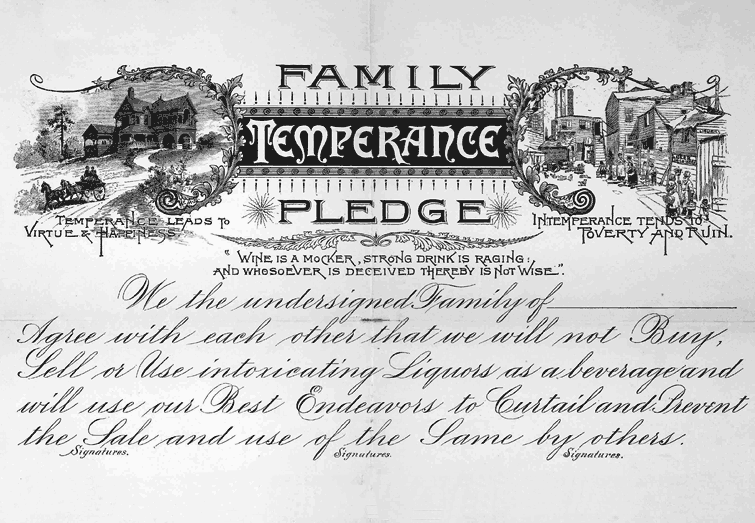
    A Pledge to be Part of the Temperance Movement.

    While the Democrats had held up Andrew Jackson as the ideal man, the Whigs began to view Abraham Lincoln in the 1840s as the ideal man, even though his personality was “artificial—that is, self-constructed.” Daniel Walker Howe, What Hath God Wrought: Transformation of America, 1815-1848, 598.

    (more…)

  • The Illinois System

    abraham_lincoln_by_nicholas_shepherd2c_1846-crop
    Abraham Lincoln in 1846, then Representative from Illinois. By: Nicholas H. Shepherd.

    Abraham Lincoln, as a Congressman in the House of Representatives, would be “an ardent supporter of internal improvements.” Daniel Walker Howe, What Hath God Wrought: Transformation of America, 1815-1848, 596.

    (more…)

  • The Emergence of Bankruptcy

    10010743373
    The Bankruptcy Act of 1841.

    In the wake of the Panics of 1837 and 1839, Congress sent the White House a new bill to be signed into law: The Bankruptcy Act of 1841. See Daniel Walker Howe, What Hath God Wrought: Transformation of America, 1815-1848, 593. From then on, bankruptcy would be part of American life, providing an option for when debts become overwhelming.

    (more…)

  • Constitution Sunday: Letters from the “Federal Farmer” to “The Republican”

    Letters from the “Federal Farmer” to “The Republican”

    New York, November 8, 1787

    Following are excerpts from a series of letters published in New York, supposedly from the Federal Farmer to The Republican:

    “A general convention for mere commercial purposes was moved for—the authors of this measure saw that the people’s attention was turned solely to the amendment of the federal system; (more…)

  • The First Presidential Succession

    Portrait of John Tyler
    Depiction of John Tyler.

    Following William Henry Harrison’s death just a month into his presidency in 1841, John Tyler rose to the presidency, in the first instance of a president dying while holding the office. See Daniel Walker Howe, What Hath God Wrought: Transformation of America, 1815-1848, 589.

    (more…)

  • The Darkest Spot on the American Mantle

    clay
    Henry Clay. By: Henry F. Darby.

    In 1832, Henry Clay addressed the Senate, expressing his hope that “some day,” America “would be rid of this, the darkest spot on its mantle,” speaking of slavery. Daniel Walker Howe, What Hath God Wrought: Transformation of America, 1815-1848, 586 quoting Life, Correspondence, and Speeches of Henry Clay, ed. Calvin Colton (New York, 1857), I, 189, 191.

    (more…)