Author: Last Best Hope of Earth

  • Setting the Stage for the War of 1812

    Landscape Painting of Georgia.

    In the early Republic, trading became a staple of the American economy, which affected American relations with other countries in drastic ways.

    American merchants “brought home products from Canton, China, and ports in the Indian Ocean, including teas, coffee, chinaware, spices, and silks, before shipping them on to Europe . . . .” Gordon Wood, Empire of Liberty, 623. America imported goods from Europe only to export them to “the West Indies, South America, and elsewhere.” Id. However, perhaps most surprisingly, between 1795 and 1805, “American trade with India was greater than that of all the European nations combined.” Id. citing Ted Widmer, Ark of the Liberties: America and the World (New York, 2008), 66.

    Much of this trading arose out of the fact that America had not transformed into a purely industrial, manufacturing economy as much of Europe had during this time period. Rather, many Americans maintained their farming and picked up trading and other practices to make virtually all Americans participants in a massive national and international economic system. See Gordon Wood, Empire of Liberty, 627. These changes had domestic political implications, with the Republicans satisfied with the economic system and the Federalists believing it was an underachieving system. Id.

    The Republicans wanted to raise America’s status in the world, rather than solely focus on the state of the economy like the Federalists. Id. at 629. The Republicans wanted to create a system that prevented war from occurring and would also make America a recognized force to be reckoned with on the international stage. Id.

    Republicans ultimately took actions that surprised other countries’ officials. For example, the Republicans replaced diplomatic missions with consuls who handled international trade. A Russian official commented that Americans were “singular,” and wanted “commercial ties without political ties,” which was widely considered an impossibility at the time. Id. at 632 citing Irving Brant, James Madison: The President, 1809-1812 (Indianapolis, 1956), 69.

    These actions by the early Americans were largely intended to distinguish America as a player on the international stage. Perhaps out of a desire to show the world that America was not England and certainly was its own country who had its own policies, the Republicans underwent this course of action, much to the chagrin of the English and to some other government officials.

    The Americans were eager to distinguish themselves and to build an economy that was sustainable. The ongoing war between Napoleonic France and England partially allowed America to use its resources to build its trade routes and grow its economy.

    Some may look to these events as some of the earliest examples of American exceptionalism, which would perhaps be a keen observation. These early years of the Republic would ultimately set the stage for the War of 1812, but for the time being, Americans would have been content knowing that the economy was growing, trade was blossoming, and they were building the new country.
  • Ubiquitous But Controlled Religion

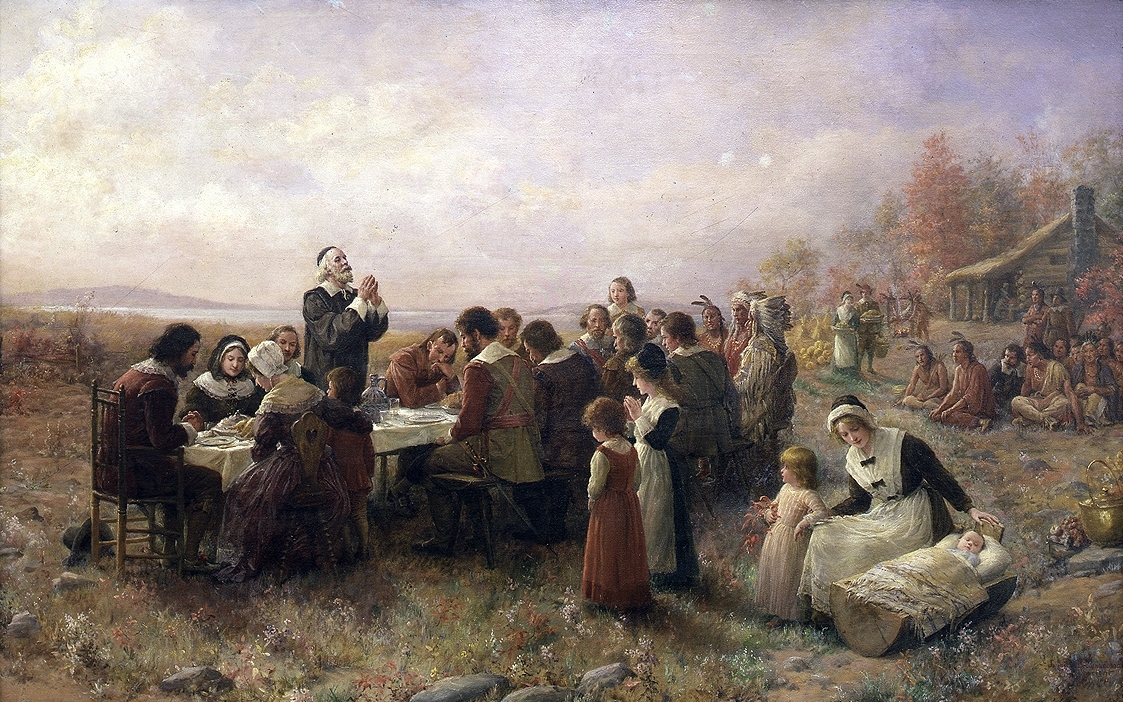
    Thanksgiving. By: Jennie Augusta Brownscombe. (1914)

    In the early Republic, religion took on a new role in society. In some segments of American society, religion became fervent. For example, in Cane Ridge, Kentucky in 1801, dozens of ministers of different denominations congregated with approximately 15,000-20,000 in a week-long conversion session. Gordon Wood, Empire of Liberty, 596. Amongst the “heat, the noise, and the confusion” were ministers, sometimes six preaching at a time, shouting “sermons from wagons and tree stumps.” Id. Many in the crowd “fell to the ground moaning and wailing in remorse; and they sang, laughed, barked, rolled, and jerked in excitement.” Id.

    Meanwhile, the states took varying approaches to dealing with religion in government. New Hampshire, Connecticut, New Jersey, North Carolina, and Georgia “required officeholders to be Protestant,” while “Maryland and Delaware [required] Christians,” while “Pennsylvania and Souther Carolina officials had to believe in one God and in heaven and hell,” while “Delaware required a belief in the Trinity.” Id. at 583 citing James H. Smylie, “Protestant Clergy, the First Amendment and Beginnings of a Constitutional Debate, 1781-91,” in Elwyn A. Smith, The Religion of the Republic (Philadelphia, 1971), 117.

    On the federal level, the Constitution of course provided protection for individuals to freely exercise their religion and also prohibited laws respecting an establishment of religion. U.S. Constitution, First Amendment. In 1802, Thomas Jefferson wrote that the First Amendment created a “wall of separation between church and state.” Thomas Jefferson to Messrs. Nehemiah Dodge and Others, 1 Jan. 1802, Jefferson: Writings, 510.

    The role that religion would ultimately play in American society was not clear in the early years of the Republic. The hysteria that surrounded some of the religious ceremonies like described in Cane Ridge made clear that religion would play a central role to many. Thomas Jefferson, and the drafters of the Constitution realized that while religion may play a central role to the lives of many Americans, it could neither be endorsed nor prohibited by the government.

    This careful move by the Founding Fathers ensured that while religion would be freely exercised and even ubiquitous in society, it would not be a democracy characterized by religion and certainly not a theocracy. The system embraced individual freedom and excluded government involvement where unnecessary. Fortunately, this system has largely been preserved by subsequent generations of Americans. Current and future public officials would do well to ignore any populist notions of the role religion should play in society and be keen on preserving the status quo of this effective system.

  • The Founding Fathers’ Religious Beliefs

    Thomas Jefferson Seated at His Desk. By: Gilbert Stuart, 1805.

    The religious beliefs of the Founding Fathers may serve as a surprise to some modern Americans. However, it is important to put into context that the Founding Fathers lived in an era that was not filled with the religious fervor that would become commonplace in the 1800s. See Gordon Wood, Empire of Liberty, 576.

    Thomas Jefferson hated “the clergy and organized religion.” Id. at 577. He said that the Trinity was “Abracadabra” and “hocus-pocus . . . so incomprehensible to the human mind that no candid man can say he has any idea of it,” and thus, ridiculing it was the best option. Id. quoting Thomas Jefferson to Horatio Spafford, 17 Mar. 1814, to James Smith, 8 Dec. 1822, in James H. Hutson, ed., The Founders on Religion: A Book of Quotations (Princeton, 2005), 68, 218.

    Benjamin Franklin also appeared to harbor at least some dissension about religion, as he advised a friend in 1786 to not publish “anything attacking traditional Christianity” as “[he] that spits against the wind . . . spits in his own face.” Gordon Wood, Empire of Liberty, 589. Franklin was keenly aware of the fact that Thomas Paine had “destroyed his reputation” by writing “scathing comments about Christianity in his Age of Reason (1794).” Id. citing Thomas Paine, The Age of Reason (1794), in Eric Foner, ed., Thomas Paine: Collected Writings (Library of America, 1995), 825.

    George Washington, however, “had no deep dislike of organized religion or of the clergy as long as they contributed to civic life.” Gordon Wood, Empire of Liberty, 585. In fact, during the Revolutionary War, “he had required all troops to attend religious services and had prescribed a public whipping for anyone disturbing those services.” Gordon Wood, Revolutionary Characters: What Made the Founders Different (New York, 2006), 35; Forrest Church, So Help Me God: The Founding Fathers and the First Great Battle over Church and State (New York, 2007), 36.

    Underlying these early views was a key concept: the early American public would not tolerate its individuals, in government or not, undermining the sanctity of religion. Thomas Paine’s alienation, after his massive success of Common Sense highlights this fact.

    It should also be noted that there were varying views about religion amongst the Founding Fathers. This diverse group of interests would ensure that the early Republic would not become a purely religious nation and not a purely secular nation.

    As is evident in so many areas of American history, and world history for that matter, where diverse interests converge and the byproduct is moderation, success is much more likely. The role of religion in America was passed through this filter of moderation, which has ebbed and flowed for the past two centuries but has remained somewhere near the middle of the two options. That moderation has prevented religion from becoming a significant, schismatizing issue.

  • Unanticipated Consequences

    Albert Gallatin, Secretary of the Treasury from 1804-1815.

    In 1807, Congress passed the Embargo Act at the behest of President Thomas Jefferson. The Embargo Act “prohibited the departure of all American ships in international trade.” Gordon Wood, Empire of Liberty, 649. Secretary of the Treasury Albert Gallatin doubted the effectiveness of the embargo on preventing the oncoming confrontation with the battling European behemoths of France and England. Id. at 650. Gallatin predicted that the embargo could result in “privations, sufferings, revenue, effect on the enemy, [and] politics at home . . . .” Id.

    Gallatin advocated for war, rather than the embargo. Id. at 651. He realized one of the greatest truths of government: “momentous actions by governments often had unanticipated consequences.” Id. In support of that point, he told President Jefferson that “governmental prohibitions do always more mischief than had been calculated; and it is not without much hesitation that a statesman should hazard to regulate the concerns of individuals as if he could do it better than themselves.” Id. quoting Gallatin to Thomas Jefferson, 18 Dec. 1807, in Henry Adams, ed., The Writings of Albert Gallatin (Philadelphia, 1879), 1: 368.

    Gallatin’s prescient words were wise at the time, as the embargo precipitated the War of 1812. However, his words also ring true throughout history. There are numerous examples throughout American history where momentous decisions led America down a path of unexpected, and often avoidable, consequences. Some may look to the 20th Century and 21st Century’s Wars in Vietnam, Iraq, and Afghanistan.

    There have been even more recent exemplifications of this principle. Most recently, Western Europe and the United States imposed economic sanctions on Russia. It was a momentous decision with unanticipated consequences: the annexation of Crimea and the conflict in Ukraine.

    Leaders, American and otherwise, should heed the words of Gallatin. Momentous decisions are inevitable, and not all consequences are knowable, but where consequences are predictable, leaders should be aware of the potential for mitigating the negative effects of those momentous decisions.

  • The Symbolism of the Early Republic

    The Great Seal of the United States, as depicted on the one-dollar note.

    In the earliest years of the Republic, the Founding Fathers sought to design the symbols and designs that would characterize the United States. One of the most prominent symbols of the early Republic is the Great Seal of the United States. Benjamin Franklin, Thomas Jefferson, and John Adams all tried to design the Great Seal. Gordon Wood, Empire of Liberty, 554.

    Benjamin Franklin proposed “a biblical scene, that of Moses” dividing the Red Sea. Id. Jefferson also wanted a depiction of a biblical scene, “the Children of Israel in the Wilderness.” Id. Adams, however, “proposed Hercules surveying the choice between Virtue and Sloth, the most popular of emblems in the eighteen century.” Id. 

    Ultimately, Congress gave the job of designing the Great Seal to Charles Thomson, who designed the Great Seal familiar to all Americans. The eagle “on one side was a symbol of empire.” Id. The pyramid “represented the strength of the new nation,” and the “all-seeing eye on the reverse stood for providence.” Id.

    The Latin mottoes also brought meaning to the new Republic. Novus Ordo Seclorum means “a new order of the ages,” and Annuit Coeptis means “He has looked after us.” These mottoes were taken from Virgil, the ancient Roman poet. Id. citing Frank H. Sommer, “Emblem and Device: The Origin of the Great Seal of the United States,” Art Quarterly, 24 (1961), 57-77; Steven C. Bullock, “‘Sensible Signs’: The Emblematic Education of Post-Revolutionary Freemasonry,” in Donald R. Kennon, ed., A Republic for the Ages: The United States Capitol and the Political Culture of the Early Republic (Charlottesville, 1999), 203, 210.

    Meanwhile, others, like Jefferson, oversaw completion of buildings reminiscent of the ancient Roman buildings of many centuries ago. He sought to make the Virginia capitol building to be a copy of the Maison Carrée, an ancient Roman temple from the first century. Gordon Wood, Empire of Liberty, 558. Jefferson believed that buildings modeled after ancient Rome would “improve the taste of my countrymen, to increase their reputation, and to reconcile to them the respect of the world, and procure them its praise.” Thomas Jefferson to William Buchanan and James Hay, 26 Jan. 1786, to James Madison, 20 Sept. 1785, Papers of Jefferson, 9: 220-22, 8: 534-35.

    These early actions by the Founding Fathers inform modern students of history, and modern Americans generally, of the grandeur and splendor that the Founding Fathers hoped America would enjoy. The Founding Fathers understood that the creation of the Republic provided the greatest hope for the country, and perhaps the world, to be the most well-functioning, egalitarian society since ancient Rome.

    The aspirations of the Founding Fathers for America must have helped Americans to propel the country ahead of others and to maintain its stature. The Founding Fathers began the narrative that America was destined for greatness. While those beginnings were modest, and much turmoil was to unfold over the course of the young country’s history, Americans will recognize that those symbols of centuries ago and the accompanying mottoes are not just meaningless symbols. They are symbols that remind all Americans of the humble, hopeful beginning of the United States.

  • An Educated Society

    Charles Peale in his Museum.

    Charles Willson Peale was an “artist, politician, scientist, tinker, and showman,” who was one of the leaders in enhancing civic society. Namely, he created a museum, which he said was to promote “the interests of religion and morality by the arrangement and display of the works of nature and art.” Lillian B. Miller, Patrons and Patriotism: The Encouragement of the Fine Arts in the United States, 1790-1860 (Chicago, 1966), 90.

    Peale first opened the museum in 1786 with his brother James Peale, and the museum had paintings, fossils, stuffed birds, stuffed wild animals, and a “miniature theater with transparent moving pictures.” Gordon Wood, Empire of Liberty, 556. It served as a contrast to the European museums of the day, which were only open to “select or privileged groups befitting Europe’s hierarchal societies . . . .” Id. Peale opened the museum to all who were able to pay the twenty-five cent admission. Id. He decided that if it were free, it would be abused and not appreciated, and if it were too expensive, not enough of the public would be able to enjoy it. Id.

    Peale’s museum enjoyed great success, “attracting nearly forty thousand visitors a year,” by 1815. Id. citing David C. Ward, Charles Willson Peale: Art and Selfhood in the Early Republic (Berkeley, 2004), 103-04.

    Peale’s museum fit into the greater spirit of the early Republic’s approach to art and education for the public. Thomas Jefferson and the Republicans encouraged “[a]nything that might inspire patriotic and republican sentiments, such as viewing Washington’s statue or one of his many portraits,” and criticized anything European. Gordon Wood, Empire of Liberty, 557.

    Further, and perhaps most notably, many Republicans, including Jefferson, began naming areas after the names of Ancient Rome or Ancient Greece. Id. Jefferson himself proposed naming new states in the Western United States various classical names, such as “Assenisipia, Pelisipia, and Cherronesus.” Id.

    It is clear from these developments that early Americans were anxious to make a society separate from Europe but reminiscent of the ancient civilizations that laid the foundation for America to exist. Much of this sentiment carries forward to today. As close as Europe was and continues to be culturally, politically, and economically, America has always had a desire to be different. Peale’s museum is just one manifestation of that desire.

    Peale’s museum also helped foster an environment in America where learning was accessible and desirable. One of the key underpinnings of the early Republican ideals was that Americans should be informed, educated, and have a thirst for knowledge. Peale’s museum created a model for other museums, all of which permitted the common American to live up to those ideals of the Republicans.

    These early actions by Peale, Jefferson, and others planted the seeds for a more robust, healthy society, capable of sustaining the Republic for an unprecedented period of time. So far, so good.

  • The Thirst for Knowledge

    Depiction of Philadelphia, Pennsylvania. 1790s.

    Throughout the development of early civil society in America, the familiar infrastructure to contemporary Americans rapidly developed. For example, as a result of new postal roads and turnpikes throughout the country, the postal system was able to achieve remarkable speeds for the time. For example, in 1790, “it had taken more than a month for news to travel from Pittsburgh to Philadelphia . . . .” Gordon Wood, Empire of Liberty, 479. Just four years later, the time was reduced to ten days. Id.

    This improvement in the postal system would have a resulting effect on the proliferation of newspapers throughout America. Congress’s Post Office Act of 1792 ensured low rates for the mailing of newspapers, by virtue of letter-writers effectively subsidizing the postage for newspapers. Id.

    This proliferation of newspapers created a widespread access to information, from small towns to big cities, and it did so rather quickly. For example, “[i]n 1800 the postal system transmitted 1.9 million newspapers a year; by 1820 it was transmitting 6 million a year.” Id. citing Richard R. John, Spreading the News: The American Postal System from Franklin to Morse (Cambridge, MA, 1995), 36-42.

    Newspapers became an American obsession. During George Washington’s presidency, the entire country had 92 newspapers, but by 1810, there were sales in excess of 22 million copies of 376 newspapers annually, the “largest aggregate circulation of newspapers of any country in the world.” Gordon Wood, Empire of Liberty, 479 citing Alfred M. Lee, The Daily Newspaper in America (New York, 1937), 715-17; Frank Luther Mott, American Journalism: A History of American Newspapers in the United States Through 250 Years, 1690-1940 (New York, 1941), 159, 167; Merle Curti, The Growth of American Thought, 3rd ed. (New York, 1964), 209; Donald H. Stewart, The Opposition Press of the Federalist Period (Albany, 1969), 15, 624.

    The fear that many of the Founding Fathers held that Americans would become as ignorant as their English counterparts, leading to all of the plaguing problems of government and society that ignorance brings, quickly proved to be an unfounded fear. Americans had a thirst for knowledge and were eager to get access to the crucial medium of the newspaper.

    This thirst for knowledge has continued to today. As discussed in The Newspaper Revolution, Americans now enjoy the privilege of accessing many forms of media, all of which contain a volume of information that cannot all be feasibly read and understood. Setting aside the allegations of bias that many have about modern media, which surely has always permeated media to varying extents, this access to knowledge is undoubtedly crucial for the continuation of the Republic and the health of the democracy of America.

    It allows any individual to learn what is happening in the world and to adopt positions regarding both domestic and foreign policy, which presumably will lead to a more informed decision in elections and more active participation in politics and discourse of issues.

    The thirst of the early Americans for knowledge and information about what was happening in the world, combined with the early government’s understanding that a robust infrastructure was necessary for the dissemination of information (and travel), allowed for the development of the society we recognize today. As is clear from modern society, Americans are certainly obsessed with media, whether they enjoy it, attack it, or just simply listen to it.

  • The Justifications for Slavery

    George Washington on his Plantation.

    Early Americans, both pro-slavery and anti-slavery, explored the potential justifications for slavery in the United States.

    In 1764, James Otis of Massachusetts asked “Can any logical inference in favor of slavery be drawn from a flat nose, a long or short face?” after pondering why only blacks had been enslaved. James Otis, The Rights of the British Colonists Asserted and Proved (1764), in Bernard Bailyn, ed., Pamphlets of the American Revolution, 1750-1776 (Cambridge, MA, 1965), 1: 439.

    Some believed that slavery could not stand against the “relentless march of liberty and progress.” Gordon Wood, Empire of Liberty, 519. For example, James Madison believed that making noise on the issue of slavery would only slow down the march of progress within the United States. Id. at 525. Perhaps those who held this view perpetuated slavery, believing that it was bound to end eventually without action.

    Others had more profoundly prejudiced and racist views toward slavery. Thomas Jefferson believed that “various characteristics of blacks . . . [such as] their tolerance of heat, their need for less sleep, their sexual ardor, their lack of imagination and artistic ability, and their music talent . . . were inherent and not learned.” Id. at 539. Jefferson believed that “blacks’ deficiencies were innate, because when they mixed their blood with whites’, they improved ‘in body and mind,’ which ‘proves that their inferiority is not the effect merely of their condition of life.’” Id. citing Thomas Jefferson, Notes on the State of Virginia, ed. Peden, 138-43.

    Even entire states took action that is hard to fathom in modern times, all with the underlying belief that slavery was justified and must be protected. The state of Kentucky wrote into its 1792 Constitution that “the legislature shall have no power to pass laws for the emancipation of slaves without the consent of their owners.” Robin L. Einhorn, American Taxation, American Slavery (Chicago, 2006), 220, 232, 249, 236; Stanley Elkins and Eric McKitrick, “A New Meaning for Turner’s Frontier: Part II: The Southwest Frontier and New England,” Political Science Quarterly, 69 (1954), 572-76. This language was added to Kentucky’s Constitution despite the fact that only a mere 16% of the state’s population were slaves. Gordon Wood, Empire of Liberty, 531.

    All of these varying views affected American policy, both foreign and domestic. Taking foreign policy as an example, while Haiti had a slave revolution in 1803 that both ended slavery and proclaimed racial equality, and the United States typically was the first country to extend diplomatic relations to a new republic, it would not be until the Civil War that the “United States [would] recognize the Haitian republic.” Id. at 537.

    As early Americans searched for justifications for slavery, many who were thinking critically would come to the same conclusion as James Otis: that there was no justification. However, those whose livelihoods depended on the existence of slavery were predisposed to never coming to that conclusion. Nonetheless, as is obvious from these varying views on justifications for slavery, hypocrisy was prevalent, ignorance was rampant (even amongst one of the greatest intellectuals, Jefferson), and at the very least, progress was slow.

    Regardless of who was right or wrong about the issue of slavery, it is clear that the justifications for slavery ran deep, permeating societal beliefs and policy decisions, foreign and domestic. Not many issues have rivaled the contentious nature of slavery. But analyzing the justifications for slavery shows just how far an issue can reverberate throughout the country, touching even the very threads that hold society together.

  • Decline and Decay

    Washington, D.C., 1871.

    In the late 1790s, Constantin Francois Volney published Ruins; or, Meditations on the Revolution of Empires, one of the most popular publications of its day. This publication not only attacked monarchical tyranny, but it reinforced amongst Americans ideals familiar to Americans then and now: that nations are fragile and seem to inevitably decay and decline. Gordon Wood, Empire of Liberty, 552.

    This keen awareness to the “mortality of all states” reinforced Americans’ “desire to build in stone and marble and to create depositories in order to leave to the future durable monuments of America’s cultivation and refinement.” Id.

    Further, Comte de Volney’s book hinted that “an uncorrupted republican government might evade the decline and decay that had beset all other governments.” Id. citing Constantin Francois Volney, A New Translation of Volney’s Ruins; or, Meditations on the Revolution of Empires (Paris, 1802).

    There are two points of analysis from the popularity of Comte de Volney’s book in the years of the early Republic.

    First, this book and underlying American beliefs combined to form the nearly uniform desire for America to not just be a powerful country in the modern world but to perpetuate itself and to be in the annals of the world as one of the most extraordinary countries to have existed. From the beginning, Americans have been keen on memorializing its most important buildings to stand the test of time. This is most obviously evidenced in the government buildings both on the federal and state levels. Washington DC itself is testament to America’s desire to build a legacy to last.

    Second, Comte de Volney’s book reinforces the notion that nearly all Americans share: that somehow, the United States can avoid inevitable decline. In support of that hope, many look to the fact that in the history of the world, there has never been such a democracy on the scale of the United States with the emphasis on rights and values that characterize America. On the other side of the argument, many would argue that success breeds complacency which breeds inefficiency, leading to decline.

    The truth about decline is probably somewhere in between the two positions. Neither success nor decline is inevitable, particularly in light of the fact that America’s model has never been tested before.

    The words of George Washington could not be truer: “The establishment of our new Government seemed to be the last great experiment for promoting human happiness.” George Washington, January 9, 1790. That experiment is ongoing and hopefully will be for many centuries to come.

  • Early Americans’ Views on Slavery

    George Washington (L.) and Thomas Jefferson (R.) on Mount Rushmore.

    Early Americans had varying views on slavery, which would set the course for slavery to become a main point of contention for Americans by the time the Civil War erupted.

    For example, in the late 1700s, many Chesapeake farmers hired out their slaves to other farmers. Gordon Wood, Empire of Liberty, 511. This development led some to believe that slavery would eventually be replaced by wage labor. Sarah S. Hughes, “Slaves for Hire: The Allocation of Black Labor in Elizabeth City County, Virginia, 1782 to 1810,” WMQ, 35 (1978), 260-86. Consequently, some Americans believed that slavery was but a passing trend that would evolve and no confrontation would emerge on the issue.

    Both George Washington and Thomas Jefferson were slave owners, but each had their own view on the subject. George Washington saw that slaves “had no incentive to work hard and develop ‘a good name’ for themselves,” which he saw as slavery’s biggest flaw. Gordon Wood, Empire of Liberty, 513. This led to the question of what slaves could accomplish had they had opportunities for advancement in both reputation and respect, which was a subject Washington pondered. Robert F. Dalzell Jr. and Lee Baldwin Dalzell, George Washington’s Mount Vernon: At Home in Revolutionary America (New York, 1998), 129, 212-13. Jefferson, meanwhile, owned one of the largest plantations in Virginia at the time, holding around 200 slaves at any given time. While he infamously condemned slavery and yet maintained a plantation with slaves, he was known as a compassionate owner, comparatively speaking. He would prescribe lighter work for women, children, the elderly, and the sick. Gordon Wood, Empire of Liberty, 515. Nonetheless, his slaves would inevitably receive lashings for misbehavior. The fact that Jefferson could be viewed as a compassionate owner speaks volumes about the severity of slavery, where the most inhumane and cruelest treatment was viewed as normal.

    Finally, there were those who opposed slavery and spread an egalitarian message hoping to abolish slavery. Gordon Wood in Empire of Liberty theorizes that the spread of this message essentially forced slave owners who wished to preserve their livelihood to “fall back on the alleged racial deficiencies of blacks as a justification for an institution that hiterto they had taken for granted and had never before needed to justify.” Id. at 508. Thus, Wood concluded, “[t]he anti-slavery movement that arose out of the Revolution inadvertently produced racism in America.” Id.

    As we now know, the early Americans’ views would ultimately collide and culminate in the Civil War some decades later. Retrospectively, it seems that it would have been naive to expect slave owners like Jefferson and Washington to truly advocate for the cause of abolishing slavery. While they were part of the group of Americans who realized that slavery was ultimately a wrong that must be righted, their personal observations about and actions toward their own slaves seem to show their mentality being akin to “This is hindering the country and its people, but someone else in the future is going to have to solve it.” And so it happened that way. But it deserves mention that the early Republic was replete with significant, fundamental issues that would shape the future of the country, many of which have been minimized or forgotten compared to the issue of slavery. Thus, to squarely blame Jefferson and Washington for not ending slavery would be unfair.

    As to Wood’s conclusion that the anti-slavery movement ultimately created racism, this deserves a great deal of consideration and analysis. The first and most obvious question is: Wouldn’t racism always have been the slave owners’ justification? Whether it was the anti-slavery movement or some other external pressure, such as economic inefficiency of slavery, slave owners would have been forced to one day justify the existence of slavery. For the slave owners, it seems that the quickest defense would have been race. While Wood may not have intentionally implied that the anti-slavery movement was solely at fault for creating racism, most would take issue with that conclusion.

    Regardless, the massive issue of slavery, with its lengthy, disturbing history, was set on a new course in the earliest days of the Republic. While this course would result in the Civil War, it also would result in the abolishment of slavery. That is the result Jefferson wanted, the result Washington wanted, and the result that helped America to move forward.