Author: Last Best Hope of Earth

  • Equality for Some

    Mary Wollstonecraft.

    Shortly after the Revolution, new principles emerged that permeated all of society, from government institutions to societal norms to family life. Egalitarianism spread to families. The family became an “autonomous private institution whose members had their own legal rights and identities.” Gordon Wood, Empire of Liberty, 500 citing Michael Grossberg, Governing the Hearth: Law and the Family in Nineteenth-Century America (Chapel Hill, 1985), 26-27.

    The rights of women became an issue, particularly after the Englishwoman Mary Wollstonecraft published “A Vindication of the Rights of Women” in 1792, which would be in “more private American libraries of the early Republic than [Thomas] Paine’s Rights of Man.” Gordon Wood, Empire of Liberty, 500 citing John Kukla, Mr. Jefferson’s Women (New York, 2007), 167-72; Nancy Isenberg, Fallen Founder: The Life of Aaron Burr (New York, 2007), 433. For the first time, American women felt that public discourse reflected their collective discontent with the subservient role.

    This led to women increasingly inserting themselves in public life. However, there were limitations, and there were naysayers. For example, Thomas Jefferson “thought that if women were permitted to ‘mix promiscuously in the public meetings of men,’ the consequences would be a depravation of morals.’” Gordon Wood, Empire of Liberty, 506 citing Alfred F. Young, Masquerade: The Life and Times of Deborah Sampson, Continental Soldier (New York, 2004), 202.

    Gordon Wood concludes in Empire of Liberty that these early efforts for equality between men and women ultimately “prepar[ed] the way for the future,” which is undoubtedly true. Gordon Wood, Empire of Liberty, 507. However, analysis of early Americans’ beliefs regarding equality deserves some attention.

    For all of the open-mindedness and revolutionary ideals floating about in the early Republic, many of which challenged some of the strongest underpinnings of Western society, the early Americans could be remarkably ignorant of the pervasiveness of inequality. It was inevitable that true equality would not be immediate.

    Perhaps equality is best viewed through the lens that equality is relative to the era. Perceived inequalities now could hardly have been imaginable in the earliest days of the Republic. For example, transgender rights, while a significant issue now that gets increasingly more consideration, would likely be inconceivable to nearly all early Americans.

    The reality is that progress is gradual. However, only through taking the smallest of steps forward can the light of liberty be eventually shed on all segments of society, bringing justice and equality to all Americans.

  • Early American Punishment

    Eastern State Penitentiary, 1820s. By: The Library Company of Philadelphia.

    By the time the United States declared its independence, capital punishment was common for murder, robbery, forgery, housebreaking, and counterfeiting. Gordon Wood, Empire of Liberty, 492. Some states had as many as two dozen crimes designated for capital punishment. Id. Further, “[e]xecution of the condemned criminals were conducted in public, and they drew thousands of spectators.” Id.

    The early Republicans, including Thomas Jefferson, formulated a new approach to punishment that was more proportionate to the crimes. There were some who looked at capital punishment and believed it was too harsh for the crimes being committed, however, these early Americans would hardly be seen as compassionate, by today’s terms. Jefferson proposed the law of retaliation, lex talionis, meaning “the state would poison the criminal who poisoned the victim and would castrate men guilty of rape, polygamy, or sodomy.” Id. at 493 citing Thomas Jefferson, A Bill for Proportioning Crime and Punishments in Cases Heretofore Capital (1776-1786), Papers of Jefferson, 2: 492-507.

    Pennsylvania was one state that led the way in more humane forms of punishment, sure not to violate the Constitution’s prohibition against cruel and unusual punishment. Pennsylvania, throughout the 1780s and 1790s enacted laws that “abolished all bodily punishments such as burning in the hand and cutting off the ears and ended the death penalty for all crimes except murder.” Gordon Wood, Empire of Liberty, 493 (internal quotations omitted).

    Ultimately, these developments led to the development of the penitentiary, a uniquely American concept that is ubiquitous in contemporary American society. A British traveler in 1806, observing an American penitentiary commented that the penitentiary is “happily adapted to the genius of the government of the country, mild, just, and merciful.” Id. at 495.

    Nonetheless, these early years of the development of the criminal justice system carry many legacies forward to today. The federal government and 31 states still allow capital punishment, however, it is considerably more rare than the earliest days of the Republic, as described. The movement toward more lenient punishment has been embraced by parts of Europe and other parts of the world, who have seemed to conclude that capital punishment does not serve as a strong enough deterrent to be relied on and is too humane to be justified.

    Americans have strong views on the subject, which are divisive and often debated. Even in the campaign for 2016, Hillary Clinton has made comments about capital punishment, which has divided Democratic supporters. New York Times, Death Penalty Could Provide Debate Fodder for Hillary Clinton and Bernie Sanders, Oct. 30, 2015, available at http://www.nytimes.com/politics/first-draft/2015/10/30/death-penalty-could-provide-debate-fodder-for-hillary-clinton-and-bernie-sanders/?_r=0.

    One thing is clear, however: America has deep roots in using capital punishment. Some will always believe that reforming criminals is impossible, whether that is because of mental illness, environmental factors, or otherwise. Others believe that reformation is possible for anybody, citing the numerous examples of criminals who reformed themselves while in prison to go on and do extraordinary things with their lives.

    Regardless of where most individuals fall on that spectrum of justification, capital punishment continues to exist in a limited set of circumstances. Other punishments have been abandoned in favor of imprisoning criminals. As policymakers grapple with these issues, remembering the beginnings of punishment in America and the ineffective nature of those harsh punishments would likely be valuable.

  • Tyranny Founded on Ignorance

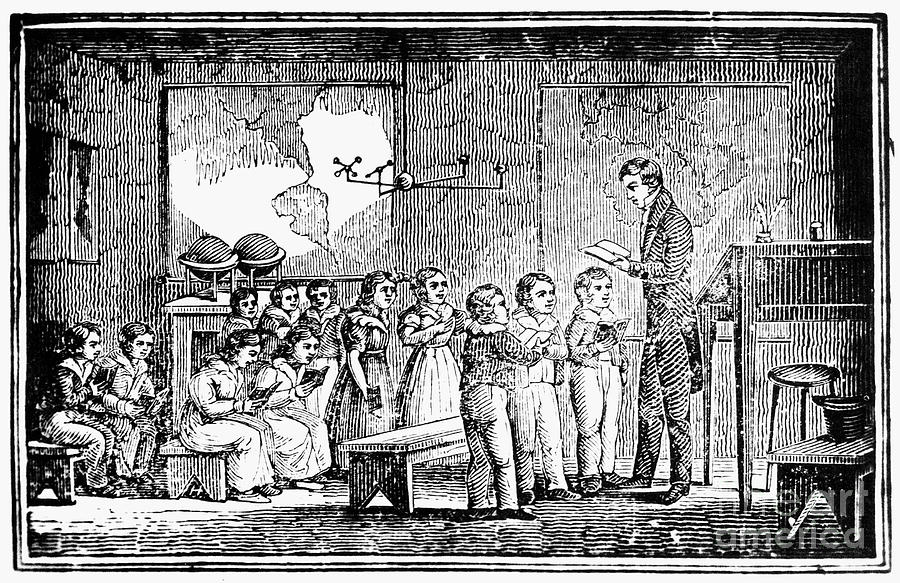
    Grammar School in 1790s. By: Granger.

    The early Republic were the years where American civil society was developing its own distinctive character. One component of that civil society was the newly created educational institutions, which many early Americans viewed as one of the safeguards against the dangerous ignorance that was supposed to allow a monarchy to continue.

    For example, Simeon Doggett stated in Discourse on Education “that the mode of government in any nation will always be moulded by the state of education. The throne of tyranny is founded on ignorance. Literature and liberty go hand in hand.” Simeon Doggett, Discourse on Education (1797), in Frederick Rudolph, ed., Essays on Education in the Early Republic (Cambridge, MA, 1965), 155-56.

    These ideals were captured in Massachusetts’ constitution: “Wisdom and knowledge, as well as virtue diffused generally among the people . . . [are] necessary for the preservation of their rights and liberties.”

    Thomas Jefferson was also a proponent of these ideals, and he developed a plan for the education system in Virginia in the 1779 Bill for the More General Diffusion of Knowledge. In this bill, he proposed a “three-tiered pyramid of local education. At the base would be three years of free elementary schools for all white children, boys and girls. The next level offered twenty regional academies with free tuition for selected boys . . . Finally, the state would support the best ten needy academic students at the university level, the aristocracy of talent that he described as ‘the most precious gift of nature.’” Gordon Wood, Empire of Liberty, 473 quoting Dumas Malone, Jefferson the Virginian (Boston, 1948), 282-83.

    While Jefferson’s system, and other similar systems dreamed up by intellectuals, ultimately were not implemented in their imagined forms, it set the groundwork for the familiar system we know today to be created in the late 1800s. See Daniel Walker Howe, Church, State, and Education in the Young American Republic, JER, 22 (2002), 1-24.

    The early Republicans imagined a universal education system throughout the country that would provide high quality education but notably only for white children. This backward thinking unfortunately characterized many of the early Americans, who had no regard for minorities. Despite that shortcoming, many of the Republicans’ dreams for the educational system in the country came to fruition.

    While the American education system has come under intense scrutiny and questioned for its position in the world, the early ideals of having an informed, educated population raised from a young age has generally come true. Most importantly, it may be debatable, but most would agree that the widespread ignorance that permitted tyranny in the late 1700s has all but disappeared.

  • A Small Key to a Big Door

    Dartmouth College, 1793.

    The Supreme Court of the United States, led by Chief Justice John Marshall made a crucial decision in Dartmouth College v. Woodward in 1819. This decision resulted “in placing all private corporations under the protection of the United States Constitution.” Gordon Wood, Empire of Liberty, 466. The vast majority of corporations thus were “no longer exclusive monopolies,” but rather “[t]hey became private property belonging to individuals, not the state.” Id.

    This development was a small key to open the big door of American commerce and capitalism. While countries in Europe were still monarchical and had antiquated systems that did not allow for privately held corporations, the United States Supreme Court ensured that America moved into the 19th Century with a system ready for innovation and entrepreneurship.

    Over the course of the 19th Century, the Civil War notwithstanding, the ability of individuals to form their own corporations provided an incentive for success that would lead to widespread prosperity. While in other countries, the state had a piece of ownership in corporations, Americans had the privilege of private ownership at a time when that was uncommon.

    Many of the developments in the early Republic have had reverberations over the past two centuries. Those developments sometimes began with small, humble steps, such as this holding by the Supreme Court. Those small steps have unquestionably aggregated to create a more prosperous society for America.

  • The Greatest Political Phenomenon

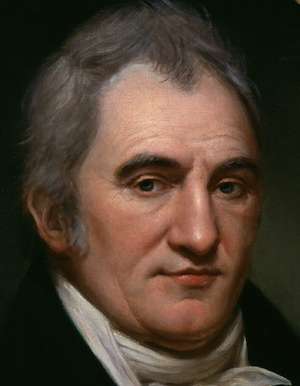
    Depiction of Joel Barlow.

    On July 4, 1809, Joel Barlow, a diplomat and poet, gave a public speech about other Americans’ feelings about the country. Gordon Wood, Empire of Liberty, 469. It was his conclusion that America had moved past its infancy and was approaching adolescence and manhood. Id. Barlow concluded that “[t]here has been no nation either ancient or modern that could have presented human nature in the same character as ours does and will present it; because there has existed no nation whose government has resembled ours . . . a representative democracy on a large scale, with a fixed constitution.” Id. quoting Joel Barlow, Oration, Delivered at Washington, July Fourth, 1809; at the Request of the Democratic Citizens of the District of Columbia (Washington, DC, 1809), 3-6, 9.

    Barlow also concluded that America was “the greatest political phenomenon, and probably will be considered as the greatest advancement in the science of government that all modern ages have produced.” Id.

    Barlow’s words still ring true, after over two centuries of progress in America. This has been evidenced by many countries throughout the world modeling their governments after America, to varying success. While some may argue that other modern countries, especially India, have adopted a democratic system and have a fixed constitution, there is no question that the United States remains unique. Taking India as a modern example of a democracy, the comparison to America is striking. While there is an identifiable, significant middle-class in the United States, India has a yawning gap between the wealthiest and poorest. The “human nature in the same character as ours” that Barlow describes simply has not been surpassed since his bold pronouncement of those words.

    There is a question as to whether the United States is the “greatest political phenomenon” that Barlow proclaims. While many countries have adopted systems similar to America, which seems to flatter the American system, the success of those countries has been apparently hindered by various external factors. Take, for example, Russia. Russia has adopted a democratic model of government in name, but rampant corruption and oligarchic tendencies have precluded Russia from ever rivaling the United States as a model of effective, transparent government.

    Even looking to Europe, and its many effective states, no country in Europe has the population and acreage to be comparable to the United States. Taking Europe as a whole, economically it is similar to the United States, but obviously governmentally, each European nation has its own operational government. This precludes any effective comparison with Europe or its individual nations.

    The sheer extent of the United States, combined with its prolonged success, seems to bring wisdom to Barlow’s prescient words. Whether Barlow predicted the success of America merely by luck or not, his words underlie those famous words of Abraham Lincoln: that the United States is the last best hope of Earth.

  • A Conscientious Path of Moderation

    Painting of John Marshall, Chief Justice of the Supreme Court of the United States from 1801-1835.

    The Constitution, in combination with the Judiciary Act of 1789, created the three-tiered court system that is familiar to modern Americans. However, one of the defining features of the judiciary is the concept of judicial review. Judicial review is the doctrine that permits a court, such as the Supreme Court in Marbury v. Madison, to declare an act of Congress unconstitutional. See Gordon Wood, Empire of Liberty, 442. In 1803, Chief Justice John Marshall was the first to exercise this power of the Supreme Court, setting the precedent for future courts, particularly in the 20th Century, to declare acts of Congress unconstitutional. Id.

    Thomas Jefferson declared the following year, in 1804, that granting the courts the power of judicial review “would make the judiciary a despotic branch.” Malone, Jefferson the President: First Term, 155. James Madison explained that judicial review “makes the Judiciary Department paramount in fact to the Legislature, which was never intended and can never be proper.” Madison’s Observations on Jefferson’s Draft of a Constitution for Virginia, 1788, Papers of Jefferson, 6: 315.

    Even lesser known Americans who believed the legislatures in the 1780s created unjust laws did “not agree that judges ought to have the authority to declare such legislation void.” Gordon Wood, Empire of Liberty, 444. One such American, Richard Dobbs Spaight, delegate to the Constitutional Convention from North Carolina stated that judicial review “operated as an absolute negative on the proceedings of the Legislature, which no judiciary ought ever to possess.” Richard Spaight to James Iredell, August 12, 1787, in Griffith J. McRee, Life and Correspondence of James Iredell (New York, 1857-1858), 2; 169-70.

    Some believed that “the power of the judges alone to declare unconstitutional laws void was too extreme, too exceptional, and too fearful an act to be used against all those ordinary unjust, unwise, and dangerous laws that were nevertheless not ‘so unconstitutional as to justify the Judges in refusing to give them effect.’” Gordon Wood, Empire of Liberty, 446 quoting Farrand, ed., Records of the Federal Convention, 1: 97, 73. Thus, some congressmen in 1792 considering establishing a procedure for federal judges to notify Congress when they would declare a law unconstitutional. Gordon Wood, Empire of Liberty, 446.

    It is notable that so many Americans were comfortable with this increasingly powerful judiciary, with the newly created tool of judicial review. Although judicial review was used in Marbury v. Madison, it would not be used again until the Dred Scott decision in 1857. Nonetheless, Americans began to associate the judiciary with being additional representatives of Americans’ collective interests. The fact that the judiciary began to assert itself in more drastic ways into the tripartite government system, combined with most Americans’ desire to have additional representation, permitted the judiciary to become a permanent part of American life.

    Further, the importance of the creation of the doctrine of judicial review could hardly be understated. While some were uncomfortable with the idea of the future of democracy occasionally being in the hands of a few judges, it provided a more neutral, reasonable filter for legislation and acts of Congress. Undoubtedly, mistakes have been made and continue to be made by the judiciary, but most Americans would take comfort that as the decades and centuries have progressed, one bad court has been counterbalanced by a good court, leaving America to go down a conscientious path of moderation.

  • The Assertive Judiciary

    Depiction of the Old Congressional Building. 1800s.

    In the early years of the Republic, there was an itching for reformation of the systems and processes that had come to define colonial life. This reformation began with “enactment of an increasing number of laws.” Gordon Wood, Empire of Liberty, 405.

    Thomas Jefferson and James Madison led this movement of reformation. While they and their like-minded Republicans had hoped to have comprehensive reform quickly, “[u]nstable, annually elected, and logrolling democratic legislatures broke apart” those plans. Id. One individual in South Carolina complained that “every new law . . . acts as rubbish, under which we bury the former.” Rudiments of Law and Government, Deduced from the Law of Nature (Charleston, SC, 1783), 35-37. Likewise, St. George Tucker, a jurist, explained that in Virginia, the legislature attempted to provide clarity and organization to the state’s laws, but bred “perplexities . . . [by] the re-enaction, omission, or suspension of former acts, whose operation is thus rendered doubtful, even in the most important cases.” St. George Tucker, Blackstone’s Commentaries: With Notes of Reference to the Constitution and Laws of the Federal Government and of the Commonwealth of Virginia (Philadelphia, 1803) I, pt. 1, xiii.

    This confusing, complex jungle of laws had to be sorted out by someone other than the legislatures. The judiciary took up that responsibility, which ironically also happened in England with William Blackstone and Lord Mansfield carving out “a huge interpretive role for British judges as they sought to bring the law into accord with equity, reason, and good sense. David Lieberman, The Province of Legislation Determined: Legal Theory in Eighteenth-Century Britain (Cambridge, UK, 1989), 13, 28.

    Americans craved reasonable, equitable law that only the judiciary could provide through its interpretation, after the legislatures’ numerous, laborious attempts to clarify the laws had failed.

    These early years foreshadow the events in the coming decades and centuries that shape the modern governmental structure. The chaotic and confused work of the early legislatures created an opening for the judiciary that did not exist immediately after the Revolution. The judiciary did not just step into this opening, it seized this opening and drastically expanded it over the course of the next two centuries, as illustrated by the decision of Marbury v. Madison, which is another topic for discussion and analysis.

    At least to some extent, the judiciary cleaned up the laws of the United States and paved the way for clearer, more accessible codes, regulations, and laws. It is difficult to understate the value of the judiciary’s actions and its reverberating consequences for the courts, for the legislatures, and for the wellbeing of the most important subjects of the laws: American citizens.

  • A Most Flawed Inheritance

    John Jay, the first United States Supreme Court Chief Justice. By: Gilbert Stuart.

    Prior to the Revolution, the colonists relied on a court system with royally appointed judges that served indefinitely “during good behavior,” which ultimately meant that judges would hold office so long as the crown was pleased with them. Gordon Wood, Empire of Liberty, 400. This led to the colonists ultimately associating the judiciary with the “resented royal governors, or chief magistrates,” which undermined the colonists’ confidence that the courts were an option for redress. Id.

    The colonists viewed the judiciary not “as an independent entity or even as a separate branch of government,” but as a political body “that performed numerous administrative and executive tasks.” Id. During these early years, the “courts in most colonies had assessed taxes, granted licenses, overseen poor relief, supervised road repairs, set prices, upheld moral standards, and all in all monitored the localities over which they presided.” Id. quoting William E. Nelson, Americanization of the Common Law: The Impact of Legal Change on Massachusetts Society, 1760-1830 (Cambridge, MA, 1975), 14-16.

    As such, early Americans, including John Adams, concluded that there were two kinds of constitutional powers: “those of legislation and those of execution.” Gordon Wood, Empire of Liberty, 401.

    After the Revolution, the role of courts in citizens’ lives changed. The Constitution’s division of government into the three branches played a significant role in this, but progress was gradual. For example, even after the Revolution, Alexander Hamilton described the duties of judges as “two-fold, ‘judicial and ministerial,’ and the ministerial duties were ‘performed out of Court and often without reference to it.’” Id. quoting Alexander Hamilton, The Examination, February 23, 1802.

    This led to John Jay, the first Chief Justice of the Supreme Court, to conclude that the Court did not have “the ‘Energy, weight and Dignity’ to support the national government and little likelihood of acquiring any.” Gordon Wood, Empire of Liberty, 437 quoting John Jay to John Adams, January 2, 1801, in Maeva Marcus et al., eds., The Documentary History of the United States Supreme Court (New York, 1992) 4:664.

    This brief look into the place of the courts at the time of the Revolution and shortly thereafter highlights the changes between the years of the early Republic and modern times. Courts are purely limited to adjudicating disputes. Depending on the jurisdiction, those disputes can be as narrow and specific as family matters, or matters under a threshold dollar amount like $5,000.00, while other courts hear more general matters. But courts do not engage in any of the administrative or ministerial functions that partially defined the role of courts in citizens’ lives.

    The most notable change since the early years of the Republic is the trust that citizens place in the judiciary. While in the early years citizens were disenchanted with the courts because the courts were so closely tied with the crown, courts now likely garner the highest respect between the three branches of government. While there are instances of corruption or wrongdoing in the court system, many look to the courts as a hallmark of America’s success in peacefully, justly, and fairly adjudicating disputes amongst citizens. Fortunately for modern Americans, this most flawed inheritance of a dysfunctional court system has been converted into one that is widely admired and heavily used.

  • The First Casualties

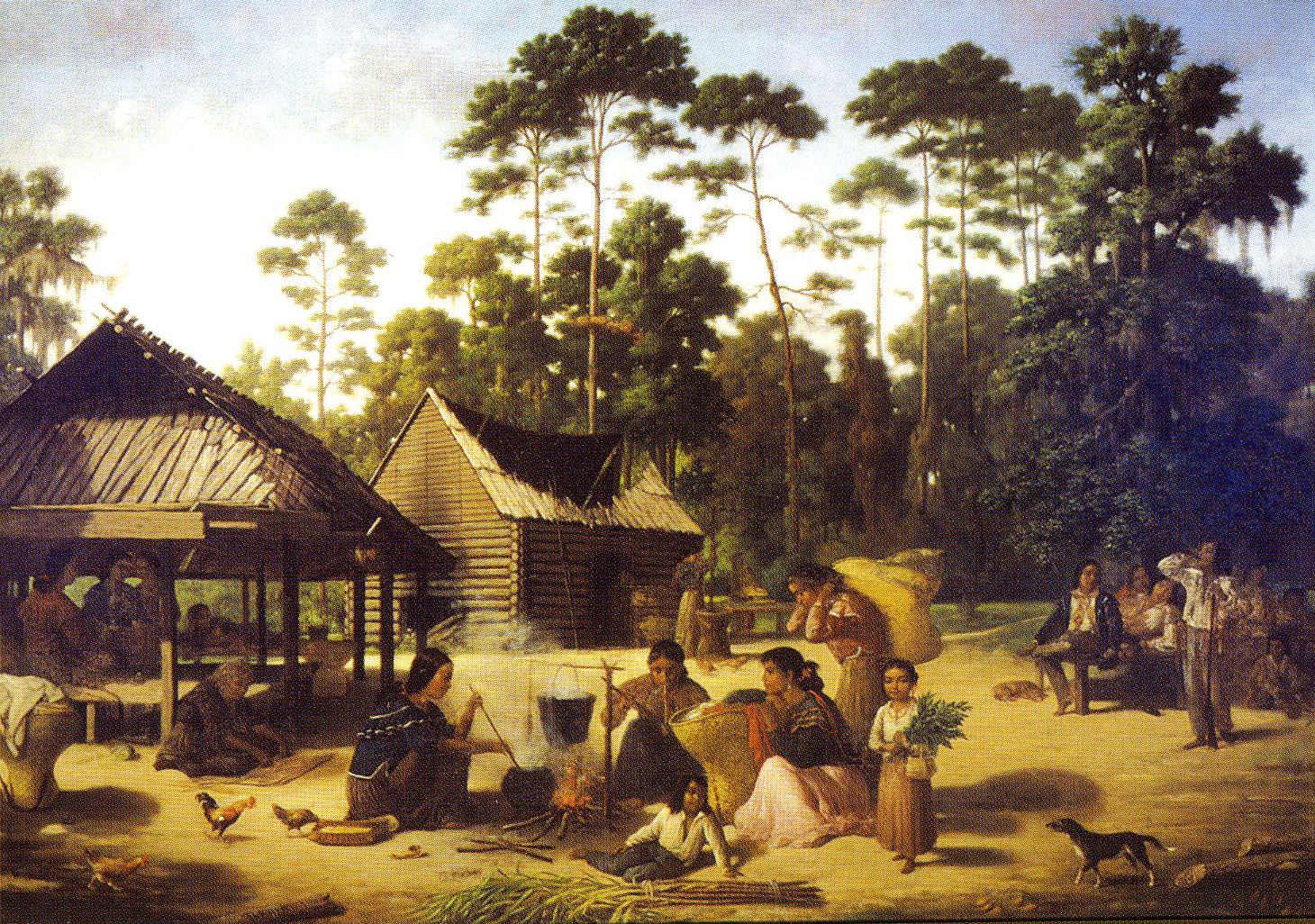
    Painting of Choctaw Village. By: Francois Bernard.

    The friction between the Native Americans and colonizing settlers is well documented and known. However, the general policy underlying that friction is perhaps best captured by Thomas Jefferson’s perspective on the subject: “let the natural demographic growth and movement of white Americans take their course.” Gordon Wood, Empire of Liberty, 398.

    Jefferson believed that this would surround the Native Americans, and ultimately force them to take up farming. Meanwhile, the American government could acquire the hunting grounds of the Native Americans and settle those lands. This strategy, executed by Jefferson and his successor, James Madison, resulted in the negotiation of 53 “treaties of land cession with various tribes.” Id.

    Some tribes, like the Cherokees in the Southwest, adapted to the new way of life (living in houses and relying on agriculture for food), but mostly, Jefferson’s plan ended in tragedy for the Native Americans. Id.

    The early Americans did not comprehend that tragedy would be the result of forcing a civilization to change its ways. These acts by the early Americans undoubtedly weakened and fragmented the Native American tribes, which enabled later presidents, like Andrew Jackson, to implement removal and relocation policies. Those policies would be the death knell for Native American society.

    Often, the sheer harshness of the early Americans toward the Native American societies is forgotten or downplayed. But the early Americans truly were ruthless both in their quest for land and for their lack of belief that the Native American way of life should have continued in any recognizable manner.

    Some may posit that these actions by the early Americans were the first examples of how the United States would routinely impose its beliefs on others, to push its interests forward. There are certainly times in American history where this has been the case, and the treatment of the Native Americans is unquestionably one of those times.

    As much as Americans have to be thankful for, it is worth taking a moment to reflect on the great tragedies that the early Americans forced on the Native Americans. While those actions enabled the American engine of growth to begin, it came at a great cost to human life and dignity, which should not be forgotten.

  • Preservation of America and its Virtues

    Painting of Daniel Boone leading party into Kentucky. By: Daniel Murphy.

    Europeans and early Americans both believed that the New World, America included, was made of a climate “harmful to all living creatures, including the Indians, who were the only humans native to the New World.” Gordon Wood, Empire of Liberty, 386. George Louis Leclerc, comte de Buffon, wrote in his 36-volume book Natural History that the New World had “some combination of elements and other physical causes, something that opposes the amplification of animated Nature.” Buffon, Natural History, General and Particular, in Henry Steele Commager and Elmo Giordanetti, eds.

    Americans were insecure about this fact. Americans knew that America had twice as much rain as Europe, that there could be wild swings in temperature, and that the same regions that would be bitterly cold in winter could be boiling hot in summer. Gordon Wood, Empire of Liberty, 389.

    America’s leaders came to believe that these conditions, particularly the intense heat and humidity, would routinely lead to the spread of diseases, like yellow fever. The leading intellectuals of the day, including Benjamin Rush, Noah Webster, Samuel Mitchill, Benjamin Latrobe and Charles Caldwell, thought how best to deal with this problem. Charles Caldwell imagined that American cities should be rebuilt as a result of the unusual climate, “requiring lofty buildings, lots of squares, and many trees, especially Lombardy poplars, which were the best kind of tree for soaking up the miasma and emitting vital air.” Id. at 390.

    Many Americans began to wonder if the Native Americans’ lack of progress in the thousands of years prior to the colonies was attributed to the circumstances of America’s land, not a difference in nature. Id. at 394. Why did so many Americans wonder this? Because a fear began to develop that Americans might degenerate to a cruder and more savage state, as a result of their environment. Id. at 395.

    Some Americans observed that as settlers moved west, they tended to lose their “politeness and refinement.” Id. at 396. Some questioned whether that was a result of the environment and was the beginning of a regressive movement back to a more savage state.

    Thomas Jefferson told a different story, however. “The tendency of the American character is then to degenerate, and to degenerate rapidly; and that not from any peculiar vice in the American people, but from the very nature of a spreading population. The population of the country is out-growing its institutions.” Thomas Jefferson to William Ludlow, September 6, 1824.

    There are two interesting points of analysis here.

    First, there is always a continual sense in American history that the essential element of American-ness is being lost. Rather than being confident that society could preserve its best traditions and attributes, Americans seem to have a fear that because styles, norms, or people change, those traditions and key American attributes are at risk. This fear seems to be misplaced, considering the extraordinary changes that American society has experienced in its over 200 years of existence.

    Second, Jefferson’s fear that the spreading population was outgrowing the government was a legitimate fear but one that ultimately did not come to fruition. As the settlers expanded the boundaries of the United States westward, the ability of the federal government and states to keep up was undoubtedly tested. However, the settlers came from the East, with all of its established institutions. Those settlers must have desired to recreate the familiar structure of American life that was familiar to them, and even those who were not familiar with the Eastern lifestyle would quickly have seen the benefits.

    Both of these points, the preservation of American virtues and the government’s ability to adapt to its growing and changing population, remain as relevant now as the early 1800s. These same issues are raised and argued over time after time throughout American history, and yet, the Union remains strong. Perhaps the concerns and the worries about these two fundamental issues, while understandable, are misplaced.