Author: Last Best Hope of Earth

  • Constitution Sunday: Charles Jarvis on the Amendment Procedure: An Irrefutable Argument for Ratification

    Massachusetts Ratifying Convention

    January 30, 1788

    Revolutions, civil wars, and coups haunt leaders of all types of governments. The very prospect of these events conjures awful images, and every leader searches for ways to prevent and mitigate them. For some, tamping down dissent with force and papering over the people’s differences through campaigns of nationalism are not only sufficient but necessary to maintain the status quo. For others, democracies, there must be some tailoring of the government’s contours to the people; even as generations pass, morals change, and principles transform.

    (more…)
  • Constitution Sunday: General William Heath on Slavery

    Massachusetts Ratifying Convention

    January 30, 1788

    In the late 1700s and early 1800s, it was not a uniquely American question of how to deal with the concept of slavery. It was an institution that, as each year passed, was becoming more and more antiquated; a relic of a time when treating humans as beasts was widespread and accepted. Yet the question remained of how a federal government or other states could wean a part of society—in the United States, the South—off of slavery. Then, there was the question of whether a federal government or other states should even be so intimately involved in another state’s business.

    (more…)
  • Constitution Sunday: Abraham Holmes and Christopher Gore on the Possible Abuses of the Federal Judiciary

    Massachusetts Ratifying Convention

    January 30, 1788

    One of the most fundamental concerns when framing a Constitution, or any law for that matter, is the danger of abuse. Those who believe that power will be abused will choose to err on the side of depriving a government of power. And those people would go one step further to posit that where there are ambiguities in a law, that law should not stand. Abraham Holmes and Christopher Gore debated this point at the Massachusetts ratifying convention.

    (more…)
  • The Assassination of James Garfield

    The Assassination of James Garfield

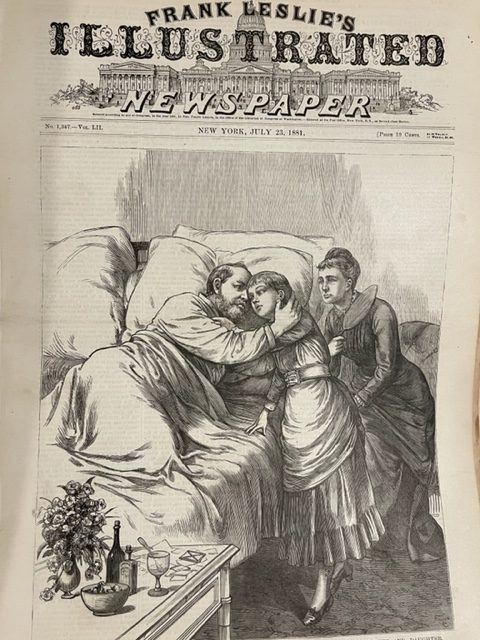
    In the late afternoon, during the summer, a thunderstorm rolled its way through the nation’s capital. Although it first had the effect of cooling the thick Washington air, the effect was fleeting. By 10 o’clock that night, the President could have hope for relief: a new apparatus—rumored to be quite effective against the oppressively humid air of India—had arrived. Staff assembled V-shaped troughs, made of zinc and “filled with ice and water,” and placed them under the windows of the President’s room.[i] The water lessened the humidity, and the ice cooled the air entering the room through the windows.[ii] The President’s pulse, temperature, and respiration satisfied his physicians, and there was optimism that “the worst was over.”[iii] It had been several weeks since the attempted assassination, and the 20th President of the United States, James Garfield, was having his secretaries attend to the pressing matters of the country as he rested.[iv] His wife and children visited his bedside, and his daughter, Mollie, “nestled her fresh face in his beard,” keeping her composure just as her mother did.[v] The President “kissed her and stroked her hair, and then she took a seat near her mother” when the “boys came in presently with manful bearing and remained a few minutes.”[vi] The cooling apparatus, the doctors said, was not giving “entire satisfaction,” and a new device—one that was “similar to that used in the mines to cool the air and send it into the chamber through the registers”—was set to be installed to relieve the President from his symptoms.[vii]

    (more…)
  • The Revolution: James Otis’ The Rights of the British Colonies Asserted and Proved

    Boston, 1764

    The origin of government are more than complicated. It is a subject that “has in all ages no less perplexed the heads of lawyers and politicians, than the origin of evil has embarrassed divines and philosophers.” Regardless of one’s perspective on origin and its mysteries, part of the foundation of every government is the protection of property, wrote James Otis.

    (more…)
  • Constitution Sunday: Amos Singletary and Jonathan Smith on “Leviathan” Swallowing Up “Us Little Folks” and on the Danger of Anarchy

    Massachusetts Ratifying Convention.

    January 25, 1788

    Amos Singletary rose at the Massachusetts Convention to say that he was troubled; the Convention was considering a Constitution that was no better than the state was under British rule in 1775. It would lead to the federal government laying “taxes, duties, imposts, and excises” on the people just as the British did. When the British did so, Singletary said, the colonies “claimed a right to tax us and bind us in all cases whatever” and thus the Revolution became necessary and warranted.

    (more…)
  • The Revolution: Cato’s Thoughts on a Question Proposed to the Public (Part III)

    Pamphlet by “Cato”: Thoughts on a Question of Importance Proposed to the Public, Whether it is probable that the Immense Extent of Territory acquired by this Nation at the late Peace, will operate towards the Prosperity, or the Ruin of the Island of Great-Britain?

    London, 1765.

    Part I here.

    Spheres of influence as well as empires are difficult to maintain. Maintaining them requires time, money, and sound discretion. The author whose pen name was Cato recognized this when discussing the British colonies, which he labeled as “unweildy Possessions [sic].” In making his arguments, he wrote, he did not base them “upon the Treachery of particular Men, or even the Degeneracy of the present Age, but upon the Mistakes of Human Nature.”

    (more…)
  • The Revolution: Thomas Jefferson on the Draft Articles of Confederation (Part II)

    The Autobiography. By: Thomas Jefferson

    July 30, 1776 – August 1, 1776

    How the colonies would get along with each other was always going to be a monumental challenge. And, when the nation was born, there was tension between delegates and their states in setting up the framework for how the colonies would vote. With states such as Massachusetts and Pennsylvania being much larger in size and population, smaller states such as Rhode Island could justifiably fear that confederating with the colonies would bring more harms than benefits. However, to the chagrin of larger states, in the draft Articles of Confederation, at Article XVII, it stated: “In determining questions each colony shall have one vote.”

    (more…)
  • The Revolution: Thomas Jefferson on the Draft Articles of Confederation (Part I)

    The Autobiography. By: Thomas Jefferson.

    July 30, 1776 – July 31, 1776

    In Thomas Jefferson’s autobiography, he wrote of the debate and adoption of the Articles of Confederation. While the country has long learned that the Constitution is far superior to those Articles, the reasons why must extend beyond “a stronger national government was needed under the Articles, and the Constitution cured that defect.” A committee took up the Articles on July 30th and 31st and then August 1st of 1776. During the first couple days, the delegates debated how to calculate each state’s monetary contribution to the “common treasury” and the “manner of voting in Congress.” And it was there that controversy occurred; controversy that would continue to the time when the Constitution was drafted and adopted and even to nearly 250 years later.

    (more…)
  • Constitution Sunday: Thomas Dawes, Jr. on Legitimate Standing Armies

    Massachusetts Ratifying Convention

    January 24, 1788

    The Constitution empowers Congress to “raise and support Armies” with the limitation that any appropriation of money for raising and supporting armies must be limited to a two-year term (Article I, Section 8, Clause 12). At the Massachusetts Ratifying Convention, there was debate as to whether that authority should exist at all and whether it should be housed with Congress.

    (more…)