Category: Early Republic

  • The Justifications for Slavery

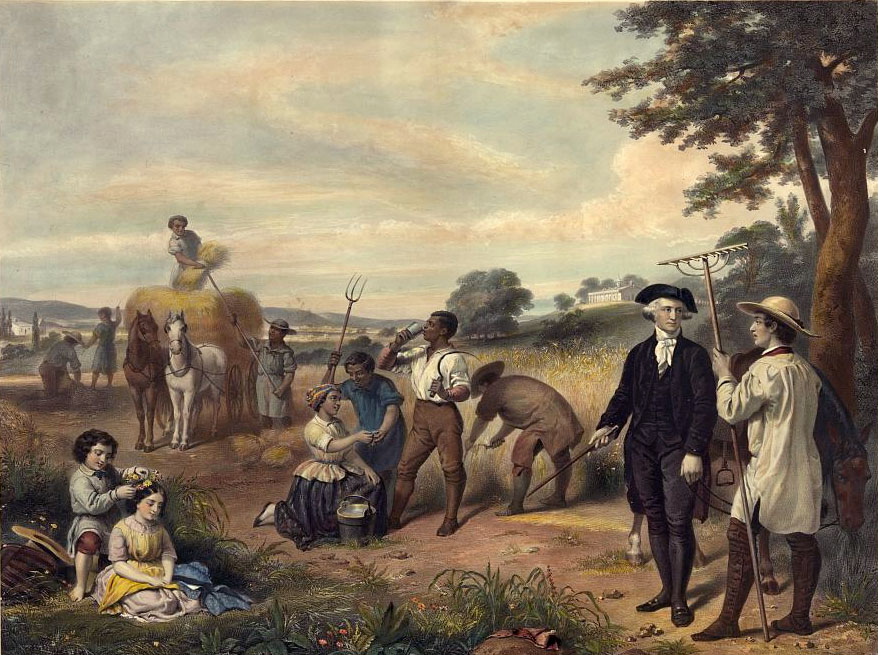
    George Washington on his Plantation.

    Early Americans, both pro-slavery and anti-slavery, explored the potential justifications for slavery in the United States.

    In 1764, James Otis of Massachusetts asked “Can any logical inference in favor of slavery be drawn from a flat nose, a long or short face?” after pondering why only blacks had been enslaved. James Otis, The Rights of the British Colonists Asserted and Proved (1764), in Bernard Bailyn, ed., Pamphlets of the American Revolution, 1750-1776 (Cambridge, MA, 1965), 1: 439.

    Some believed that slavery could not stand against the “relentless march of liberty and progress.” Gordon Wood, Empire of Liberty, 519. For example, James Madison believed that making noise on the issue of slavery would only slow down the march of progress within the United States. Id. at 525. Perhaps those who held this view perpetuated slavery, believing that it was bound to end eventually without action.

    Others had more profoundly prejudiced and racist views toward slavery. Thomas Jefferson believed that “various characteristics of blacks . . . [such as] their tolerance of heat, their need for less sleep, their sexual ardor, their lack of imagination and artistic ability, and their music talent . . . were inherent and not learned.” Id. at 539. Jefferson believed that “blacks’ deficiencies were innate, because when they mixed their blood with whites’, they improved ‘in body and mind,’ which ‘proves that their inferiority is not the effect merely of their condition of life.’” Id. citing Thomas Jefferson, Notes on the State of Virginia, ed. Peden, 138-43.

    Even entire states took action that is hard to fathom in modern times, all with the underlying belief that slavery was justified and must be protected. The state of Kentucky wrote into its 1792 Constitution that “the legislature shall have no power to pass laws for the emancipation of slaves without the consent of their owners.” Robin L. Einhorn, American Taxation, American Slavery (Chicago, 2006), 220, 232, 249, 236; Stanley Elkins and Eric McKitrick, “A New Meaning for Turner’s Frontier: Part II: The Southwest Frontier and New England,” Political Science Quarterly, 69 (1954), 572-76. This language was added to Kentucky’s Constitution despite the fact that only a mere 16% of the state’s population were slaves. Gordon Wood, Empire of Liberty, 531.

    All of these varying views affected American policy, both foreign and domestic. Taking foreign policy as an example, while Haiti had a slave revolution in 1803 that both ended slavery and proclaimed racial equality, and the United States typically was the first country to extend diplomatic relations to a new republic, it would not be until the Civil War that the “United States [would] recognize the Haitian republic.” Id. at 537.

    As early Americans searched for justifications for slavery, many who were thinking critically would come to the same conclusion as James Otis: that there was no justification. However, those whose livelihoods depended on the existence of slavery were predisposed to never coming to that conclusion. Nonetheless, as is obvious from these varying views on justifications for slavery, hypocrisy was prevalent, ignorance was rampant (even amongst one of the greatest intellectuals, Jefferson), and at the very least, progress was slow.

    Regardless of who was right or wrong about the issue of slavery, it is clear that the justifications for slavery ran deep, permeating societal beliefs and policy decisions, foreign and domestic. Not many issues have rivaled the contentious nature of slavery. But analyzing the justifications for slavery shows just how far an issue can reverberate throughout the country, touching even the very threads that hold society together.
  • Decline and Decay

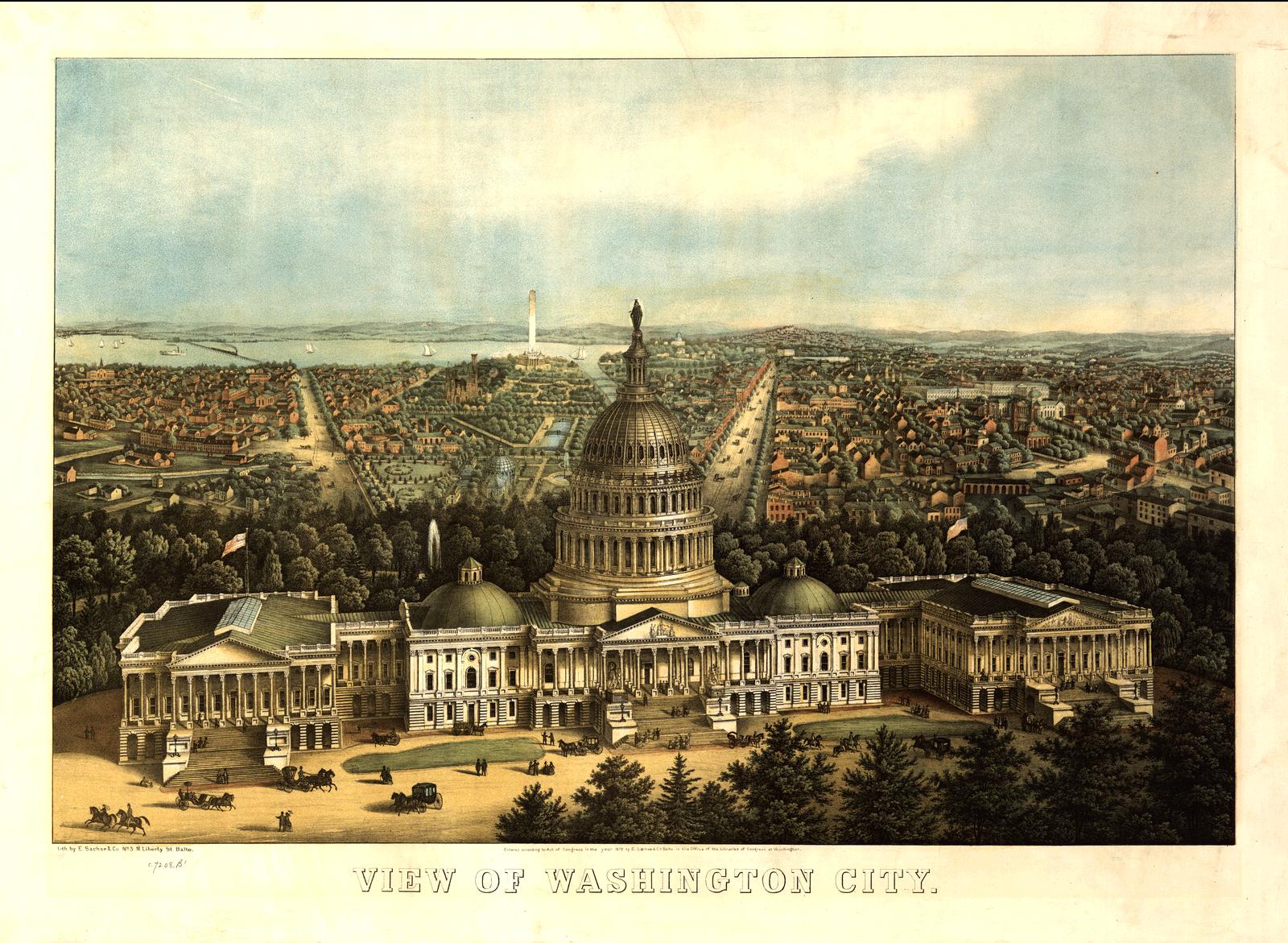
    Washington, D.C., 1871.

    In the late 1790s, Constantin Francois Volney published Ruins; or, Meditations on the Revolution of Empires, one of the most popular publications of its day. This publication not only attacked monarchical tyranny, but it reinforced amongst Americans ideals familiar to Americans then and now: that nations are fragile and seem to inevitably decay and decline. Gordon Wood, Empire of Liberty, 552.

    This keen awareness to the “mortality of all states” reinforced Americans’ “desire to build in stone and marble and to create depositories in order to leave to the future durable monuments of America’s cultivation and refinement.” Id.

    Further, Comte de Volney’s book hinted that “an uncorrupted republican government might evade the decline and decay that had beset all other governments.” Id. citing Constantin Francois Volney, A New Translation of Volney’s Ruins; or, Meditations on the Revolution of Empires (Paris, 1802).

    There are two points of analysis from the popularity of Comte de Volney’s book in the years of the early Republic.

    First, this book and underlying American beliefs combined to form the nearly uniform desire for America to not just be a powerful country in the modern world but to perpetuate itself and to be in the annals of the world as one of the most extraordinary countries to have existed. From the beginning, Americans have been keen on memorializing its most important buildings to stand the test of time. This is most obviously evidenced in the government buildings both on the federal and state levels. Washington DC itself is testament to America’s desire to build a legacy to last.

    Second, Comte de Volney’s book reinforces the notion that nearly all Americans share: that somehow, the United States can avoid inevitable decline. In support of that hope, many look to the fact that in the history of the world, there has never been such a democracy on the scale of the United States with the emphasis on rights and values that characterize America. On the other side of the argument, many would argue that success breeds complacency which breeds inefficiency, leading to decline.

    The truth about decline is probably somewhere in between the two positions. Neither success nor decline is inevitable, particularly in light of the fact that America’s model has never been tested before.

    The words of George Washington could not be truer: “The establishment of our new Government seemed to be the last great experiment for promoting human happiness.” George Washington, January 9, 1790. That experiment is ongoing and hopefully will be for many centuries to come.

  • Early Americans’ Views on Slavery

    George Washington (L.) and Thomas Jefferson (R.) on Mount Rushmore.

    Early Americans had varying views on slavery, which would set the course for slavery to become a main point of contention for Americans by the time the Civil War erupted.

    For example, in the late 1700s, many Chesapeake farmers hired out their slaves to other farmers. Gordon Wood, Empire of Liberty, 511. This development led some to believe that slavery would eventually be replaced by wage labor. Sarah S. Hughes, “Slaves for Hire: The Allocation of Black Labor in Elizabeth City County, Virginia, 1782 to 1810,” WMQ, 35 (1978), 260-86. Consequently, some Americans believed that slavery was but a passing trend that would evolve and no confrontation would emerge on the issue.

    Both George Washington and Thomas Jefferson were slave owners, but each had their own view on the subject. George Washington saw that slaves “had no incentive to work hard and develop ‘a good name’ for themselves,” which he saw as slavery’s biggest flaw. Gordon Wood, Empire of Liberty, 513. This led to the question of what slaves could accomplish had they had opportunities for advancement in both reputation and respect, which was a subject Washington pondered. Robert F. Dalzell Jr. and Lee Baldwin Dalzell, George Washington’s Mount Vernon: At Home in Revolutionary America (New York, 1998), 129, 212-13. Jefferson, meanwhile, owned one of the largest plantations in Virginia at the time, holding around 200 slaves at any given time. While he infamously condemned slavery and yet maintained a plantation with slaves, he was known as a compassionate owner, comparatively speaking. He would prescribe lighter work for women, children, the elderly, and the sick. Gordon Wood, Empire of Liberty, 515. Nonetheless, his slaves would inevitably receive lashings for misbehavior. The fact that Jefferson could be viewed as a compassionate owner speaks volumes about the severity of slavery, where the most inhumane and cruelest treatment was viewed as normal.

    Finally, there were those who opposed slavery and spread an egalitarian message hoping to abolish slavery. Gordon Wood in Empire of Liberty theorizes that the spread of this message essentially forced slave owners who wished to preserve their livelihood to “fall back on the alleged racial deficiencies of blacks as a justification for an institution that hiterto they had taken for granted and had never before needed to justify.” Id. at 508. Thus, Wood concluded, “[t]he anti-slavery movement that arose out of the Revolution inadvertently produced racism in America.” Id.

    As we now know, the early Americans’ views would ultimately collide and culminate in the Civil War some decades later. Retrospectively, it seems that it would have been naive to expect slave owners like Jefferson and Washington to truly advocate for the cause of abolishing slavery. While they were part of the group of Americans who realized that slavery was ultimately a wrong that must be righted, their personal observations about and actions toward their own slaves seem to show their mentality being akin to “This is hindering the country and its people, but someone else in the future is going to have to solve it.” And so it happened that way. But it deserves mention that the early Republic was replete with significant, fundamental issues that would shape the future of the country, many of which have been minimized or forgotten compared to the issue of slavery. Thus, to squarely blame Jefferson and Washington for not ending slavery would be unfair.

    As to Wood’s conclusion that the anti-slavery movement ultimately created racism, this deserves a great deal of consideration and analysis. The first and most obvious question is: Wouldn’t racism always have been the slave owners’ justification? Whether it was the anti-slavery movement or some other external pressure, such as economic inefficiency of slavery, slave owners would have been forced to one day justify the existence of slavery. For the slave owners, it seems that the quickest defense would have been race. While Wood may not have intentionally implied that the anti-slavery movement was solely at fault for creating racism, most would take issue with that conclusion.

    Regardless, the massive issue of slavery, with its lengthy, disturbing history, was set on a new course in the earliest days of the Republic. While this course would result in the Civil War, it also would result in the abolishment of slavery. That is the result Jefferson wanted, the result Washington wanted, and the result that helped America to move forward.

  • Equality for Some

    Mary Wollstonecraft.

    Shortly after the Revolution, new principles emerged that permeated all of society, from government institutions to societal norms to family life. Egalitarianism spread to families. The family became an “autonomous private institution whose members had their own legal rights and identities.” Gordon Wood, Empire of Liberty, 500 citing Michael Grossberg, Governing the Hearth: Law and the Family in Nineteenth-Century America (Chapel Hill, 1985), 26-27.

    The rights of women became an issue, particularly after the Englishwoman Mary Wollstonecraft published “A Vindication of the Rights of Women” in 1792, which would be in “more private American libraries of the early Republic than [Thomas] Paine’s Rights of Man.” Gordon Wood, Empire of Liberty, 500 citing John Kukla, Mr. Jefferson’s Women (New York, 2007), 167-72; Nancy Isenberg, Fallen Founder: The Life of Aaron Burr (New York, 2007), 433. For the first time, American women felt that public discourse reflected their collective discontent with the subservient role.

    This led to women increasingly inserting themselves in public life. However, there were limitations, and there were naysayers. For example, Thomas Jefferson “thought that if women were permitted to ‘mix promiscuously in the public meetings of men,’ the consequences would be a depravation of morals.’” Gordon Wood, Empire of Liberty, 506 citing Alfred F. Young, Masquerade: The Life and Times of Deborah Sampson, Continental Soldier (New York, 2004), 202.

    Gordon Wood concludes in Empire of Liberty that these early efforts for equality between men and women ultimately “prepar[ed] the way for the future,” which is undoubtedly true. Gordon Wood, Empire of Liberty, 507. However, analysis of early Americans’ beliefs regarding equality deserves some attention.

    For all of the open-mindedness and revolutionary ideals floating about in the early Republic, many of which challenged some of the strongest underpinnings of Western society, the early Americans could be remarkably ignorant of the pervasiveness of inequality. It was inevitable that true equality would not be immediate.

    Perhaps equality is best viewed through the lens that equality is relative to the era. Perceived inequalities now could hardly have been imaginable in the earliest days of the Republic. For example, transgender rights, while a significant issue now that gets increasingly more consideration, would likely be inconceivable to nearly all early Americans.

    The reality is that progress is gradual. However, only through taking the smallest of steps forward can the light of liberty be eventually shed on all segments of society, bringing justice and equality to all Americans.

  • Early American Punishment

    Eastern State Penitentiary, 1820s. By: The Library Company of Philadelphia.

    By the time the United States declared its independence, capital punishment was common for murder, robbery, forgery, housebreaking, and counterfeiting. Gordon Wood, Empire of Liberty, 492. Some states had as many as two dozen crimes designated for capital punishment. Id. Further, “[e]xecution of the condemned criminals were conducted in public, and they drew thousands of spectators.” Id.

    The early Republicans, including Thomas Jefferson, formulated a new approach to punishment that was more proportionate to the crimes. There were some who looked at capital punishment and believed it was too harsh for the crimes being committed, however, these early Americans would hardly be seen as compassionate, by today’s terms. Jefferson proposed the law of retaliation, lex talionis, meaning “the state would poison the criminal who poisoned the victim and would castrate men guilty of rape, polygamy, or sodomy.” Id. at 493 citing Thomas Jefferson, A Bill for Proportioning Crime and Punishments in Cases Heretofore Capital (1776-1786), Papers of Jefferson, 2: 492-507.

    Pennsylvania was one state that led the way in more humane forms of punishment, sure not to violate the Constitution’s prohibition against cruel and unusual punishment. Pennsylvania, throughout the 1780s and 1790s enacted laws that “abolished all bodily punishments such as burning in the hand and cutting off the ears and ended the death penalty for all crimes except murder.” Gordon Wood, Empire of Liberty, 493 (internal quotations omitted).

    Ultimately, these developments led to the development of the penitentiary, a uniquely American concept that is ubiquitous in contemporary American society. A British traveler in 1806, observing an American penitentiary commented that the penitentiary is “happily adapted to the genius of the government of the country, mild, just, and merciful.” Id. at 495.

    Nonetheless, these early years of the development of the criminal justice system carry many legacies forward to today. The federal government and 31 states still allow capital punishment, however, it is considerably more rare than the earliest days of the Republic, as described. The movement toward more lenient punishment has been embraced by parts of Europe and other parts of the world, who have seemed to conclude that capital punishment does not serve as a strong enough deterrent to be relied on and is too humane to be justified.

    Americans have strong views on the subject, which are divisive and often debated. Even in the campaign for 2016, Hillary Clinton has made comments about capital punishment, which has divided Democratic supporters. New York Times, Death Penalty Could Provide Debate Fodder for Hillary Clinton and Bernie Sanders, Oct. 30, 2015, available at http://www.nytimes.com/politics/first-draft/2015/10/30/death-penalty-could-provide-debate-fodder-for-hillary-clinton-and-bernie-sanders/?_r=0.

    One thing is clear, however: America has deep roots in using capital punishment. Some will always believe that reforming criminals is impossible, whether that is because of mental illness, environmental factors, or otherwise. Others believe that reformation is possible for anybody, citing the numerous examples of criminals who reformed themselves while in prison to go on and do extraordinary things with their lives.

    Regardless of where most individuals fall on that spectrum of justification, capital punishment continues to exist in a limited set of circumstances. Other punishments have been abandoned in favor of imprisoning criminals. As policymakers grapple with these issues, remembering the beginnings of punishment in America and the ineffective nature of those harsh punishments would likely be valuable.

  • Tyranny Founded on Ignorance

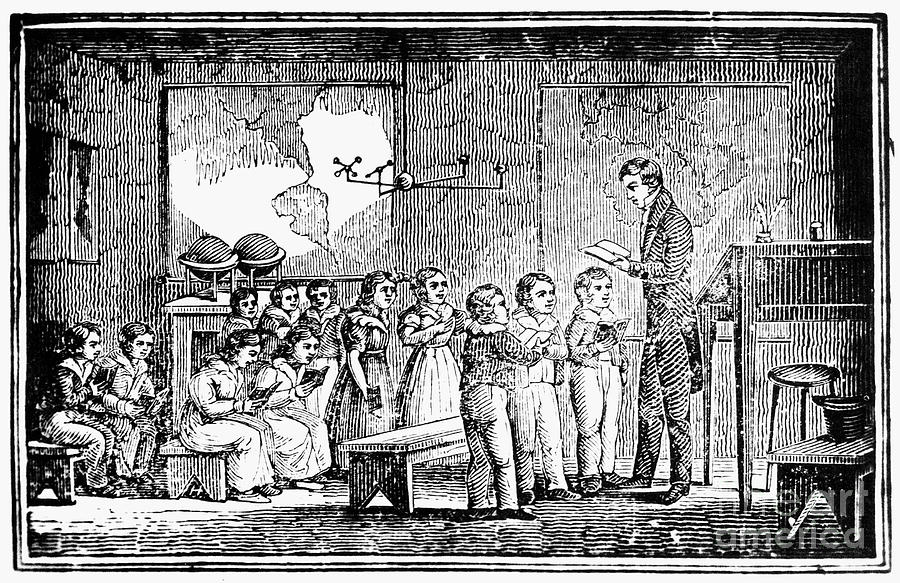
    Grammar School in 1790s. By: Granger.

    The early Republic were the years where American civil society was developing its own distinctive character. One component of that civil society was the newly created educational institutions, which many early Americans viewed as one of the safeguards against the dangerous ignorance that was supposed to allow a monarchy to continue.

    For example, Simeon Doggett stated in Discourse on Education “that the mode of government in any nation will always be moulded by the state of education. The throne of tyranny is founded on ignorance. Literature and liberty go hand in hand.” Simeon Doggett, Discourse on Education (1797), in Frederick Rudolph, ed., Essays on Education in the Early Republic (Cambridge, MA, 1965), 155-56.

    These ideals were captured in Massachusetts’ constitution: “Wisdom and knowledge, as well as virtue diffused generally among the people . . . [are] necessary for the preservation of their rights and liberties.”

    Thomas Jefferson was also a proponent of these ideals, and he developed a plan for the education system in Virginia in the 1779 Bill for the More General Diffusion of Knowledge. In this bill, he proposed a “three-tiered pyramid of local education. At the base would be three years of free elementary schools for all white children, boys and girls. The next level offered twenty regional academies with free tuition for selected boys . . . Finally, the state would support the best ten needy academic students at the university level, the aristocracy of talent that he described as ‘the most precious gift of nature.’” Gordon Wood, Empire of Liberty, 473 quoting Dumas Malone, Jefferson the Virginian (Boston, 1948), 282-83.

    While Jefferson’s system, and other similar systems dreamed up by intellectuals, ultimately were not implemented in their imagined forms, it set the groundwork for the familiar system we know today to be created in the late 1800s. See Daniel Walker Howe, Church, State, and Education in the Young American Republic, JER, 22 (2002), 1-24.

    The early Republicans imagined a universal education system throughout the country that would provide high quality education but notably only for white children. This backward thinking unfortunately characterized many of the early Americans, who had no regard for minorities. Despite that shortcoming, many of the Republicans’ dreams for the educational system in the country came to fruition.

    While the American education system has come under intense scrutiny and questioned for its position in the world, the early ideals of having an informed, educated population raised from a young age has generally come true. Most importantly, it may be debatable, but most would agree that the widespread ignorance that permitted tyranny in the late 1700s has all but disappeared.

  • A Small Key to a Big Door

    Dartmouth College, 1793.

    The Supreme Court of the United States, led by Chief Justice John Marshall made a crucial decision in Dartmouth College v. Woodward in 1819. This decision resulted “in placing all private corporations under the protection of the United States Constitution.” Gordon Wood, Empire of Liberty, 466. The vast majority of corporations thus were “no longer exclusive monopolies,” but rather “[t]hey became private property belonging to individuals, not the state.” Id.

    This development was a small key to open the big door of American commerce and capitalism. While countries in Europe were still monarchical and had antiquated systems that did not allow for privately held corporations, the United States Supreme Court ensured that America moved into the 19th Century with a system ready for innovation and entrepreneurship.

    Over the course of the 19th Century, the Civil War notwithstanding, the ability of individuals to form their own corporations provided an incentive for success that would lead to widespread prosperity. While in other countries, the state had a piece of ownership in corporations, Americans had the privilege of private ownership at a time when that was uncommon.

    Many of the developments in the early Republic have had reverberations over the past two centuries. Those developments sometimes began with small, humble steps, such as this holding by the Supreme Court. Those small steps have unquestionably aggregated to create a more prosperous society for America.

  • The Greatest Political Phenomenon

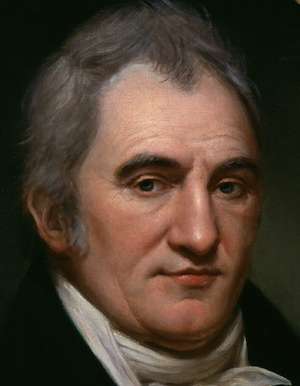
    Depiction of Joel Barlow.

    On July 4, 1809, Joel Barlow, a diplomat and poet, gave a public speech about other Americans’ feelings about the country. Gordon Wood, Empire of Liberty, 469. It was his conclusion that America had moved past its infancy and was approaching adolescence and manhood. Id. Barlow concluded that “[t]here has been no nation either ancient or modern that could have presented human nature in the same character as ours does and will present it; because there has existed no nation whose government has resembled ours . . . a representative democracy on a large scale, with a fixed constitution.” Id. quoting Joel Barlow, Oration, Delivered at Washington, July Fourth, 1809; at the Request of the Democratic Citizens of the District of Columbia (Washington, DC, 1809), 3-6, 9.

    Barlow also concluded that America was “the greatest political phenomenon, and probably will be considered as the greatest advancement in the science of government that all modern ages have produced.” Id.

    Barlow’s words still ring true, after over two centuries of progress in America. This has been evidenced by many countries throughout the world modeling their governments after America, to varying success. While some may argue that other modern countries, especially India, have adopted a democratic system and have a fixed constitution, there is no question that the United States remains unique. Taking India as a modern example of a democracy, the comparison to America is striking. While there is an identifiable, significant middle-class in the United States, India has a yawning gap between the wealthiest and poorest. The “human nature in the same character as ours” that Barlow describes simply has not been surpassed since his bold pronouncement of those words.

    There is a question as to whether the United States is the “greatest political phenomenon” that Barlow proclaims. While many countries have adopted systems similar to America, which seems to flatter the American system, the success of those countries has been apparently hindered by various external factors. Take, for example, Russia. Russia has adopted a democratic model of government in name, but rampant corruption and oligarchic tendencies have precluded Russia from ever rivaling the United States as a model of effective, transparent government.

    Even looking to Europe, and its many effective states, no country in Europe has the population and acreage to be comparable to the United States. Taking Europe as a whole, economically it is similar to the United States, but obviously governmentally, each European nation has its own operational government. This precludes any effective comparison with Europe or its individual nations.

    The sheer extent of the United States, combined with its prolonged success, seems to bring wisdom to Barlow’s prescient words. Whether Barlow predicted the success of America merely by luck or not, his words underlie those famous words of Abraham Lincoln: that the United States is the last best hope of Earth.

  • A Conscientious Path of Moderation

    Painting of John Marshall, Chief Justice of the Supreme Court of the United States from 1801-1835.

    The Constitution, in combination with the Judiciary Act of 1789, created the three-tiered court system that is familiar to modern Americans. However, one of the defining features of the judiciary is the concept of judicial review. Judicial review is the doctrine that permits a court, such as the Supreme Court in Marbury v. Madison, to declare an act of Congress unconstitutional. See Gordon Wood, Empire of Liberty, 442. In 1803, Chief Justice John Marshall was the first to exercise this power of the Supreme Court, setting the precedent for future courts, particularly in the 20th Century, to declare acts of Congress unconstitutional. Id.

    Thomas Jefferson declared the following year, in 1804, that granting the courts the power of judicial review “would make the judiciary a despotic branch.” Malone, Jefferson the President: First Term, 155. James Madison explained that judicial review “makes the Judiciary Department paramount in fact to the Legislature, which was never intended and can never be proper.” Madison’s Observations on Jefferson’s Draft of a Constitution for Virginia, 1788, Papers of Jefferson, 6: 315.

    Even lesser known Americans who believed the legislatures in the 1780s created unjust laws did “not agree that judges ought to have the authority to declare such legislation void.” Gordon Wood, Empire of Liberty, 444. One such American, Richard Dobbs Spaight, delegate to the Constitutional Convention from North Carolina stated that judicial review “operated as an absolute negative on the proceedings of the Legislature, which no judiciary ought ever to possess.” Richard Spaight to James Iredell, August 12, 1787, in Griffith J. McRee, Life and Correspondence of James Iredell (New York, 1857-1858), 2; 169-70.

    Some believed that “the power of the judges alone to declare unconstitutional laws void was too extreme, too exceptional, and too fearful an act to be used against all those ordinary unjust, unwise, and dangerous laws that were nevertheless not ‘so unconstitutional as to justify the Judges in refusing to give them effect.’” Gordon Wood, Empire of Liberty, 446 quoting Farrand, ed., Records of the Federal Convention, 1: 97, 73. Thus, some congressmen in 1792 considering establishing a procedure for federal judges to notify Congress when they would declare a law unconstitutional. Gordon Wood, Empire of Liberty, 446.

    It is notable that so many Americans were comfortable with this increasingly powerful judiciary, with the newly created tool of judicial review. Although judicial review was used in Marbury v. Madison, it would not be used again until the Dred Scott decision in 1857. Nonetheless, Americans began to associate the judiciary with being additional representatives of Americans’ collective interests. The fact that the judiciary began to assert itself in more drastic ways into the tripartite government system, combined with most Americans’ desire to have additional representation, permitted the judiciary to become a permanent part of American life.

    Further, the importance of the creation of the doctrine of judicial review could hardly be understated. While some were uncomfortable with the idea of the future of democracy occasionally being in the hands of a few judges, it provided a more neutral, reasonable filter for legislation and acts of Congress. Undoubtedly, mistakes have been made and continue to be made by the judiciary, but most Americans would take comfort that as the decades and centuries have progressed, one bad court has been counterbalanced by a good court, leaving America to go down a conscientious path of moderation.

  • The Assertive Judiciary

    Depiction of the Old Congressional Building. 1800s.

    In the early years of the Republic, there was an itching for reformation of the systems and processes that had come to define colonial life. This reformation began with “enactment of an increasing number of laws.” Gordon Wood, Empire of Liberty, 405.

    Thomas Jefferson and James Madison led this movement of reformation. While they and their like-minded Republicans had hoped to have comprehensive reform quickly, “[u]nstable, annually elected, and logrolling democratic legislatures broke apart” those plans. Id. One individual in South Carolina complained that “every new law . . . acts as rubbish, under which we bury the former.” Rudiments of Law and Government, Deduced from the Law of Nature (Charleston, SC, 1783), 35-37. Likewise, St. George Tucker, a jurist, explained that in Virginia, the legislature attempted to provide clarity and organization to the state’s laws, but bred “perplexities . . . [by] the re-enaction, omission, or suspension of former acts, whose operation is thus rendered doubtful, even in the most important cases.” St. George Tucker, Blackstone’s Commentaries: With Notes of Reference to the Constitution and Laws of the Federal Government and of the Commonwealth of Virginia (Philadelphia, 1803) I, pt. 1, xiii.

    This confusing, complex jungle of laws had to be sorted out by someone other than the legislatures. The judiciary took up that responsibility, which ironically also happened in England with William Blackstone and Lord Mansfield carving out “a huge interpretive role for British judges as they sought to bring the law into accord with equity, reason, and good sense. David Lieberman, The Province of Legislation Determined: Legal Theory in Eighteenth-Century Britain (Cambridge, UK, 1989), 13, 28.

    Americans craved reasonable, equitable law that only the judiciary could provide through its interpretation, after the legislatures’ numerous, laborious attempts to clarify the laws had failed.

    These early years foreshadow the events in the coming decades and centuries that shape the modern governmental structure. The chaotic and confused work of the early legislatures created an opening for the judiciary that did not exist immediately after the Revolution. The judiciary did not just step into this opening, it seized this opening and drastically expanded it over the course of the next two centuries, as illustrated by the decision of Marbury v. Madison, which is another topic for discussion and analysis.

    At least to some extent, the judiciary cleaned up the laws of the United States and paved the way for clearer, more accessible codes, regulations, and laws. It is difficult to understate the value of the judiciary’s actions and its reverberating consequences for the courts, for the legislatures, and for the wellbeing of the most important subjects of the laws: American citizens.