Category: Early Republic

  • East Versus West?

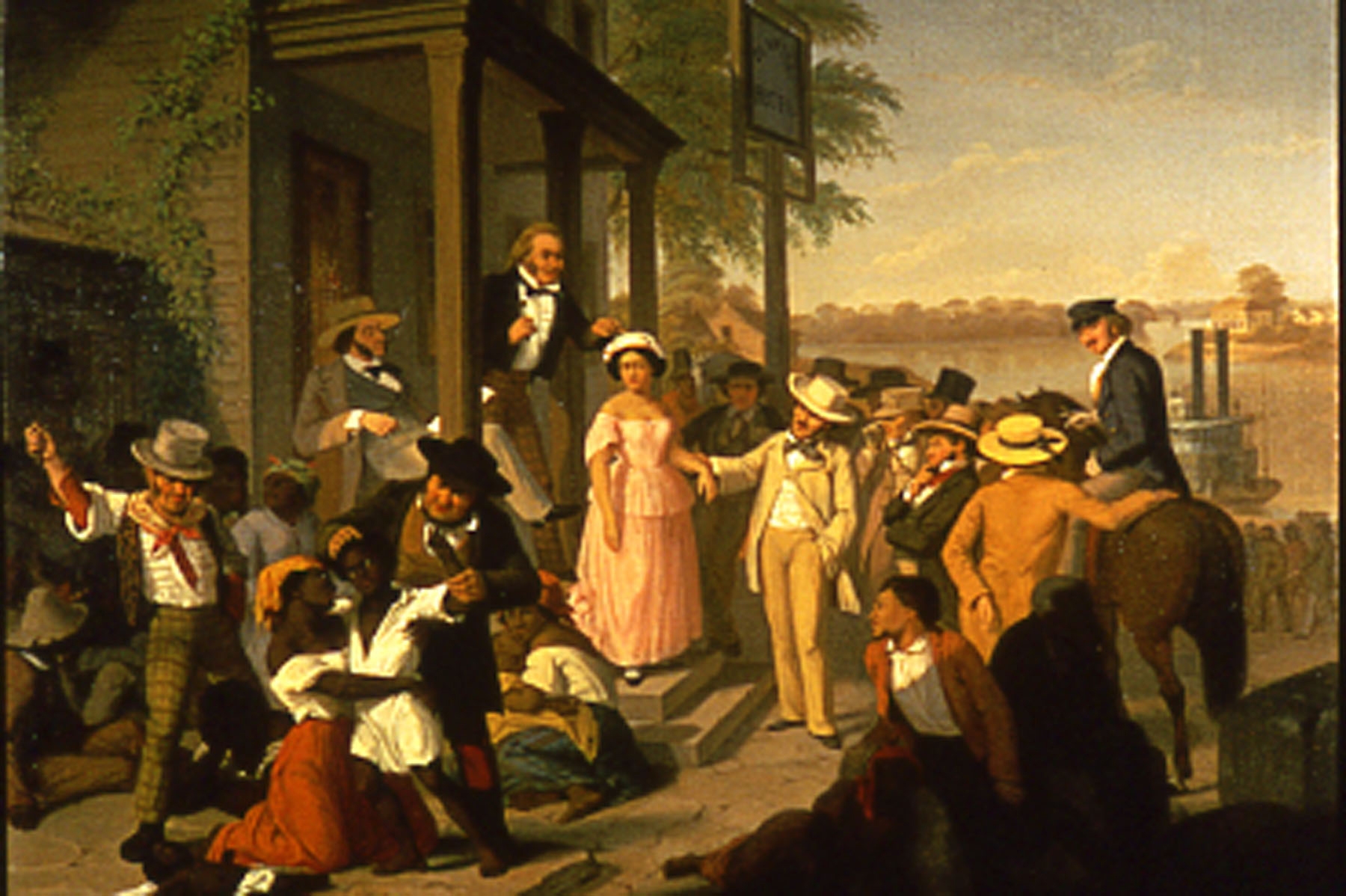
    Pittsburgh, Pennsylvania – Late 1700s, Early 1800s.

    In 1790, President Washington implemented an excise tax on spirits distilled within the United States. A bold move for the Federalists, who were seeking to create a more assertive, more organized, more cohesive federal government. The maverick states did not take kindly to it, nor did the citizens affected by this newly created tax.

    What was their reaction? Seek secession. The Federalists, including Washington and his Secretary of State, Alexander Hamilton, had a dilemma on their hands. The federal government needed legitimacy, but it also needed to maintain the peace amongst the ever-expanding states and their differing populations. It seems to be forgotten in modern discourse that there were more fractures in American history than just North versus South in the Civil War era. In the early 1790s, the fracture split East between West, as the Eastern aristocrats and monied individuals sought to impose taxes and other restrictions on the Western settlers.

    Washington and Alexander had differing views. Hamilton advocated for an immediate use of force by a militia, while Washington sent a peace commission, hoping to resolve the rebellion in the West without force. Ultimately, the peace commission failed, and a force of 15,000 men quelled the rebellion with only a few arrests and presidential pardons of those convicted of treason. John C. Miller, The Federalist Era, (New York, 1960), 158; Gordon S. Wood, Empire of Liberty, (New York, 2009), 138.

    Ultimately, the rebellion, now known as the Whiskey Rebellion, was perhaps the first test of the federal government’s role. The states had become accustomed to policing themselves, free of interference, and Washington’s action of assembling a militia and sending the militia to Western Pennsylvania set the clear, stern tone of the federal government.

    It is tempting to speculate what could have happened had Washington not taken such decisive action to quell the rebellion. Would there have been a secession? Was the Western economy sufficient to sustain itself? Would it have led to a first Civil War, only to be followed by a second? Less dramatically, would not taking decisive action have led to a weak federal government, similar to the one that prompted the drafting and adoption of the Constitution in the first place?

    Setting aside the potentials and the speculation, the Whiskey Rebellion foreshadowed the problems to come for the United States and set the stage for the role of the federal government. Even now, Americans debate how involved the federal government should be in the individual affairs of states, but by setting an early example, Washington and Hamilton made it more likely than not that the federal government would take decisive action when necessary to protect the health and wellbeing of the Union.
  • Seeds of Success

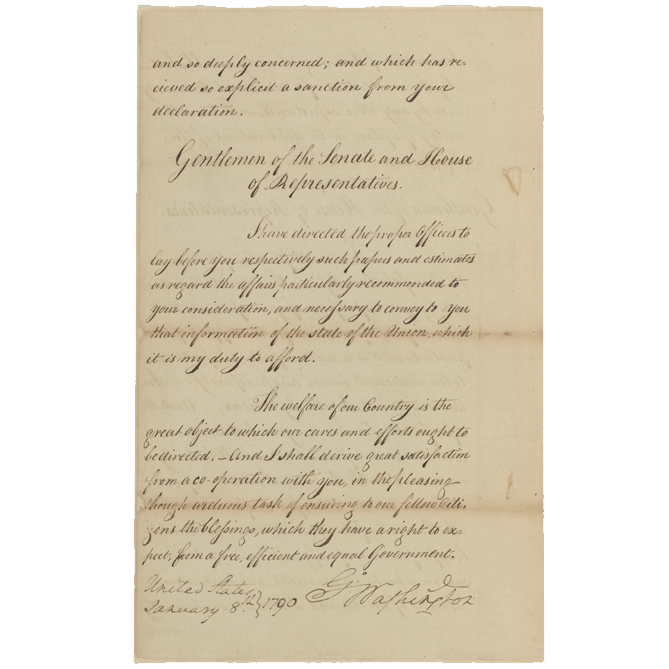
    George Washington’s First Annual Message to Congress. January 8, 1790.

    In George Washington’s First Annual Message to Congress, he looked beyond the largely then-agricultural states and expressed his aspiration that the United States would be self-sufficient for its agricultural, manufacturing, and military needs. At the time, this was a Federalist-backed belief, so that the United States could become a rival to the powers of Europe.

    But it planted the seeds for the transformation of America. Then-Secretary of Treasury Alexander Hamilton took Washington’s message to heart, drawing up the Report on the Subject of Manufactures on December 5, 1791. In his report, Hamilton recognized that the building of the American powerhouse economy would take “three or four decades,” but he sketched out the basic economic keys to enabling the transformation to occur. For example, Hamilton explained the necessity of establishing banks, a national mint, and a uniform, paper currency.

    These actions by Hamilton and Washington planted the seeds for the United States to take full advantage of the Industrial Revolution’s seismic changes, which of course would place the United States among the leading nations in the world. Considering what was to come in the next three to four decades, and the two centuries since then, Hamilton and Washington have shown their wisdom and vision for the country.

    Looking more broadly at American history, it is difficult to identify a more pivotal moment in setting the trajectory for the country. The gravity of policy decisions seldom have the long term consequences that the early decisions of the first presidents had. One could speculate that the Americans’ preparedness for the Spanish American War, World War I, and World War II was bolstered by Washington’s and Hamilton’s idea to transition the economy from a largely agricultural society to a manufacturing, military-focused society.

    Regardless, it does not require speculation to conclude that we are certainly the beneficiaries of their wisdom.

  • The Monarchical Republic

    George Washington. By: Gilbert Stuart.

    At the time of George Washington’s presidency, the role, image, and traditions surrounding the executive office was unclear. It was a new concept entirely, particularly in light of the numerous, well-established monarchies of Europe. In fact, during this time, Poland had an elected monarchy.

    For clarity as to the role of the president, many Americans looked to the monarchs of Europe, demanding that the presidency must carry with it a level of regality, tradition, and pomp that was intended to invoke honor and dignity. However much Americans wished to dispose of the monarchical system and replace it with a republic, Americans had little guidance outside of Europe for how a leader should conduct himself or herself.

    Many of the traditions first established during Washington’s presidency, such as formal dinners with the powder-haired president where no individual was permitted to speak, have fallen by the wayside in the past two centuries. This is despite the power of the president consistently growing since the days of Washington. However, it seems that Americans now would not tolerate a stiff, overly dignified president who appears to be far superior to the common person. Why is that? Perhaps it’s American pragmatism? Or a collective fear of having a Messianic leader?

    Probably a little bit of both. Underlying much of the American sentiment, now and then, is the fear that the republic will slowly become either an empire or a kingdom, in the way that Rome did. These fears underlie the American pragmatism and create a collective feeling that any person with too much power, and any government with too much power, is undesirable.

    It is safe to say that Americans have always been keen to avoid both the English and Roman ways of declining in power. Avoiding monarchy, while still flirting with its decorum, characterized the early years of the American republic. Now, it is all but forgotten.