By the time of the Revolution, the states had begun to take steps toward sustaining themselves after independence from Britain was effectuated. One of those steps was the drafting of constitutions. Constitutions, while understood generally in Britain and elsewhere, had a unique meaning for Americans.
By 1776, the states were debating their respective constitutions and the Declaration of Independence was becoming a reality, all of which was fostering an environment of great debate. One part of that debate was what the role of governor should be for each state, and many of the conclusions and decisions made during that debate carry forth to modern America.
Involvement in government is crucial to the success of government as a whole. During the American Revolution, it was clear that participation in the political process would continue to be valued. Since those years, much has changed.
To fully understand the magnitude and impact of the American Revolution, context is crucial. While the Enlightenment was the process of society learning “the sources of a flourishing society and human happiness,” the Revolution was the process of finding the best form of government perhaps the world has ever known. See Gordon Wood, The Idea of America: Reflections on the Birth of the United States, 59.
As explained in The Birth of the Senate, the states’ creation of an upper house of Congress set the precedent for a fully functioning, bicameral legislature in most states and the federal government. However, the selection process of who should be a senator was another subject for debate.
Throughout American history, there has always been a question about the nature of representation: do representatives represent only their constituents in their district or do they represent the entire people, as their actions impact the entire people? This debate played out in the years surrounding the American Revolution and continues today.
Thomas Paine’s Common Sense was a hugely influential pamphlet that has been cherished by several generations of Americans. However, it had its detractors who did not believe that “republicanism for America was a matter of common sense.” Gordon Wood, The Creation of the American Republic: 1776-1787, 94.
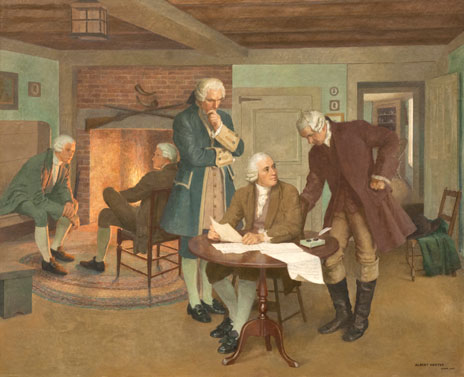
John Adams, Samuel Adams, and James Bowdoin Drafting the Massachusetts Constitution of 1780. By: Albert Herter.
As the colonies went through the Revolution, it became clear that republicanism would take the place of English imperialism. Americans were aware that republicanism put “social and moral demands” upon the people, which would change how people lived. Gordon Wood, The Creation of the American Republic: 1776-1787, 91.
The Copley Family. By: John Singleton Copley, one of the most prominent early American painters of middle-class, ordinary life.
The political discourse in the years of the American Revolution parallels with the discourse of today. Just as commentators and analysts opine about trends in society, pamphleteers did the same in the Revolutionary years.
For example, pamphleteers believed that American society during the American Revolution was unique, as there was a perception that “wealth does not obtain the same degree of influence here, which it does in old countries.” John F. Roche, Joseph Reed: A Moderate in the American Revolution (N.Y. 1957), 187.
The American Revolution was a consequence of more than just The Stamp Act of 1765 or the frustration that Americans felt with the British imperial system. But in fact, the “American Revolution was actually many revolutions at once.” Gordon Wood, The Creation of the American Republic: 1776-1787, 75.






 Last Best Hope of Earth