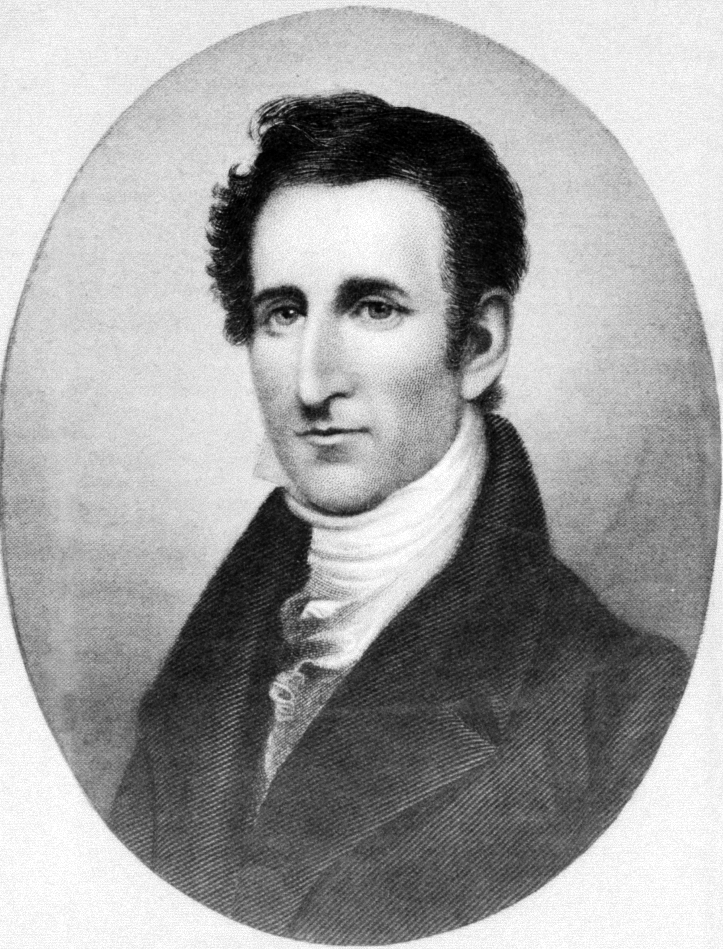
While the Democrats had held up Andrew Jackson as the ideal man, the Whigs began to view Abraham Lincoln in the 1840s as the ideal man, even though his personality was “artificial—that is, self-constructed.” Daniel Walker Howe, What Hath God Wrought: Transformation of America, 1815-1848, 598.
Abraham Lincoln in 1846, then Representative from Illinois. By: Nicholas H. Shepherd.
Abraham Lincoln, as a Congressman in the House of Representatives, would be “an ardent supporter of internal improvements.” Daniel Walker Howe, What Hath God Wrought: Transformation of America, 1815-1848, 596.
In 1832, Henry Clay addressed the Senate, expressing his hope that “some day,” America “would be rid of this, the darkest spot on its mantle,” speaking of slavery. Daniel Walker Howe, What Hath God Wrought: Transformation of America, 1815-1848, 586 quotingLife, Correspondence, and Speeches of Henry Clay, ed. Calvin Colton (New York, 1857), I, 189, 191.
The Election of 1840 juxtaposed the Whig Party’s policies against the Democratic Party’s more fluid policies. The Whigs “possessed a more coherent program: a national bank, a protective tariff, government subsidies to transportation projects, the public lands treated as a source of revenue, and tax-supported public schools.” Daniel Walker Howe, What Hath God Wrought: Transformation of America, 1815-1848, 583-84. The Democrats did not have such rigid policies, relying instead on the “emotional bond” they they had with their followers, rather than policy initiatives. Id. at 584 citing Matthew Crenson, The Federal Machine: Beginnings of Bureaucracy in Jacksonian America (Baltimore, 1975), 29.
In 1830, Daniel Webster, Senator from Massachusetts, engaged in a heated debate with Robert Hayne, Senator from South Carolina, which touched on the political theory of federal and state sovereignty.
On July 4, 1826, during America’s Golden Jubilee, celebrating the 50th anniversary of the Declaration of Independence, Thomas Jefferson and John Adams died. Daniel Walker Howe, What Hath God Wrought: Transformation of America, 1815-1848, 243. The two political rivals were two of the last three surviving signers of the Declaration of Independence, leaving only Charles Carroll of Maryland alive. Id. President John Quincy Adams, learning of his father’s death and Jefferson’s death, remarked that it was a “‘visible and palpable mark of Divine favor,’ to the nation, and most of his countrymen agreed.” Id.quoting James Morton Smith, The Republic of Letters (New York, 1995), II, 1973-74.
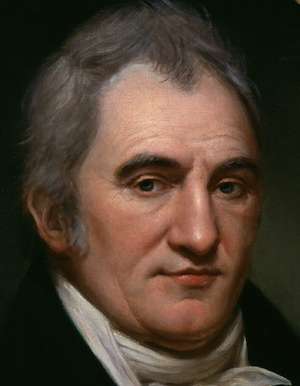
On July 4, 1809, Joel Barlow, a diplomat and poet, gave a public speech about other Americans’ feelings about the country. Gordon Wood, Empire of Liberty, 469. It was his conclusion that America had moved past its infancy and was approaching adolescence and manhood. Id. Barlow concluded that “[t]here has been no nation either ancient or modern that could have presented human nature in the same character as ours does and will present it; because there has existed no nation whose government has resembled ours . . . a representative democracy on a large scale, with a fixed constitution.” Id. quoting Joel Barlow, Oration, Delivered at Washington, July Fourth, 1809; at the Request of the Democratic Citizens of the District of Columbia (Washington, DC, 1809), 3-6, 9.
Barlow also concluded that America was “the greatest political phenomenon, and probably will be considered as the greatest advancement in the science of government that all modern ages have produced.” Id.
Barlow’s words still ring true, after over two centuries of progress in America. This has been evidenced by many countries throughout the world modeling their governments after America, to varying success. While some may argue that other modern countries, especially India, have adopted a democratic system and have a fixed constitution, there is no question that the United States remains unique. Taking India as a modern example of a democracy, the comparison to America is striking. While there is an identifiable, significant middle-class in the United States, India has a yawning gap between the wealthiest and poorest. The “human nature in the same character as ours” that Barlow describes simply has not been surpassed since his bold pronouncement of those words.
There is a question as to whether the United States is the “greatest political phenomenon” that Barlow proclaims. While many countries have adopted systems similar to America, which seems to flatter the American system, the success of those countries has been apparently hindered by various external factors. Take, for example, Russia. Russia has adopted a democratic model of government in name, but rampant corruption and oligarchic tendencies have precluded Russia from ever rivaling the United States as a model of effective, transparent government.
Even looking to Europe, and its many effective states, no country in Europe has the population and acreage to be comparable to the United States. Taking Europe as a whole, economically it is similar to the United States, but obviously governmentally, each European nation has its own operational government. This precludes any effective comparison with Europe or its individual nations.
The sheer extent of the United States, combined with its prolonged success, seems to bring wisdom to Barlow’s prescient words. Whether Barlow predicted the success of America merely by luck or not, his words underlie those famous words of Abraham Lincoln: that the United States is the last best hope of Earth.
This blog is intended to capture the spirit of the words of Abraham Lincoln in his December 1, 1862 address to Congress amidst the Civil War: “We shall nobly save, or meanly lose, the last best hope of earth.” These words reflect the optimism for America’s future, the uniqueness of America’s role in the world, and the direness of the Civil War. These words are also highly contextual, as likely few modern Americans would call the United States “the last best hope of earth.”
Nonetheless, by uncovering the past and juxtaposing it with contemporary events, this blog aspires to both inform and inspire the reader by showing that despite the doomsayers (modern and historical), the United States is not only mostly adhering to its founding principles but also on an upward trajectory, as it generally has been since its inception.




 Last Best Hope of Earth