Tag: Alexander Hamilton

  • The Louisiana Controversy

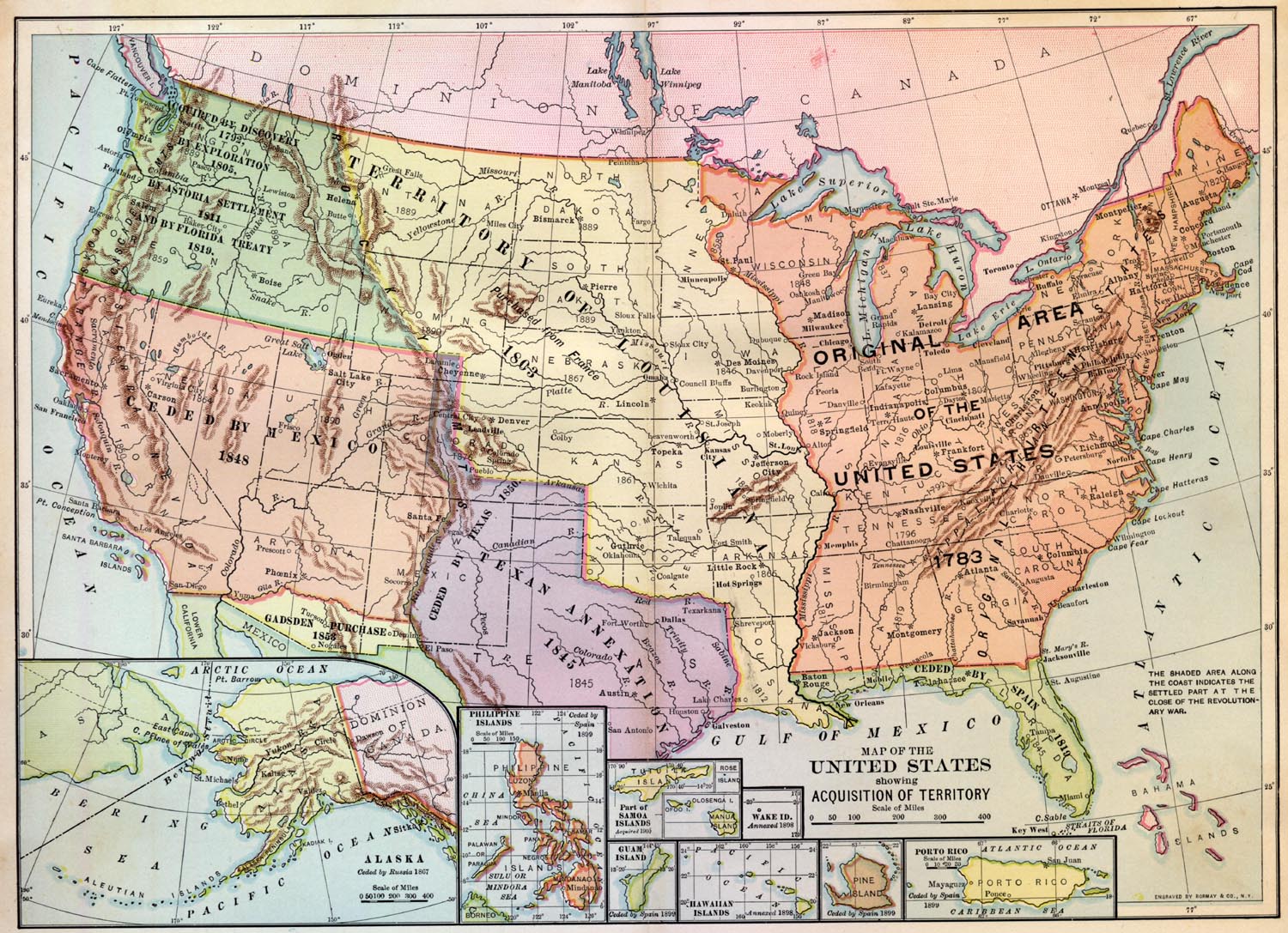
    A map portraying the Louisiana Purchase’s territory.

    The Louisiana Purchase in 1803 added approximately 823,000 square miles to the United States’ territory. At that time, Thomas Jefferson favored the purchase, as it protected America from the threat of France or Britain invading the United States, particularly through New Orleans. Gordon Wood, Empire of Liberty, 369. The acquisition also would force the territory of Florida, owned by Spain then, to join the United States, which it of course eventually did.

    A majority of Americans saw the Louisiana Purchase as a momentous occasion for America, in that it ended the struggle for control of the Mississippi River but it also allowed America to gain independence from the European powers of France and Britain. Id.

    Fisher Ames, a Representative of Massachusetts from 1789-1797, declared that the Louisiana Purchase was “a great waste, a wilderness unpeopled with any beings except wolves and wandering Indians.” He explained that it was a waste by stating: “We are to spend money of which we have too little for land of which we already have too much.” Id. He saw it as instead a way for “Imperial Virginia to move its slaveholding population westward to gain influence. Id. at 370.

    Even Alexander Hamilton favored the purchase, but expressed his reservations as to its effect on the United States as a whole: Could it be made “an integral part of the United States,” or would it merely be a colony of America? Id.

    Certainly, very few modern Americans would now question the wisdom and the investment of the Louisiana Purchase, for territorial purposes alone. The short term security benefits are long forgotten, as the European powers who then threatened the United States are now its strongest allies.

    Nonetheless, these views by Fisher Ames and Alexander Hamilton show that even the most popular and beneficial decisions by presidents are not without dissent. Now, sometimes analysts and commentators are tempted to speculate that there was a moment in American history where a presidents’ actions were widely appreciated and admired and free of dissent.

    While that may occasionally be true, even with the Louisiana Purchase, that added so much territory for settlers to use and security for the existing states, there was dissent.

  • Shift to Idealism

    George Washington Inauguration, 1789.

    The early Republic years were filled with hope and optimism for what the new country could achieve. The Republicans, through the 1790s and into the first decade of the 1800s, had a new idea about what government should be and how it should fit into the citizens’ lives.

    Republicans imagined “that people’s natural sociability and willingness to sacrifice their selfish interests for the sake of the whole would be sufficient social adhesives,” and a powerful federal government would not be necessary. See Gordon Wood, Empire of Liberty, 301.

    Alexander Hamilton and the Federalists thought these ideas were merely “pernicious dreams” of the Republicans and were surely too radical to be true. See id.

    Since those early years of the Republic, there has been a continuation of this debate. Undoubtedly, at least part of Thomas Jefferson’s and the Republicans’ view regarding Americans’ compassion and charity is true. Americans, as a collective, are charitable to a number of causes and organizations around the world, and Americans reinforce that principle that they are willing to occasionally sacrifice their selfish interests for the betterment of others.

    However, that compassion and charity does not supplant the need for a federal government to take some actions that could not have been contemplated by the Republicans or the Federalists. The Federalists’ misguided notion that a bureaucracy was necessary for the perpetuation of the country was just as incorrect as the Republicans’ belief that the people would inherently be willing to sacrifice their selfish interests in all regards.

    This would later become evident as the federal government’s intrusion was necessary to eradicate slavery, prevent discriminatory laws from being enforced, and ensure minorities’ rights, among a myriad of other examples.

    Some of what the Republicans believed and some of what the Federalists believed ultimately has proven to be true. Both Hamilton and Jefferson would be satisfied in knowing that their debate has vigorously continued, even if they would not be elated to know some of their ideals have been eroded.

  • Political Parties

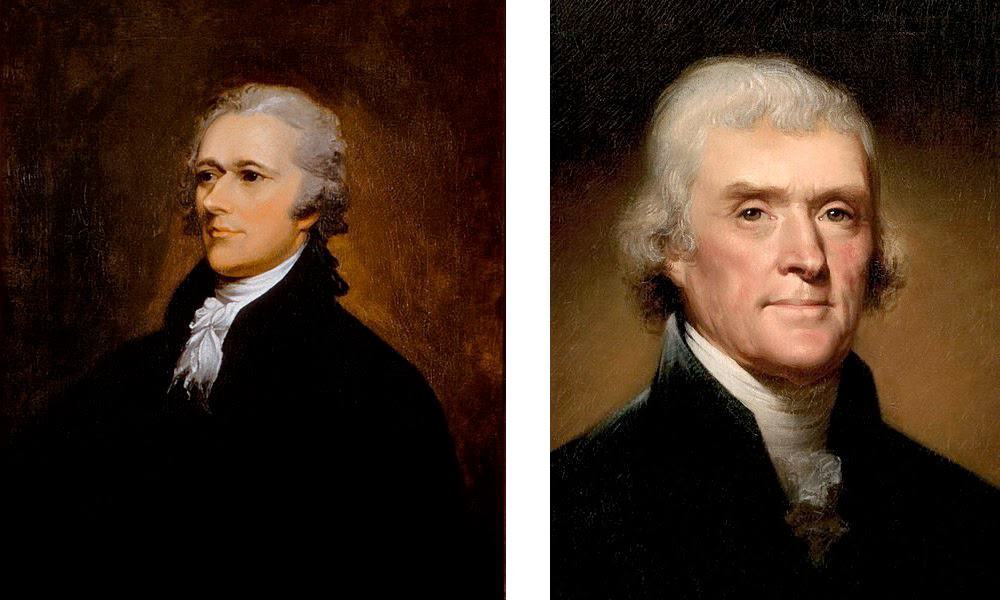
    Alexander Hamilton, L. Thomas Jefferson, R.

    Alexander Hamilton and Thomas Jefferson had a contentious relationship, from their time serving as Secretaries in Washington’s administration forward. That contentious relationship manifested itself, at least partially, in the fact that they had crucial ideological differences. At first, those ideological differences were not reflected by different memberships in political parties. During the time they were Secretaries in Washington’s administration, there were no political parties.

    When the two political parties, the Federalists and the Republicans, were created, Hamilton and Jefferson both had overblown ideas of what would each other’s party intended. Jefferson feared that Hamilton wished to implement a monarchy, and Hamilton feared that Jefferson intended to overthrow the government of the United States. As a general matter, the Federalist government feared that any Republicans or individuals with different views were determined to undermine the existence of the government and determined to bring an end to the system that the majority of Americans had worked so hard to create.

    In fact, however, the Republican party did not see itself as a political party, and the Federalists did not view themselves as members of a political party in those early years. For example, the Federalists saw themselves as the vast majority of people who were concerned about the state of the country. Those in the Republican party ultimately began making Democratic-Republican Societies throughout the country, which demanded changes from the status quo of the predominantly Federalist government.

    What a change the political party system has undergone since the late 1790s. Many would attribute the success of America’s political system to the fact that two main parties, now the Democrats and Republicans, have consistently vied against each other, generally agreeing to move the country forward by meeting in the middle. As Hamilton and Jefferson exaggerated the intentions and beliefs of the opposing party, modern Democrats and Republicans tend to do the same, at least to an extent.

    That healthy debate between two adversaries has sustained not only the court system from ancient days to modern days but also the American system of politics. An adversarial contest between two parties prevents a cacophony of voices that tend to overwhelm multi-party political systems. Rather, it places two parties against each other, creating competition, encouraging debate, and having the net effect of putting the country on a moderate path, with gradual changes coming over the course of decades. Perhaps that gradual, conservative nature of progress has been the cause of America’s prolonged success.

  • East Versus West?

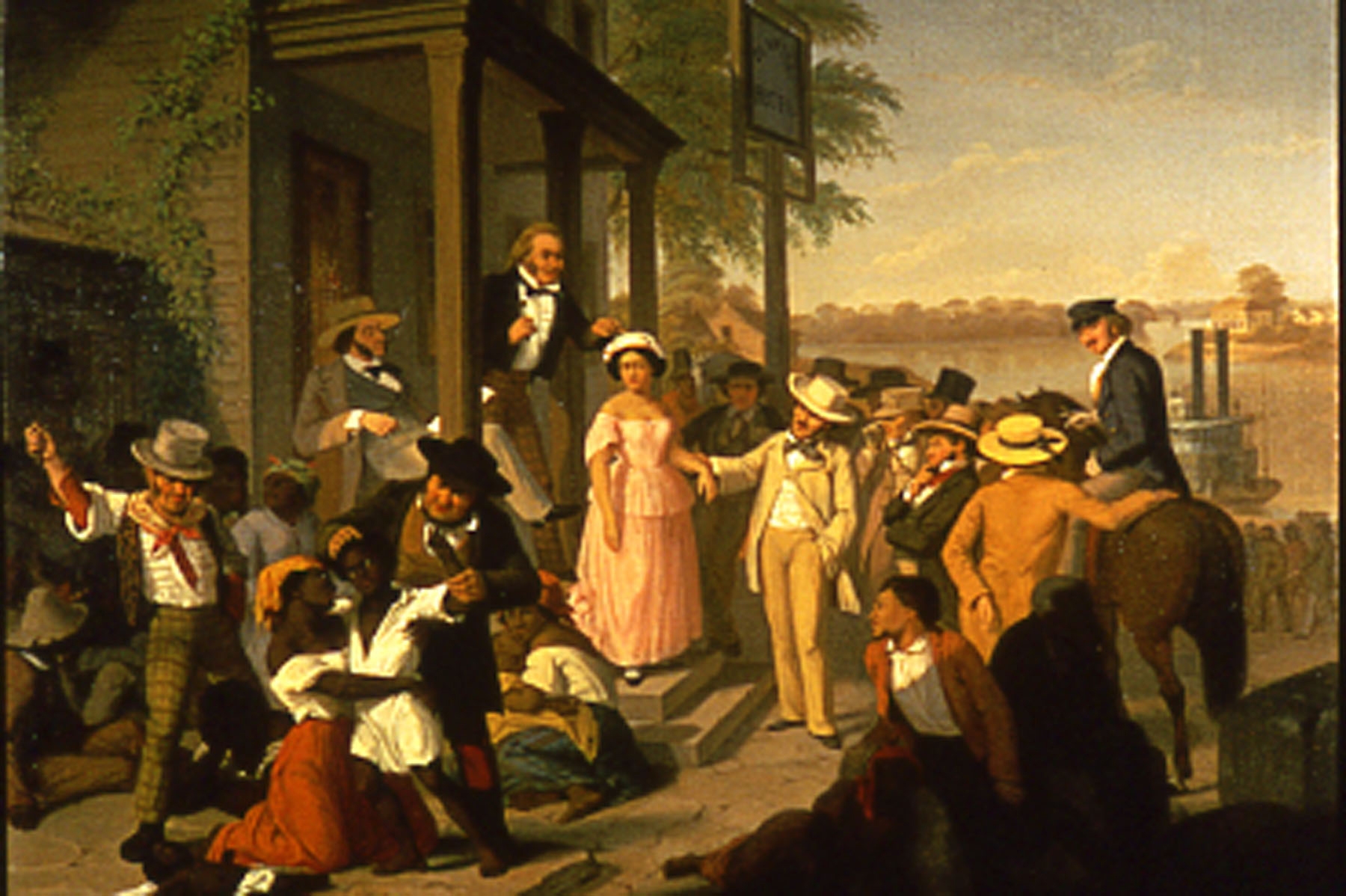
    Pittsburgh, Pennsylvania – Late 1700s, Early 1800s.

    In 1790, President Washington implemented an excise tax on spirits distilled within the United States. A bold move for the Federalists, who were seeking to create a more assertive, more organized, more cohesive federal government. The maverick states did not take kindly to it, nor did the citizens affected by this newly created tax.

    What was their reaction? Seek secession. The Federalists, including Washington and his Secretary of State, Alexander Hamilton, had a dilemma on their hands. The federal government needed legitimacy, but it also needed to maintain the peace amongst the ever-expanding states and their differing populations. It seems to be forgotten in modern discourse that there were more fractures in American history than just North versus South in the Civil War era. In the early 1790s, the fracture split East between West, as the Eastern aristocrats and monied individuals sought to impose taxes and other restrictions on the Western settlers.

    Washington and Alexander had differing views. Hamilton advocated for an immediate use of force by a militia, while Washington sent a peace commission, hoping to resolve the rebellion in the West without force. Ultimately, the peace commission failed, and a force of 15,000 men quelled the rebellion with only a few arrests and presidential pardons of those convicted of treason. John C. Miller, The Federalist Era, (New York, 1960), 158; Gordon S. Wood, Empire of Liberty, (New York, 2009), 138.

    Ultimately, the rebellion, now known as the Whiskey Rebellion, was perhaps the first test of the federal government’s role. The states had become accustomed to policing themselves, free of interference, and Washington’s action of assembling a militia and sending the militia to Western Pennsylvania set the clear, stern tone of the federal government.

    It is tempting to speculate what could have happened had Washington not taken such decisive action to quell the rebellion. Would there have been a secession? Was the Western economy sufficient to sustain itself? Would it have led to a first Civil War, only to be followed by a second? Less dramatically, would not taking decisive action have led to a weak federal government, similar to the one that prompted the drafting and adoption of the Constitution in the first place?

    Setting aside the potentials and the speculation, the Whiskey Rebellion foreshadowed the problems to come for the United States and set the stage for the role of the federal government. Even now, Americans debate how involved the federal government should be in the individual affairs of states, but by setting an early example, Washington and Hamilton made it more likely than not that the federal government would take decisive action when necessary to protect the health and wellbeing of the Union.

  • Seeds of Success

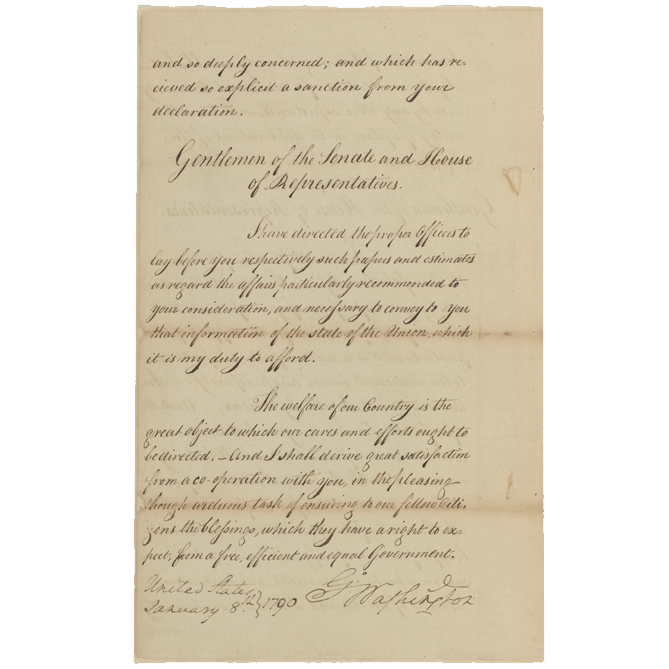
    George Washington’s First Annual Message to Congress. January 8, 1790.

    In George Washington’s First Annual Message to Congress, he looked beyond the largely then-agricultural states and expressed his aspiration that the United States would be self-sufficient for its agricultural, manufacturing, and military needs. At the time, this was a Federalist-backed belief, so that the United States could become a rival to the powers of Europe.

    But it planted the seeds for the transformation of America. Then-Secretary of Treasury Alexander Hamilton took Washington’s message to heart, drawing up the Report on the Subject of Manufactures on December 5, 1791. In his report, Hamilton recognized that the building of the American powerhouse economy would take “three or four decades,” but he sketched out the basic economic keys to enabling the transformation to occur. For example, Hamilton explained the necessity of establishing banks, a national mint, and a uniform, paper currency.

    These actions by Hamilton and Washington planted the seeds for the United States to take full advantage of the Industrial Revolution’s seismic changes, which of course would place the United States among the leading nations in the world. Considering what was to come in the next three to four decades, and the two centuries since then, Hamilton and Washington have shown their wisdom and vision for the country.

    Looking more broadly at American history, it is difficult to identify a more pivotal moment in setting the trajectory for the country. The gravity of policy decisions seldom have the long term consequences that the early decisions of the first presidents had. One could speculate that the Americans’ preparedness for the Spanish American War, World War I, and World War II was bolstered by Washington’s and Hamilton’s idea to transition the economy from a largely agricultural society to a manufacturing, military-focused society.

    Regardless, it does not require speculation to conclude that we are certainly the beneficiaries of their wisdom.