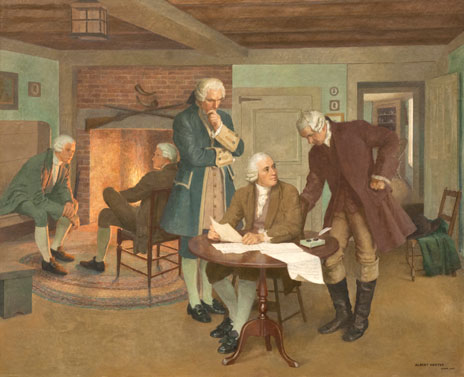
John Adams, Samuel Adams, and James Bowdoin Drafting the Massachusetts Constitution of 1780. By: Albert Herter.
As the colonies went through the Revolution, it became clear that republicanism would take the place of English imperialism. Americans were aware that republicanism put “social and moral demands” upon the people, which would change how people lived. Gordon Wood, The Creation of the American Republic: 1776-1787, 91.
The Copley Family. By: John Singleton Copley, one of the most prominent early American painters of middle-class, ordinary life.
The political discourse in the years of the American Revolution parallels with the discourse of today. Just as commentators and analysts opine about trends in society, pamphleteers did the same in the Revolutionary years.
For example, pamphleteers believed that American society during the American Revolution was unique, as there was a perception that “wealth does not obtain the same degree of influence here, which it does in old countries.” John F. Roche, Joseph Reed: A Moderate in the American Revolution (N.Y. 1957), 187.
The American Revolution was a consequence of more than just The Stamp Act of 1765 or the frustration that Americans felt with the British imperial system. But in fact, the “American Revolution was actually many revolutions at once.” Gordon Wood, The Creation of the American Republic: 1776-1787, 75.
Sacrificing private interest for the public good is a noble virtue. It was an idea widely revered in the years surrounding the American Revolution. But despite the pervasiveness of that idea, some believed it was leading America down a path toward destruction. (more…)
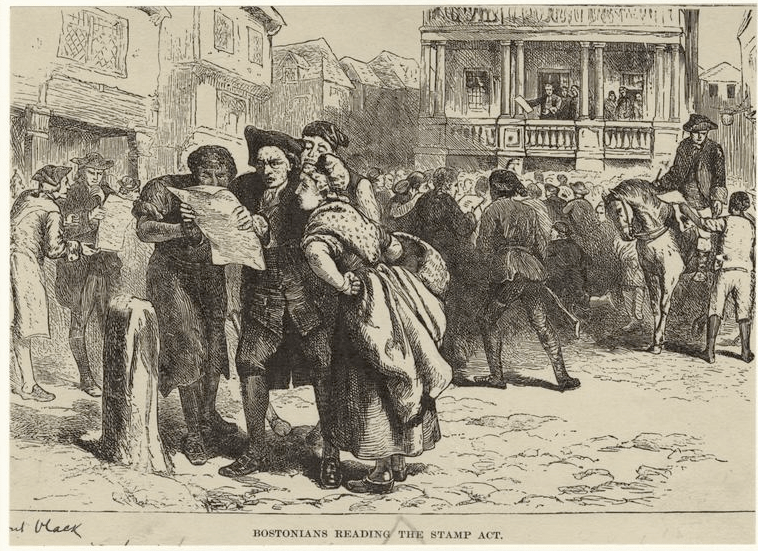
Depiction of Bostonians Reading the Stamp Act of 1765. Courtesy of New York Public Library Digital Image Gallery.
While one could find numerous causes of the American Revolution, perhaps none was a more proximate cause than the Stamp Act of 1765. The Stamp Act was the English Parliament’s taxation on every American’s use of paper, and this was perhaps the greatest manifestation of the idea of virtual representation.
City Hall of New York City in 1789, where Congress convened during the 1790s.
In the earliest years of the American Republic, theories were abound about the proper structure of government to best balance equality and wise decision-making. John Adams stated, in his Thoughts on Government, that “a people cannot be long free, nor ever happy, whose government is in one assembly.” Gordon Wood, The Creation of the American Republic: 1776-1787, 208-09 quoting John Adams, Thoughts on Government, Adams, ed., Works of John Adams, IV, 194, 196. These theories became tested throughout the young country, in each of the state’s constitutions.
At the time of the American Revolution, it was commonly believed amongst Americans that formulating the ideal government would require a different system than any previously conceived. The Founding Fathers had their own ideas.
As the American Revolution became more and more inevitable, states began contemplating the role and responsibilities of their legislatures. Those contemplations centered around curing the perceived ills and shortcomings of the English constitution.
The Peale Family, 1771-1773. By: Charles Willson Peale.
In the 1760s and 1770s, Americans had a complicated relationship with the English constitution. The English constitution was both a model for government, in some respects, and the strongest wedge being driven between the colonists and the English.
View of the Capitol Building in Washington, D.C., circa 1800.
While revolution was necessary to reinvent the American system of government to best meet the needs of Americans, another key element was necessary. The early Americans realized that “[p]eace is seldom made, and never kept, unless the subject retain such a power in his hands as may oblige the prince to stand to what is agreed.” Gordon Wood, The Creation of the American Republic: 1776-1787, 24 quoting Foster, Short Essay on Civil Government, 29-30.




 Last Best Hope of Earth