In 1790 and 1791, Alexander Hamilton, as Secretary of the Treasury, proposed the creation of a financial system in four reports, which covered the topics of a national bank, a mint, and manufactures. Gordon Wood, Revolutionary Characters: What Made the Founders Different, 133. (more…)
The effects of the American Revolution throughout the world were not immediately clear, but Thomas Jefferson opined that it would be “a movement on behalf of the rights of man.” Gordon Wood, Revolutionary Characters: What Made the Founders Different, 110. (more…)
George Washington, to some, is revered as a brilliant general. To others, he is to be remembered because in his will drafted in the summer of 1799, he freed all of his slaves and took the extra step of ensuring that the slaves would be taught to read and write and be prepared for “some useful occupation.” Gordon Wood, Revolutionary Characters: What Made the Founders Different, 40. (more…)
John Trumbull’s Depiction of the Drafting Committee of the Declaration of Independent Presenting the Draft to Congress.
The Founding Fathers have a complicated legacy, and that legacy is constantly undergoing change. While the reverence of the Founding Fathers fluctuates generation-by-generation, certain questions emerge about the Founding Fathers’ effectiveness in setting the foundation for the United States.
Gordon Wood, in Revolutionary Characters: What Made the Founders Different, presented the Founding Fathers’ legacy as: “If it was the intense commitment of this generation of founders to new enlightened values that separates it from other generations, why, it might be asked, and indeed, as it has been asked by recent critical historians, did these so-called enlightened and liberally educated gentlemen not do more to reform their society? Why did they fail to enhance the status of women? Eliminate slavery entirely? Treat the Indians in a more humane manner?” Gordon Wood, Revolutionary Characters: What Made the Founders Different, 26.
It has become popular, glamorous even, to question the principles and integrity of the Founding Fathers in recent years, for their lack of ridding the country of its most foul traits. The Founding Fathers lived in a much different world than contemporary Americans.
To be fair to the Founding Fathers, accomplishing any of the goals similar to abolishing slavery, ensuring equality of men and women, and treating Indians in a humane manner, must have come after ensuring the creation of a government that would last ages. As Thomas Jefferson drafted the Declaration of Independence and James Madison drafted the Constitution, and the Founding Fathers came to sign and approve those documents, their priority was creating an environment and a country that would facilitate future successes and ensure equality in for future generations.
The Founding Fathers were not in a position to contemplate every injustice and inequality, amidst the Revolutionary War, the tumultuous years of the early Republic, and the rapid growth of the country.
To expect them to have addressed and resolved every issue that was perhaps foreseeable at the time of the Revolution is to ignore their extraordinary accomplishments. The Founding Fathers collectively deliberated what the best form of government should be. They created the most extraordinary government that has thrived for over two centuries and has been a model for successful government.
While it is popular to question the Founding Fathers’ accomplishments, the context of their work must be remembered. We remember each American icon for their accomplishments, given the circumstances that existed during their respective times. The Founding Fathers’ time was perhaps the most tumultuous and contentious in American history, and yet they devised a system that has allowed one of the most free and just societies known to the world.
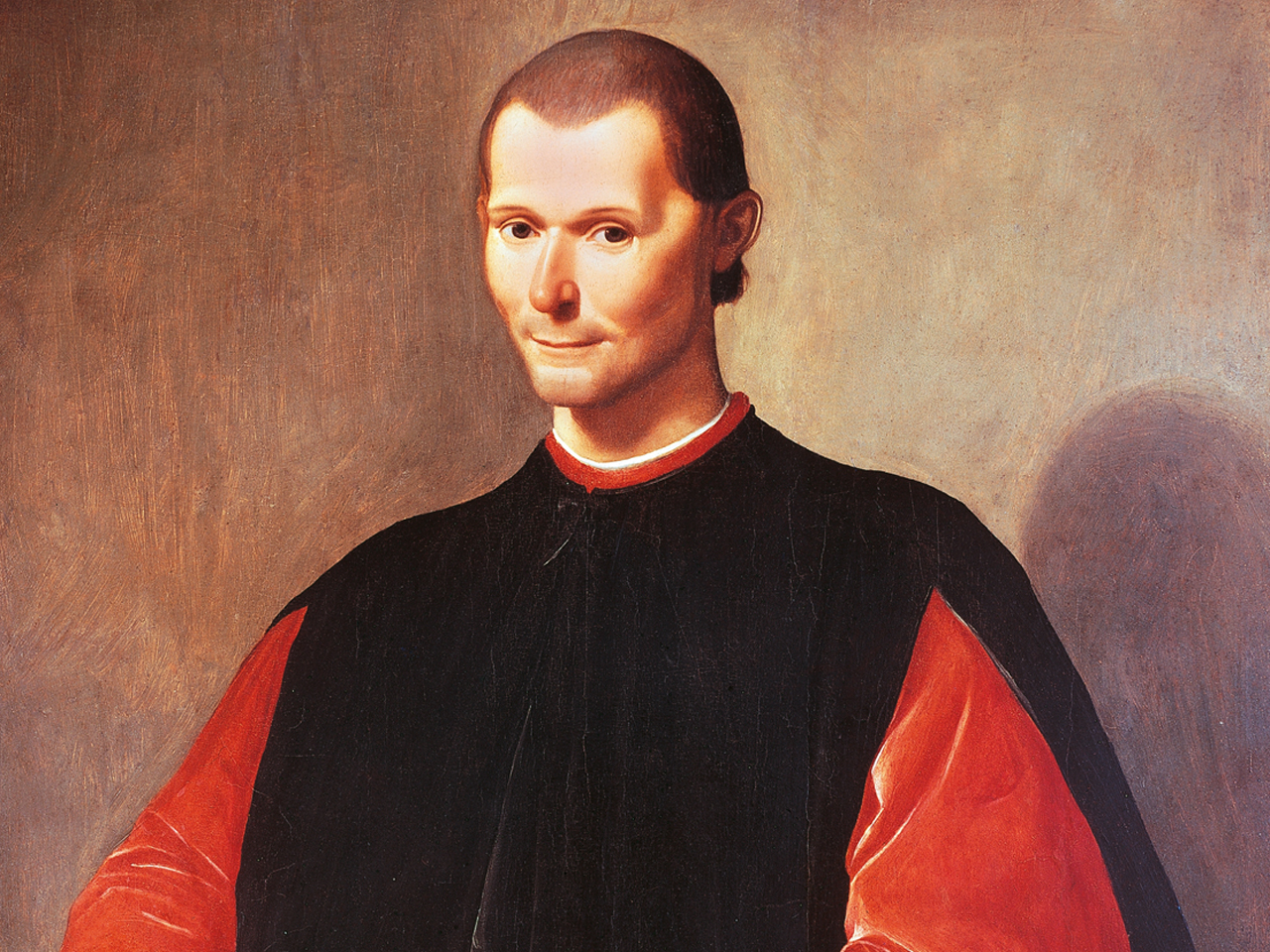
Portrait of Niccolo Machiavelli. By: Santi di Tito.
The political spirit of the colonies in the 1700s, while unfamiliar in many respects, has parallels to the modern political landscape in America. The colonies political thought was closer to Niccolo Machiavelli and Montesquieu, rather than John Locke.
The colonists generally “did not conceive of society in rational, mechanistic terms; rather society was organic and developmental.” Gordon Wood, Creation of the American Republic: 1776-1787, 29. One of the common views at the time was: “It is with states as it is with men, they have their infancy, their manhood, and their decline.” Id. quoting Stow Persons, “The Cyclical Theory of History in Eighteenth-Century America,” American Quarterly, 6 (1954), 147-63.
This theory of nations and people presented “a variable organic cycle of birth, maturity, and death, in which states, like the human body, carried within themselves the seeds of their own dissolution,” with the speed of dissolution “depending on the changing spirit of the society.” Gordon Wood, Creation of the American Republic: 1776-1787, 29 quoting Stow Persons, “The Cyclical Theory of History in Eighteenth-Century America,” American Quarterly, 6 (1954), 147-63.
In contemporary America, these beliefs regarding the cyclical nature of nations would resonate with many. Even if most modern Americans do not think in terms of analogizing nations with men, the rise and fall of nations is still a popular subject.
Notably, Americans, and their immediate predecessors, have always been painfully aware of the seemingly temporary nature of prosperity in the strongest of nations. Optimistically, Americans have always hoped to devise a system of government and a culture that was capable of avoiding what seems to be inevitable decline.
Whether that is possible or not, this American hope fuels an insecurity of decline and a desire to study history so as not to repeat it. Perhaps this insecurity can prevent or mitigate the most common causes of decline and even significantly delay decline, but can it stop decline from happening altogether? It is doubtful.
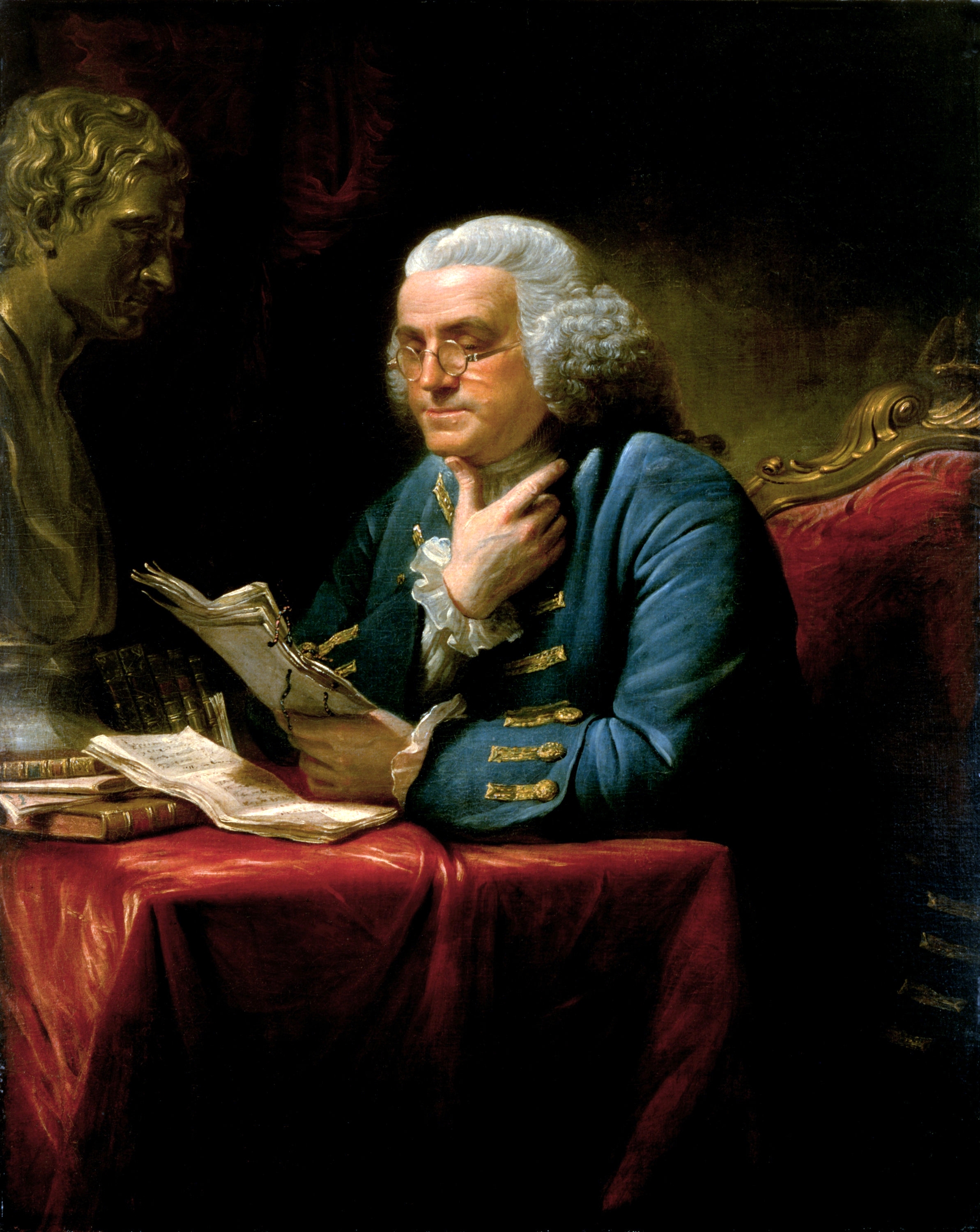
Benjamin Franklin, depicted in London in 1767. By: David Martin.
Benjamin Franklin, one of the most well-known and most revered Founding Fathers, had a more controversial history than most modern Americans realize.
In the late 1750s and early 1760s, Franklin was a “complete Anglophile.” Gordon Wood, Revolutionary Characters: What Made the Founders Different, 79. He made “disparaging comments about the provinciality and vulgarity of America in contrast with the sophistication and worthiness of England.” Id. He also believed that America, not England, was “corrupt and luxury-loving.” Id.
While living in England, Franklin was becoming more influential and had become a deputy postmaster. Id. at 84. In 1772, Franklin came into possession of some damning letters that would change his life. In the late 1760s, Thomas Hutchinson, the then-lieutenant governor of Massachusetts, had written letters to an Englishman advocating taking away liberties from the colonists so as to “maintain the colonies’ dependency on Great Britain.” Id. at 83. Franklin sent these letters to Massachusetts, prompting a crisis that would result in Franklin being terminated as deputy postmaster. Id.
In March 1775, he came back to America a changed man: a passionate patriot. Some of this passion was feigned, so as to show his fellow colonists that he was not an Englishman masquerading as a revolutionary. Id. at 84. He would become one of the most popular and widely respected Americans in the world, with only George Washington outshining him.
By the time of his death in 1790, Benjamin Franklin had created a legacy that lasts to this day. In the early Republic, that legacy was predicated on him showing that being self-made in America was not only possible, it was downright glamorous. Often forgotten or lost after those years of the early Republic, however, is that Franklin was not the same as the other Founding Fathers.
While Alexander Hamilton was not a full-blooded American and Thomas Jefferson spent a significant amount of time in Europe, Franklin so fully affiliated himself with England that it is difficult to draw a parallel to a contemporary American figure. In modern times, such an affiliation would certainly spell doom to a legacy.
Nonetheless, Franklin is remembered for his genius, his relatable nature, and his embodiment of the most American of ideals. Modern Americans’ forgiveness is likely warranted, but some may wonder: What if Franklin had not sent those letters? What would his legacy be then?
The English Whigs were an influential, even revered, group for many of the colonists in America. Their beliefs resonated with ordinary, common people.
The Whigs believed that “the promotion of the people’s happiness was the sole purpose of government.” Gordon Wood, The Creation of the American Republic: 1776-1787, 20. Further, government was “a wise, a necessary, and a sacred thing,” which restrained the “lusts and passions that drove all men.” Id. quoting Samuel Williams, A Discourse on the Love of our Country (Salem, 1775), 28; John Joachim Zubly, The Law of Liberty (Philadelphia, 1775), 6-7.
The basics of the social contract were fundamental to Whig beliefs. The government officials “agreed to use their superior power to protect the rights of the people,” who “pledged their obedience, but only . . . as long as the rulers promoted the public interest.” Gordon Wood, The Creation of the American Republic: 1776-1787, 20 citing Dan Foster, A Short Essay on Civil Government (Hartford, 1775).
Many Whig leaders in England became idols for American liberty. William Pitt, the First Earl of Chatham, developed an almost cult-like following amongst a segment of colonists in America. In Bristol County, Massachusetts, one colonist explained: “Our toast in general is,—Magna Charta [sic], the British Constitution,—Pitt and Liberty forever!” Clinton Rossiter, Seedtime of the Republic. The Origin of the American Tradition of Political Liberty (New York: Harcourt, Bruce and Company, 1953), 145, 359-60.
This early American obsession with the Whig ideology would frame the revolutionaries’ beliefs and priorities. Those beliefs and priorities have carried forward to modern Americans.
The social contract certainly has not been forgotten, as many modern Americans are fully aware of the fact that their elected officials can be voted out just as easily as they were voted in.
However, the political theory surrounding the purpose of government perhaps has been lost over the years. The Whig belief that the sole purpose of government is to promote the happiness of the people is an optimistic, hopeful perspective. Many contemporary Republicans, particularly of the Ronald Reagan era, would not be able to disagree loud and fast enough to this Whig belief. Even some modern Democrats may take issue with it, as it is perhaps not nuanced enough to apply to a nuanced society.
While we were quick to import the Whig belief that government’s sole purpose is to promote happiness, should we, as modern Americans be so quick to dismiss it? If the purpose of government is not happiness for all, then what is it?
For many colonists and early Americans, politics was a contentious, yet simple subject. Many believed that politics “was nothing more than a perpetual battle between the passions of the rulers, whether one or a few, and the united interest of the people.” Gordon Wood, The Creation of the American Republic: 1776-1787, 18.
Thomas Gordon, an Englishman and a Whig, wrote that “[w]hatever is good for the People is bad for their Governors; and what is good for the Governors, is pernicious to the People.” Id.quoting John Trenchard and Thomas Gordon, Cato’s Letters: Or, Essays on Liberty, Civil and Religious, and Other Important Subjects, 5th ed. (London, 1748), II, 249.
These beliefs defined the Whigs, the Americans who identified with the British Whig political party led by Charles James Fox. The British Whigs were adamantly opposed to a strong monarchy. Later, in the 1830s, a movement would emerge in America called the Whig Party, which was opposed to a strong presidency.
The American Revolution developed these views in a uniquely American way. The British Whigs were focused on restraining the power of one of the mightiest empires, led by a monarchy, the world has ever known. They hoped to displace the Tories, the political party who supported the powerful monarchy. Colonists in America who embraced the Whig ideology realized that to prevent such a dilemma from playing out in America, those colonists had to develop new systems and institutions that prevented such a concentration of power in the government.
Despite the colonists progress in creating those systems and institutions, the dynamic that Whigs identified between rulers and their people still resonates today. Many modern Americans believe that government officials will inevitably only cater to the interests of government officials, not the common people. Some say it is human nature and no amount of political theorizing can conjure up a system that prevents it from happening.
One has to wonder, does the American system’s representative nature not curtail that dynamic from occurring? Has America effectively addressed rulers only looking out for rulers?
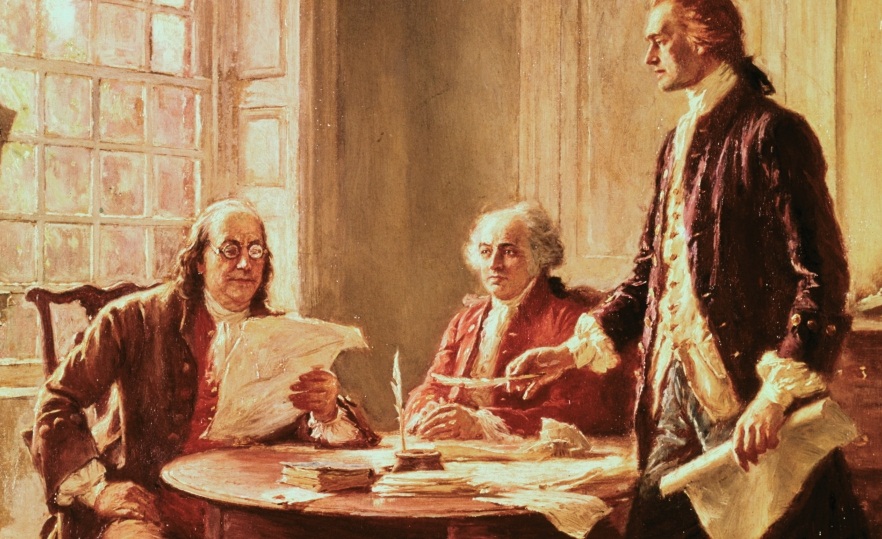
Depiction of Benjamin Franklin, John Adams, and Thomas Jefferson.
Gordon Wood began his 2006 book Revolutionary Characters: What Made the Founders Different by stating that “[n]o other major nation honors its past historical characters, especially characters who existed two centuries ago, in quite the manner we Americans do.” Gordon Wood, Revolutionary Characters: What Made the Founders Different, 3.
He continued, stating that Americans “want to know what Thomas Jefferson would think of affirmative action, or George Washington of the invasion of Iraq.” Id.
Scholars apparently have varying views as to why modern Americans revere the Founding Fathers, over two centuries after they first acquired their fame. Id. at 4.
Some scholars believe that it is because Americans are concerned “with constitutional jurisprudence and original intent” forming the basis for the Constitution. Id.
Other scholars posit that analyzing the Founding Fathers allows modern Americans to “recover what was wise and valuable in America’s past.” Id.
Another set of scholars explain that Americans look to the Founding Fathers to define the American identity. Id.
As Gordon Wood explained, this was not always the case. Toward the late 1800s and early 1900s, some Americans questioned the wisdom, accomplishments, and place of the Founding Fathers. Id. at 5. Nonetheless, for a significant portion of the 1900s and continuing into the 2000s, Americans look to the Founding Fathers for guidance.
While scholars may disagree as to the underlying purpose for modern Americans to honor the Founding Fathers, it can likely be explained by two points: (1) the Founding Fathers rigorously worked to create the best form of government possible and (2) the Founding Fathers knew adversity, difficulty, and hardship and yet held the country together.
As to the first point, the Founding Fathers engaged in one of the most substantial debates in history as to how a country should be best governed by its people to best ensure their happiness and prosperity. The resulting government was not only revolutionary and coherent, it has facilitated America’s success for two centuries with only 27 amendments to the Constitution being necessary.
The second point weighs a little heavier. The United States has endured many wars, tragedies, and difficulties. Few rival the tumultuous, uncertain times of the Revolution. Regardless, in both stable times and otherwise, America and its leaders have looked to the Founding Fathers for guidance. The logic underlying that goes “If the Founding Fathers could lead a revolution and fight a war against a mighty empire successfully, how would they deal with this scenario?”
All of the scholars’ views as to why Americans honor the Founding Fathers feeds into this point. When Americans ask these questions, like “What would the Founding Fathers do?”, they do so out of a wishful curiosity that leads to no clear answer.
This is a result that would likely please the Founding Fathers. The Founding Fathers did not have a secret to making the right decisions or coming to the right conclusions. They only did so through vigorous debate with each other and unyielding optimism about America’s future. That contentious debate spawned the system, institutions, beliefs, and ideals that define America.
Those debates should rage on with vigor. It is the least that modern Americans can do to repay the Founding Fathers.
Washington Crossing the Delaware River. By: Emanuel Leutze.
The American Revolution is one of the most extraordinary revolutions to have taken place in world history. Not only would it result in the birth of one of the most influential and most powerful nations ever known, but it would also be a revolution with seemingly peculiar triggers.
As Gordon Wood in The Creation of the American Republic: 1776-1787 explained, “[t]here was none of the legendary tyranny of history that had so often driven desperate people into rebellion.” Gordon Wood, The Creation of the American Republic: 1776-1787, 3. Daniel Leonard concluded that “[n]ever in history . . . had there been so much rebellion with so ‘little real cause.’” Id.
Some analysts have speculated that Americans had learned “how to define the rights of nature, how to search into, to distinguish, and to comprehend, the principles of physical, moral, religious, and civil liberty,” so as to prevent tyranny before it occurred. Id. at 4. Because of these actions and considerations, some would call America the Empire of Reason. Id.
In 1768, John Dickinson wrote that colonists did not ask “what evil has actually attended particular measures,” instead asking “what evil, in the nature of things, is likely to attend them.” Id. at 5 quoting John Dickinson, Letters from a Farmer in Pennsylvania to the Inhabitants of the British Colonies (Philadelphia, 1768) in Paul L. Ford, ed., The Life and Writings of John Dickinson (Historical Society of Pennsylvania, Memoirs, 14 [Philadelphia, 1895]), 392, 389.
The spirit of the American Revolution, framed this way, raises questions about how and why the colonists insisted on pursuing a revolution. For example, why were the colonists unified in fearing all forms of tyranny? In modern times, this question seems hardly worth asking, but in the late 1700s, tyranny so permeated the nations of the world that it would likely have felt unchallengeable. Nonetheless, the colonists were persistent in achieving the society they dreamed was possible.
Perhaps the colonists’ actions in these years planted the seeds for future generations of Americans to question everything around them. Whether that is hyperbole or not, it is clear that Americans would become obsessed, and still are obsessed, with defining the contours of their rights and liberties. The project of creating an ideal society with all of its accompaniments can never cease.
Consequently, it is only fair to say that the Empire of Reason is still alive and well.





 Last Best Hope of Earth