Tag: Ancient Rome

  • Constitution Sunday: “Brutus” X

    New York Journal

    January 24, 1788

    History is replete with military coups. At a time when a country’s government has grown weak, the temptation to make drastic change can become overwhelming. Sometimes, rather than wait for the next election, the military makes its move—to the detriment of the democracy, the people, and the chances for protecting the people’s rights. There are some who believe that the best way to prevent such coups is to prohibit having a standing army altogether. In 1788, an author, using the pen name Brutus, saw that the liberties of the people faced imminent threat if there was a “large standing army” allowed in the United States and made the case that the Constitution should prohibit such an army as it created too much of a danger to the viability of the Republic.

    (more…)
  • Constitution Sunday: Nathaniel Barrell, a “Plain Husbandman,” Warns of the Passion for Power, but Favors Ratification

    February 5, 1788

    Massachusetts Ratifying Convention

    The draft Constitution had its parts that inspired and other parts that terrified. Nathaniel Barrell, either as a sign of his modesty or as a way to relate to his fellow residents of Massachusetts, claimed that he would not speak with the eloquence of a Cicero but would articulate his objections to the Constitution.

    (more…)
  • Constitution Sunday: “Cato” V

    “Cato” V

    New York Journal, November 22, 1787

    Following are excerpts from an anonymous article published in the New York Journal:

    To the Citizens of the State of New-York.

    In my last number I endeavored to prove that the language of the article relative to the establishment of the executive of this new government was vague and inexplicit, that the great powers of the President (more…)

  • A Supreme Court Tragedy: Dred Scott v. Sandford

    05_e
    The Taney Supreme Court.

    In 1857, the United States Supreme Court decided one of the most controversial cases in the history of the country. Just days after James Buchanan began his term as president, Chief Justice Roger Taney wrote the opinion for the Court, ruling that neither slaves nor freedmen could be citizens of the United States. The implications of this decision, and its reasoning, have been analyzed, dissected, and discussed since 1857. While many have concluded it is one of the Supreme Court’s worst decisions, its impact on Antebellum America should not be overlooked.

    (more…)

  • The Fugitive Slave

    john_houstin_hires
    The Fugitive Slave. By: John Houston. 1853.

    The Fugitive Slave Act, passed as part of the Compromise of 1850, was intended to resolve the tension surrounding the issue of slavery. Its provisions, however, ensured that it would not have such an alleviating effect.¹ The Act “denied the alleged fugitive any right to jury trial, not even guaranteeing it in the jurisdiction from which he had escaped.” David Potter, The Impending Crisis: America Before the Civil War, 1848-1861, 131. It also allowed a court to appoint a commissioner to decide a fugitive slave’s case. See id. That commissioner was entitled to a $10 fee where the “alleged fugitive was delivered to the claimant,” but if the slave was set free, the commissioner would receive only a $5 fee, creating an incentive for returning fugitives to slavery. Id. Finally, the Act gave federal marshals the power “to summon all citizens to aid in enforcement of the Act.” Id. citing Stanley W. Campbell, The Slave Catchers: Enforcement of the Fugitive Slave Law, 1850-1860 (Chapel Hill, 1968). (more…)

  • The Inauguration of William Henry Harrison

    rembrandt_peale_-_william_henry_harrison_-_google_art_project
    William Henry Harrison. By: Rembrandt Peale.

    William Henry Harrison, a Whig, won the White House in the election of 1840. In March 1841, for his inauguration, he stood in the cold and wind and spoke for an hour and a half. See Daniel Walker Howe, What Hath God Wrought: Transformation of America, 1815-1848, 570.

    (more…)

  • Constitution Sunday: The Weaknesses of Brutus Exposed: “A Citizen of Philadelphia” [Pelatiah Webster]

    The Weaknesses of Brutus Exposed: “A Citizen of Philadelphia” [Pelatiah Webster]

    Philadelphia, November 8, 1787

    Following is a series of excerpts from Pelatiah Webster’s article published in Philadelphia:

    “This government must have a supreme power, superior to and able to controul each and all of its parts. ‘Tis essential to all governments, that such a power (more…)

  • Constitution Sunday: Reply to Wilson’s Speech: “Centinel” [Samuel Bryan] II

    Reply to Wilson’s Speech: “Centinel” [Samuel Bryan] II

    Freeman’s Journal (Philadelphia), October 24, 1787

    Following are excerpts from Samuel Bryan’s article, published in response to James Wilson’s speech:

    “Friends, countrymen, and fellow-citizens, As long as the liberty of the press (more…)

  • Autopsies of the Dead Republics

    Edmund Pendleton
    Edmund Pendleton. By: William Pendleton.

    Ancient Rome and Ancient Greece were intertwined with the American Revolution and the establishment of the American republic.

    (more…)

  • Bringing the Revolution into Focus

    yorktown80
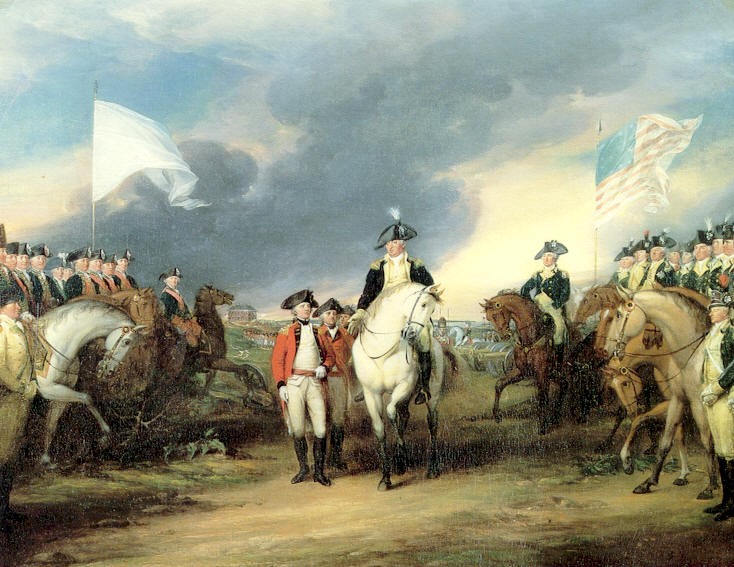
    Siege of Yorktown. By: John Trumbull.

    To fully understand the magnitude and impact of the American Revolution, context is crucial. While the Enlightenment was the process of society learning “the sources of a flourishing society and human happiness,” the Revolution was the process of finding the best form of government perhaps the world has ever known. See Gordon Wood, The Idea of America: Reflections on the Birth of the United States, 59.

    (more…)