Tag: Articles of Confederation

  • Constitution Sunday: James Wilson’s Summation and Final Rebuttal

    Constitution Sunday: James Wilson’s Summation and Final Rebuttal

    Pennsylvania Ratifying Convention.

    December 11, 1787

    Before concluding the Pennsylvania Ratifying Convention, James Wilson delivered a closing argument for ratifying the draft Constitution and took on many of his adversaries’ best arguments while presenting the most compelling reasons for adopting the Constitution. To detractors of the Constitution, a most glaring flaw in the document was its creation of a relatively powerful federal government as compared to that existing under the Articles of Confederation. Some called for scrapping the draft Constitution and simply enlarging the powers of the present federal government to make it more effective yet still modest.

    (more…)
  • Constitution Sunday: The Weaknesses of Brutus Exposed: “A Citizen of Philadelphia” [Pelatiah Webster]

    The Weaknesses of Brutus Exposed: “A Citizen of Philadelphia” [Pelatiah Webster]

    Philadelphia, November 8, 1787

    Following is a series of excerpts from Pelatiah Webster’s article published in Philadelphia:

    “This government must have a supreme power, superior to and able to controul each and all of its parts. ‘Tis essential to all governments, that such a power (more…)

  • The Panic of 1819

    william-jones
    William Jones. Artist Unknown.

    America’s reliance on cotton as an economic staple presented an opportunity for prosperity and an accompanying risk. In late 1818, the value of cotton fell as supply outpaced demand and “London banks decided there was no longer a need to extend more credit.” Daniel Walker Howe, What Hath God Wrought: Transformation of America, 1815-1848, 142. Then, the Second Bank of the United States, just two years into its life, “responded by shifting suddenly away from its own expansionist policy,” by the direction of William Jones, which only exacerbated the credit problem. See id. at 142-43. The Panic of 1819 erupted.

    (more…)

  • The Inadequacy of the Confederation

    jj-1958-306-pub-001-606x750
    John Jay. By: John Trumbull.

    By 1787, the strength and stability of the states was under scrutiny. Shays’ Rebellion had erupted, citizens had become more licentious, and state legislatures appeared to be running rampant, doing significant damage to the health of the country as a whole. See Gordon Wood, The Creation of the American Republic: 1776-1787, 465.

    (more…)

  • A Supreme Sovereign Power

    Portrait
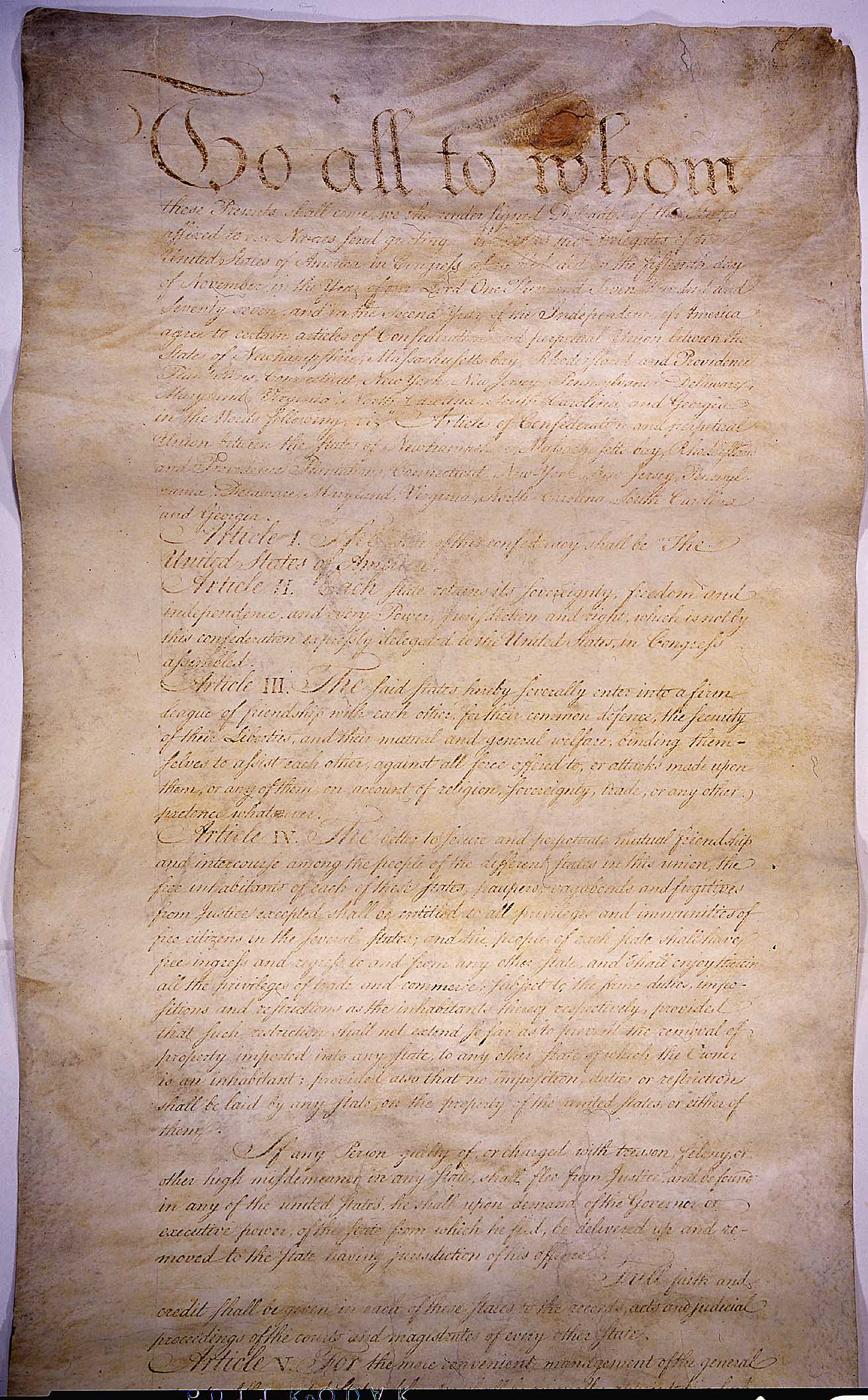
    Page 1 of the Articles of Confederation.

    Despite the fact that the Articles of Confederation loosely held the states together, there was still a remarkable union achieved. There were privileges and immunities granted, “reciprocity of extradition and judicial proceedings among the states,” no “travel and discriminatory trade restrictions between states, and the substantial grant of powers to the Congress in Article 9 made the league of states as cohesive and strong as any similar sort of republican confederation in history—stronger in fact than some Americans had expected.” Gordon Wood, The Creation of the American Republic: 1776-1787, 359. (more…)

  • Coalescing All the States

    johnadams-copley1784-2237
    John Adams. By: John Singleton Copley.

    Americans had a keen understanding of the idea, popularized by Montesquieu, that “only a small homogeneous society whose interests were essentially similar could properly sustain a republican government.” Gordon Wood, The Creation of the American Republic: 1776-1787, 356. This idea created a fundamental problem for America: it was not a small homogeneous society, and it was rapidly expanding.

    (more…)