
It was a time of oratory and a time when Ohioans became President. James Garfield was a product of the time. He was born into “a poor family” and “an intellectual in love with books.”[i] He attended the Western Reserve Eclectic Institute as a student and janitor, and by the following year, he became an assistant professor.[ii] Garfield was a man who treasured intellect. When William Dean Howells came to Garfield’s home in Hiram, Ohio in 1870, he sat on the porch and told a story about New England’s poets; Garfield “stopped him, ran out into his yard, and hallooed the neighbors sitting on their porches: ‘He’s telling about Holmes, and Longfellow, and Lowell, and Whittier.’”[iii] At a time when the Midwest fostered “a strong tradition of vernacular intellectualism” that manifested itself in “crowds for the touring lectures, the lyceums, and later the Chautauquas,” the neighbors gathered and listened “to Howells while the whippoorwills flew and sang in the evening air.”[iv]
(more…)Tag: Battle of Shiloh
-

The Battle of Gettysburg
By the spring of 1863, the Union had given the Confederacy every reason to remain defensive: for the duration of the war, federal troops had invaded points throughout the south forcing the rebels to shift to the location of each incision. Allowing this dynamic to continue to play out meant the only way for a Confederate success was a negotiated peace. On May 15, the southern brain trust, including General Robert E. Lee and President Jefferson Davis, convened in Richmond to discuss strategy. Lee proposed that he lead an effort that would remove the threat to Richmond, throw the Yankees on their heels, spell political doom for the Republicans (led by Abraham Lincoln in the White House), open up the possibility of Britain or France recognizing the Confederacy, and, at worst, an armistice that resulted in the Confederate States of America coexisting with the United States.[i] While Postmaster-General John Reagan and other Confederates felt that Lee should have sent troops to protect Vicksburg and the west from the trouble Ulysses S. Grant and his men were causing, Lee did not want to oblige the Confederacy to remain on the defensive but instead introduce the “prospect of an advance” as it would change “the aspect of affairs.”[ii] (more…)
-
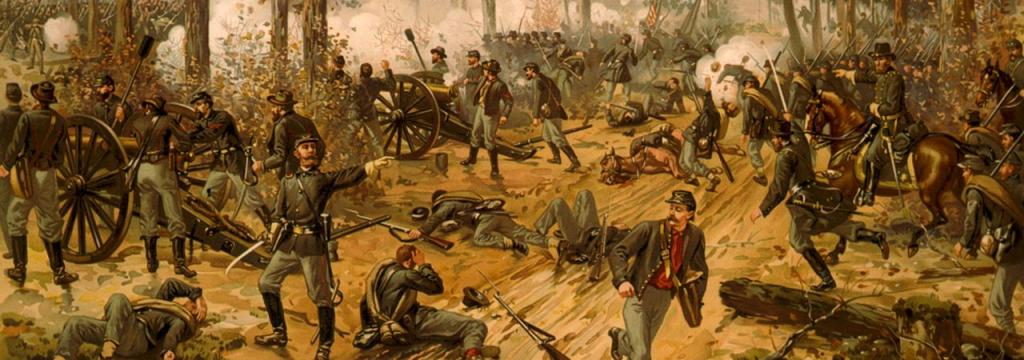
The Battle of Shiloh
Two of the greatest Confederate generals in early 1862, Albert Sidney Johnston and P.G.T. Beauregard, rendezvoused in Corinth, Mississippi with a combined 42,000 men.[i] The city not only could serve as an origin point of a campaign into nearby Tennessee; it also was the meeting point for the Confederacy’s “main north-south and east-west railroads.”[ii] Given Corinth’s importance, Henry Halleck ordered Ulysses S. Grant to march his men to Pittsburg Landing, wait for his fellow general Don Carlos Buell to arrive with his army, and then move on Corinth as a combined force numbering approximately 75,000.[iii]
 Last Best Hope of Earth