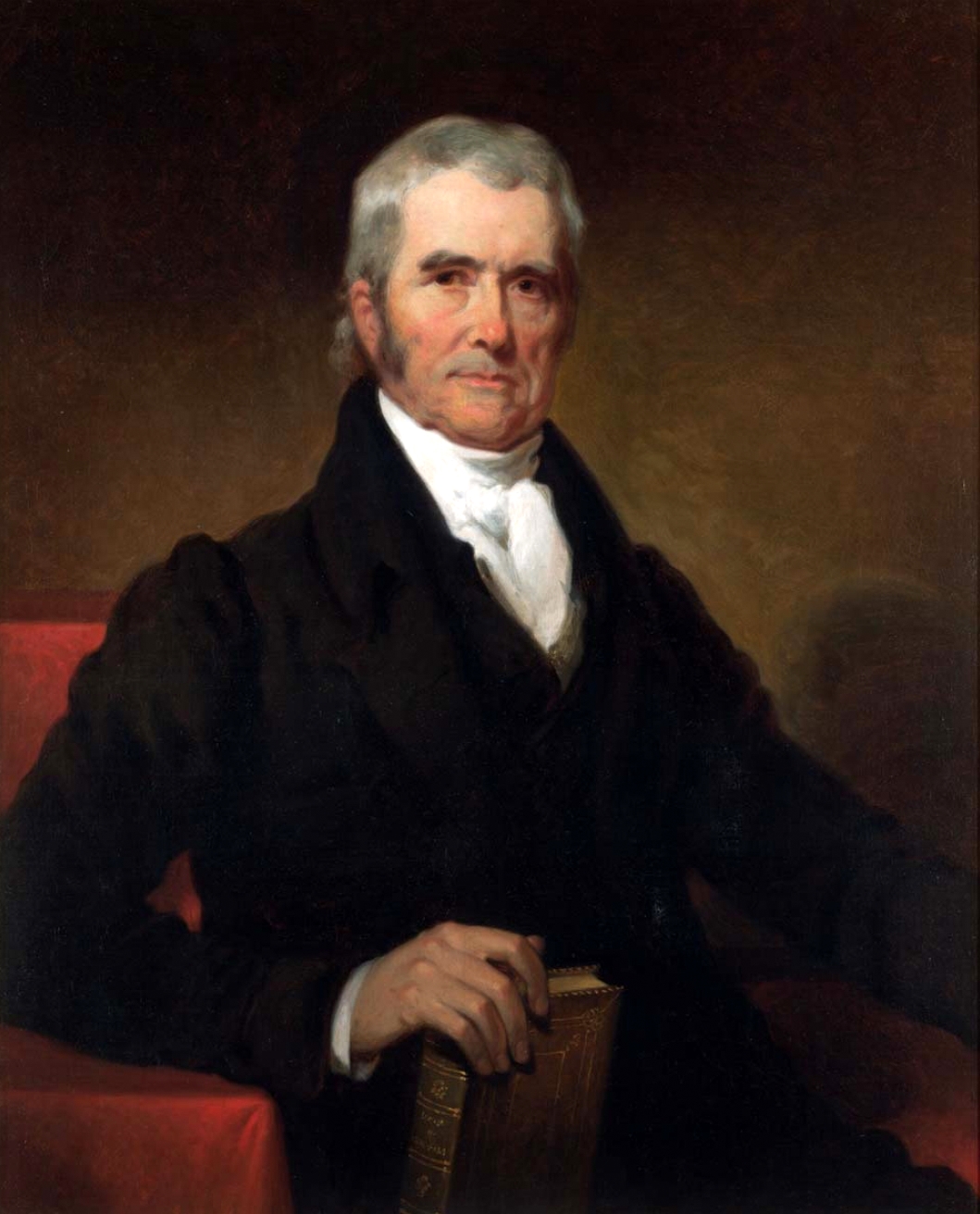
John Marshall, the fourth Chief Justice of the United States Supreme Court. By: Henry Inman.
In the first years of the American Republic, there were drastic changes in the law. The importance and organization of laws were coming into place. At the top were constitutional rights, which, as James Cannon explained “must be protected and defended ‘as the apple of your eye’ from danger ‘or they will be lost forever.’” Gordon Wood, The Creation of the American Republic: 1776-1787, 293 quoting James Cannon, “Cassandra,” Apr. 1776, Force, ed., American Archives, 4th Ser., V, 1094, quoting from Hulme, Historical Essay, 143-44. Cannon continued, stating that constitutional rights must be set “on a foundation never more to be shaken,” meaning that constitutional rights “must be specified and written down in immutable documents. Id.
Many expected that the American Revolution would lead to some “bloody noses” as “almost all revolutions are founded in blood.” Samuel A. Otis to Theodore Sedgwick, July 30, 1782, Theodore Sedgwick Papers, A. 55, Massachusetts Historical Society, Boston. The British had made predictions that separating from Britain would lead to quarrels and the Americans splitting into parties. Gordon Wood, The Creation of the American Republic: 1776-1787, 397. As the Revolutionary years went on, it looked that the British were right, which appeared to put America on a path toward destruction.
By the time of the Revolution, the states had begun to take steps toward sustaining themselves after independence from Britain was effectuated. One of those steps was the drafting of constitutions. Constitutions, while understood generally in Britain and elsewhere, had a unique meaning for Americans.
Thomas Paine’s Common Sense was a hugely influential pamphlet that has been cherished by several generations of Americans. However, it had its detractors who did not believe that “republicanism for America was a matter of common sense.” Gordon Wood, The Creation of the American Republic: 1776-1787, 94.
The American Revolution was a consequence of more than just The Stamp Act of 1765 or the frustration that Americans felt with the British imperial system. But in fact, the “American Revolution was actually many revolutions at once.” Gordon Wood, The Creation of the American Republic: 1776-1787, 75.
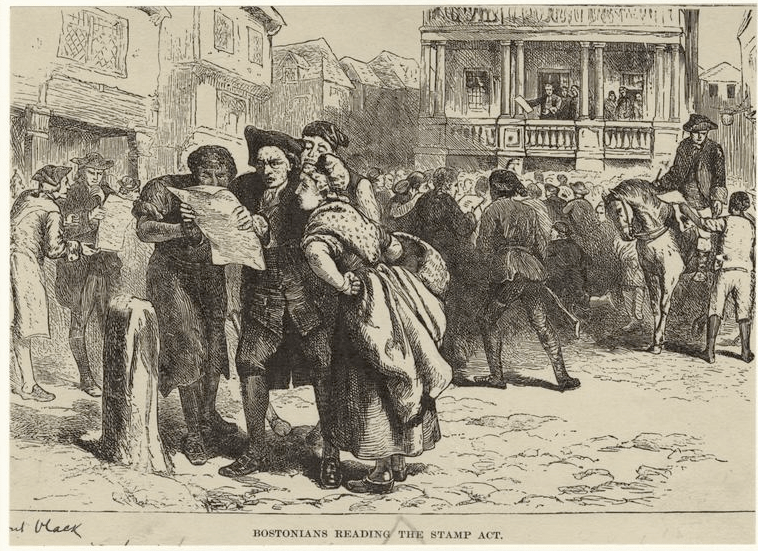
Depiction of Bostonians Reading the Stamp Act of 1765. Courtesy of New York Public Library Digital Image Gallery.
While one could find numerous causes of the American Revolution, perhaps none was a more proximate cause than the Stamp Act of 1765. The Stamp Act was the English Parliament’s taxation on every American’s use of paper, and this was perhaps the greatest manifestation of the idea of virtual representation.
The Peale Family, 1771-1773. By: Charles Willson Peale.
In the 1760s and 1770s, Americans had a complicated relationship with the English constitution. The English constitution was both a model for government, in some respects, and the strongest wedge being driven between the colonists and the English.
Signing of the Constitution. By: Louis S. Glanzman.
John Adams had strong opinions about federalism. He believed that the government should be structured similarly to the British Empire, given the British Empire’s extraordinary success.
At the time of the signing of the Constitution, Adams firmly believed that the Constitution had secured a national government, as opposed to a government dividing its sovereignty into states and a federal government. Gordon Wood, Revolutionary Characters: What Made the Founders Different, 191. (more…)
For many colonists and early Americans, politics was a contentious, yet simple subject. Many believed that politics “was nothing more than a perpetual battle between the passions of the rulers, whether one or a few, and the united interest of the people.” Gordon Wood, The Creation of the American Republic: 1776-1787, 18.
Thomas Gordon, an Englishman and a Whig, wrote that “[w]hatever is good for the People is bad for their Governors; and what is good for the Governors, is pernicious to the People.” Id.quoting John Trenchard and Thomas Gordon, Cato’s Letters: Or, Essays on Liberty, Civil and Religious, and Other Important Subjects, 5th ed. (London, 1748), II, 249.
These beliefs defined the Whigs, the Americans who identified with the British Whig political party led by Charles James Fox. The British Whigs were adamantly opposed to a strong monarchy. Later, in the 1830s, a movement would emerge in America called the Whig Party, which was opposed to a strong presidency.
The American Revolution developed these views in a uniquely American way. The British Whigs were focused on restraining the power of one of the mightiest empires, led by a monarchy, the world has ever known. They hoped to displace the Tories, the political party who supported the powerful monarchy. Colonists in America who embraced the Whig ideology realized that to prevent such a dilemma from playing out in America, those colonists had to develop new systems and institutions that prevented such a concentration of power in the government.
Despite the colonists progress in creating those systems and institutions, the dynamic that Whigs identified between rulers and their people still resonates today. Many modern Americans believe that government officials will inevitably only cater to the interests of government officials, not the common people. Some say it is human nature and no amount of political theorizing can conjure up a system that prevents it from happening.
One has to wonder, does the American system’s representative nature not curtail that dynamic from occurring? Has America effectively addressed rulers only looking out for rulers?
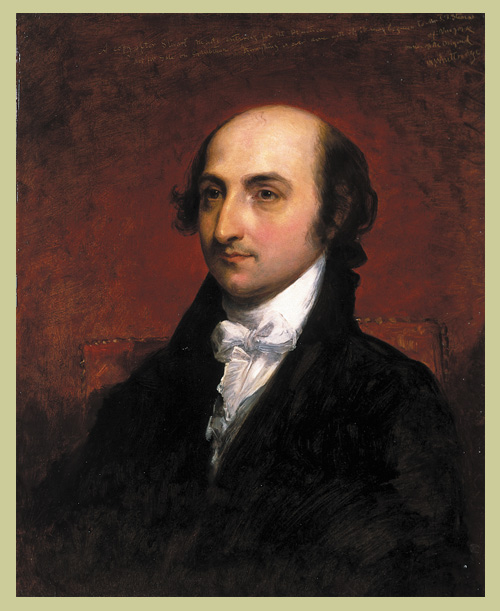
Albert Gallatin knew as early as 1799 that the United States “had become commercially and socially different from the former mother country” England. Gordon Wood, Empire of Liberty, 704. At that time, Gallatin was a Congressman, but he would later serve as Secretary of the Treasury from 1801 to 1814.
In realizing that America was different, he said that Britain had “trades and occupations” that were “so well distinguished that a merchant and a farmer are rarely combined in the same person; a merchant is a merchant and nothing but a merchant; a manufacturer is only a manufacturer; a farmer is merely a farmer; but this is not the case in this country.” Id. at 704-05 quoting Annals of Congress, 5th Congress, 3rd session (Jan. 1799), 9: 2650.
He said that if one were to venture into the middle of America, that individual would “scarcely find a farmer who is not, to some degree, a trader. In a grazing part of the country, you will find them buying and selling cattle; in other parts you will find them distillers, tanners, or brick-makers. So that, from one end of the United States to the other, the people are generally traders.” Annals of Congress, 5th Congress, 3rd session (Jan. 1799), 9: 2650.
This meant that Thomas Jefferson’s dream of Americans being a nation of agriculture and avoiding the industrialization that Europe had experienced was not a dream to be realized, even after the transformative War of 1812.
While this may have been troubling to Jefferson, Gallatin’s observations showed that Americans were developing a collective entrepreneurial spirit. Trading became an integral part of the American economy.
Part of this was inevitably by necessity, where some had to supplement their income by engaging in trading that perhaps they did not have experience in. On the other hand, part of this change from England must have been that there was a wealth of natural resources and a middle class emerging in America.
This early development after the War of 1812 should sound familiar to most modern Americans. First, although the middle class may change in size and wealth generation-by-generation, it has continually existed since the early Republic. Second, and most notably, Americans still carry an entrepreneurial spirit with them. Many would cite that entrepreneurial spirit for the success of America. It is certainly a factor.




 Last Best Hope of Earth