Tag: Britain

  • The War of 1812

    jackson_neworleans
    Painting of the Battle of New Orleans during the War of 1812.

    The War of 1812 is often a forgotten war in modern times. It was a war that tested the Americans’ resolve in staying an independent nation and ultimately a war that brought together Americans in a way that no previous event had. Gordon Wood, Empire of Liberty, 699.

    It was also a war that brought about seemingly unusual events, particularly in retrospect. For example, the Americans, led by William Hull, planned and attempted a three-pronged attack on Canada. Id. at 677. Then, perhaps even stranger, the governor of Massachusetts entered into negotiations “with the British, offering part of Maine in return for an end to the war.” Id. at 693.

    Ultimately, the British invaded the United States and made an unexpected march directly on Washington, burning much of it to the ground. That was the extent of damage in America, however, and both countries entered into negotiations of a peace treaty. President James Madison led the way in negotiating a treaty with Britain, the Treaty of Ghent, which would peacefully end the war. Id. at 697.

    President Madison, a Jeffersonian Republican, conducted himself with the logic that it was better “to allow the country to be invaded and the capital burned than to build up state power in a European monarchical manner.” Id. at 698. Madison’s skillful handling of the war would result in 57 “towns and counties throughout the United States” being named after him, “more than any other president.” Id. at 699 citing Forrest Church, So Help Me God: The Founding Fathers and the First Great Battle Over Church and State (New York, 2007), 350. John Adams told Thomas Jefferson in 1817 that Madison had “acquired more glory, and established more Union than all his three Predecessors, Washington, Adams, Jefferson, put together.” Gordon Wood, Empire of Liberty, 699 quoting John Adams to Thomas Jefferson, 2 Feb. 1817, in Lester J. Cappon, ed., The Adams-Jefferson Letters: The Complete Correspondence Between Thomas Jefferson and Abigail and John Adams (Chapel Hill, 1959), 2: 508.

    Thomas Jefferson concluded in 1818 that “[o]ur government is now so firmly put on its republican tack that it will not be easily monarchised by forms.” Thomas Jefferson to Lafayette, 23 Nov. 1818, in Gilbert Chinard, ed., The Letters of Lafayette and Jefferson (Baltimore, 1929), 396.

    The War of 1812 has many quirks, as discussed above but perhaps most notably was the Battle of New Orleans, which took place after the Treaty of Ghent was signed but before word had reached the whole country. The Battle of New Orleans, led on the American side by Andrew Jackson, inflicted massive casualties to the British. Gordon Wood, Empire of Liberty, 698.

    Of course, the Star Spangled Banner was also a byproduct of the War of 1812 as well.

    As forgotten as the War of 1812 may be, it had significant consequences for the future of the country. America became a unified country, with the collective hardship of fighting the British twice creating a bond between Americans that would be strong, even if short-lived. It also was a war that illustrated the Republican principles of Madison and Jefferson could be successful. This set the stage for Republican dominance in politics, which was already underway by the time the War of 1812 began.

    While the Civil War would eventually come to define the 19th Century for America, with its horrific nature and result of keeping the country united, the War of 1812 ensured that there was an America worth fighting for. Had the War of 1812 not occurred, perhaps the Civil War would have been waged differently and perhaps the course of American history would have had a noticeable absence of patriotism. While it is impossible to predict, the wise decisions of American leaders in those tumultuous years and those who fought for their young country give modern Americans much to be thankful for.

  • Everyone’s Tax Policy

    Portrait of John Eppes.

    Amidst the War of 1812, the Republicans passed a tax law “which included a direct tax on land, a duty on imported salt, and excise taxes on stills, retailers, auction sales, sugar carriages, and negotiable paper. All these taxes, however, were not to go into effect until the beginning of 1814.” Gordon Wood, Empire of Liberty, 684.

    One Virginian congressman wisely concluded that “everyone is for taxing every body, except himself and his Constituents.” Id. citing Donald R. Hickey, The War of 1812: A Forgotten Conflict (Urbana, IL, 1989), 122. It is believed that this quote is attributable to the Chairman of the House Ways and Means Committee, Congressman John Eppes. Bill White, Barron’s, Pay It All, and Pay it Quickly, Feb. 13, 2015, available at http://www.barrons.com/articles/SB51367578116875004693704580454041219159332.

    While this was during the War of 1812 and was undoubtedly true then, it is a prescient quote and universally applicable. Taxation has consistently been viewed as an evil necessity by many and a necessity that should be imposed on others, not themselves. While this perspective is only natural for self-preservation, it is one that is dangerous for the future generations of Americans.

    Taxation has always played a unique role in American society, beginning with the British taxes on America’s colonial goods, which were viewed as crippling the colonial economy unnecessarily. Taxation was later viewed as an impediment on growth and an unnecessary burden on finances.

    Modern policymakers would do well to remember that taxation is a tool to place a burden on future generations without necessity and without justification. The temptation to act in conformance with populist beliefs should not prevent policymakers from confronting the uncomfortable truth: taxation is necessary to preserve the society that all Americans should enjoy.

    While the appropriate taxation rate is always up for debate and will always be debated, the burden of taxation should be fairly apportioned to all generations of Americans, so as to ensure that revenues are raised consistently to provide the services and necessities to all Americans for the foreseeable future of the country.

  • Gearing up for the War of 1812

    Depiction of the Battle of Lake Erie.

    In large part, the War of 1812 was brought about by necessity but also by politics.

    In terms of necessity, the British were executing a policy of impressment where the British would inspect American ships for contraband or material support for the French. America’s foreign policy adopted in reaction to these events was to create commercial warfare through trading, bringing the conflict to a head. In terms of politics, however, the Republicans saw the likely potential of war as a second war for independence and a defense of republicanism. Gordon Wood, Empire of Liberty, 669. On the other side of the aisle, the Federalists, such as Alexander Hanson of Maryland, welcomed the war believing that the Republicans would mismanage the war “so to discredit their party and bring the Federalists back into power.” Id.

    Despite the oncoming war, the Republicans were aware that the country’s military was not prepared for a war, much less with one of the world’s supreme powers: Great Britain. In 1807, the Republicans strengthened the army and navy, but in 1810, the Republicans questioned themselves and did not further strengthen the military. Id. at 671. John Taylor, a Republican senator, stated that armies and navies “only serve to excite wars, squander money, and extend corruptions.” Id.

    Ultimately, the army was expanded prior to the war but the navy was not, for fear that its permanent establishment was unnecessary and would only endanger the longevity of the Republic. There was a large group of Republicans “who in the early months of 1812 voted against all attempts to arm and prepare the navy, who opposed all efforts to beef up the War Department, who rejected all tax increases, and yet who in June 1812 voted for the war.” Id. at 672.

    These years prior to the War of 1812 reflect the early Americans’ desire to not just proclaim independence but prove that independence and not take the risk of being viewed as a client state of England. The war was not inevitable, but it became so when the Republicans so strongly opposed impressment by the British and created a foreign policy of disrupting the commerce of England. The war was not necessary for the short term health of the United States, as England and France were embroiled in a long war that left America to be a secondary concern.

    But for the long term health of the United States, the War of 1812 was absolutely necessary. America needed to become a country unto itself, capable of asserting its presence and becoming a leader in the world. If it had not taken a strong stance against England, there was a serious danger that one of two things would happen: England, after its war with France, would invade the United States to take back “the colonies” or America would always be seen as England’s brash client state.

    The Republicans, although disorganized in executing their policies, effectively preserved the long term wellbeing of the United States in bringing on the War of 1812. But that would only become clear after significant casualties, damage, and perseverance.

  • The Louisiana Controversy

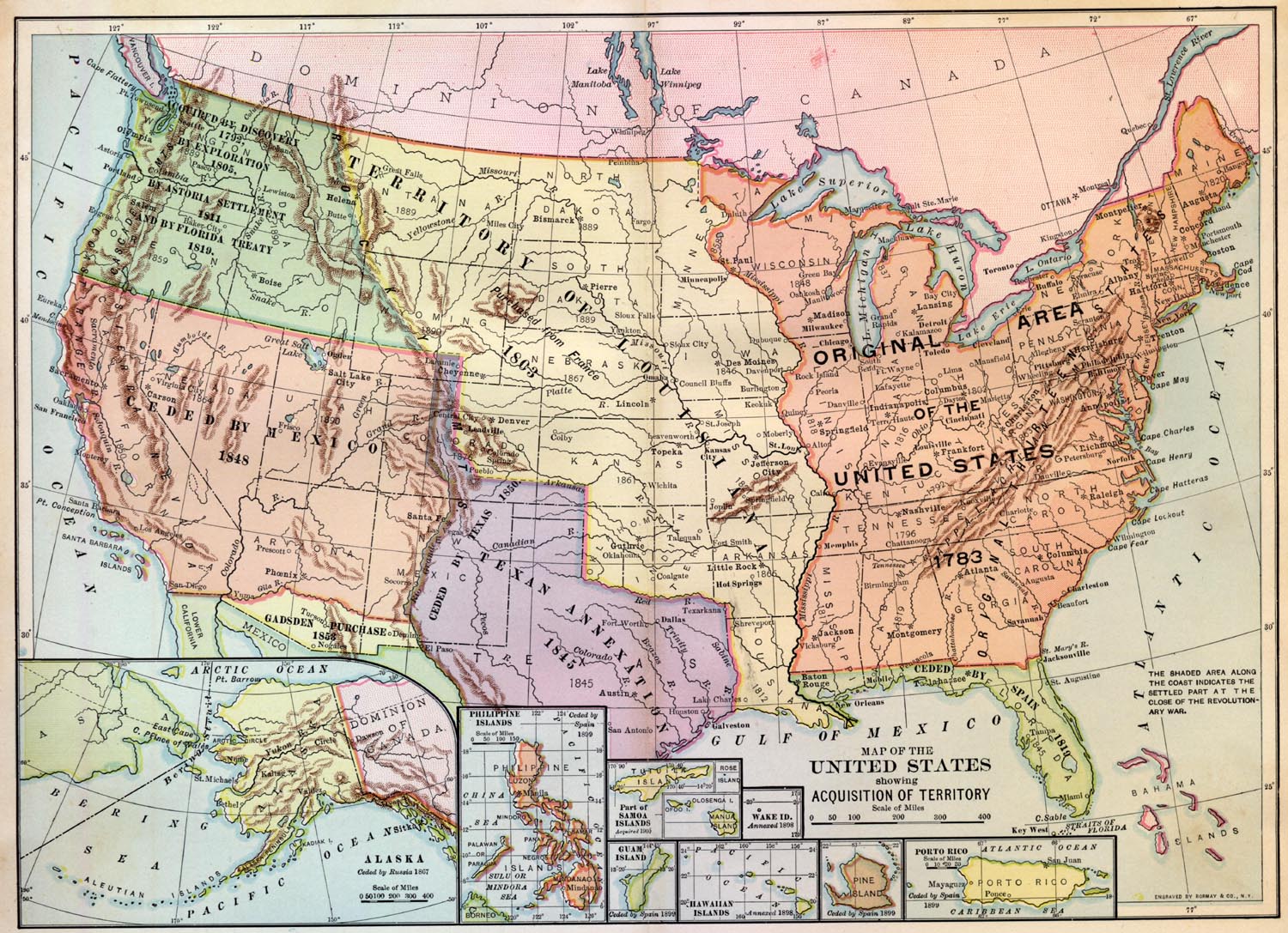
    A map portraying the Louisiana Purchase’s territory.

    The Louisiana Purchase in 1803 added approximately 823,000 square miles to the United States’ territory. At that time, Thomas Jefferson favored the purchase, as it protected America from the threat of France or Britain invading the United States, particularly through New Orleans. Gordon Wood, Empire of Liberty, 369. The acquisition also would force the territory of Florida, owned by Spain then, to join the United States, which it of course eventually did.

    A majority of Americans saw the Louisiana Purchase as a momentous occasion for America, in that it ended the struggle for control of the Mississippi River but it also allowed America to gain independence from the European powers of France and Britain. Id.

    Fisher Ames, a Representative of Massachusetts from 1789-1797, declared that the Louisiana Purchase was “a great waste, a wilderness unpeopled with any beings except wolves and wandering Indians.” He explained that it was a waste by stating: “We are to spend money of which we have too little for land of which we already have too much.” Id. He saw it as instead a way for “Imperial Virginia to move its slaveholding population westward to gain influence. Id. at 370.

    Even Alexander Hamilton favored the purchase, but expressed his reservations as to its effect on the United States as a whole: Could it be made “an integral part of the United States,” or would it merely be a colony of America? Id.

    Certainly, very few modern Americans would now question the wisdom and the investment of the Louisiana Purchase, for territorial purposes alone. The short term security benefits are long forgotten, as the European powers who then threatened the United States are now its strongest allies.

    Nonetheless, these views by Fisher Ames and Alexander Hamilton show that even the most popular and beneficial decisions by presidents are not without dissent. Now, sometimes analysts and commentators are tempted to speculate that there was a moment in American history where a presidents’ actions were widely appreciated and admired and free of dissent.

    While that may occasionally be true, even with the Louisiana Purchase, that added so much territory for settlers to use and security for the existing states, there was dissent.