Tag: Congress

  • Constitution Sunday: Reply to Elbridge Gerry: “A Landholder” [Oliver Ellsworth] IV

    Reply to Elbridge Gerry: “A Landholder” [Oliver Ellsworth] IV

    Connecticut Courant (Hartford), November 26, 1787

    Following are excerpts from Oliver Ellsworth’s article:

    “Such a body of men might be an army to defend the country in case of foreign invasion, but not a legislature, and the expence to support them would equal the whole national revenue. (more…)
  • The Master of Parliamentary Procedure

    john_q-_adams
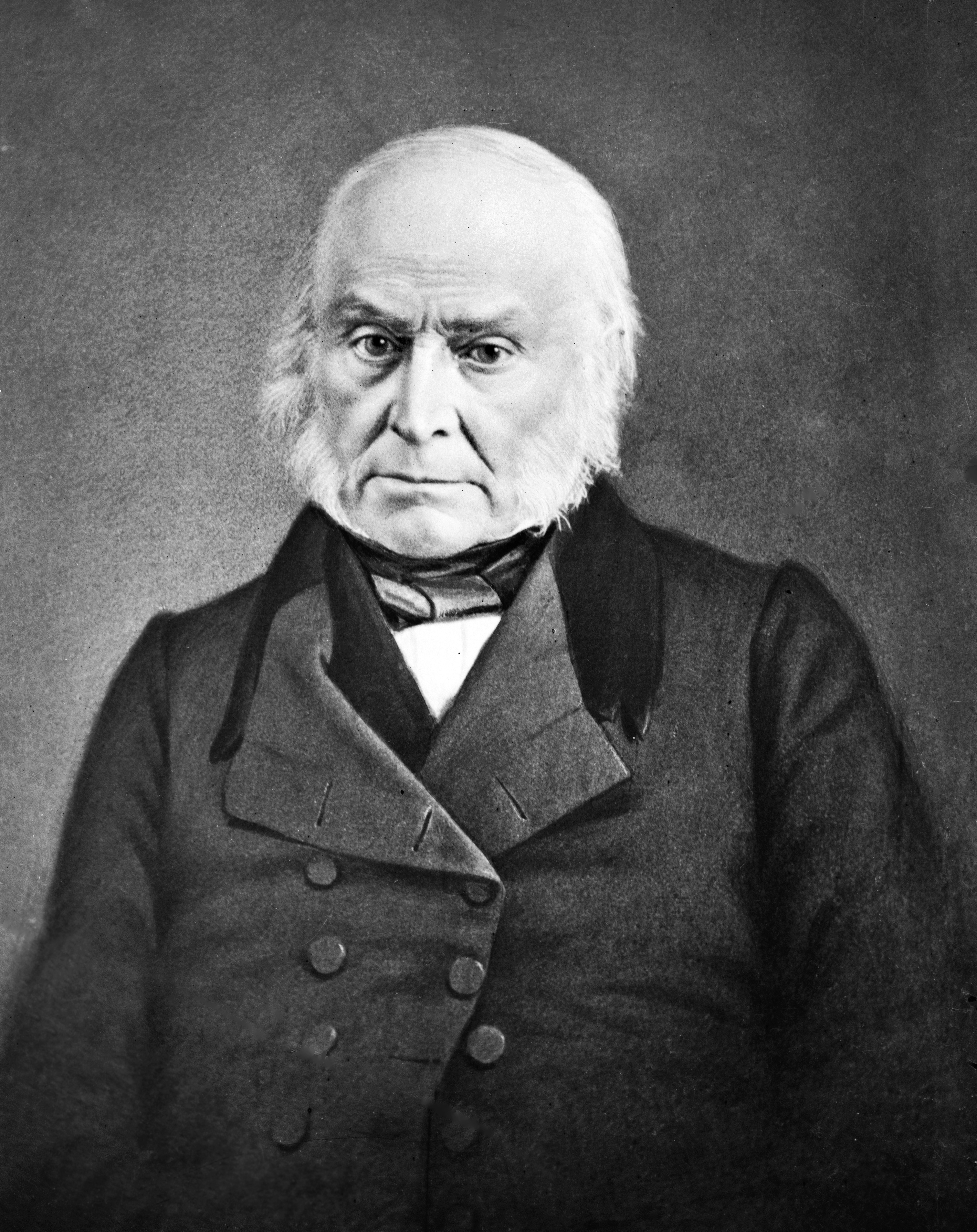
    John Quincy Adams.

    The United States Congress was not above adopting its own rules that would silence abolitionist views. While mass mailings to southerners became a regular occurrence for abolitionists, creating significant tension between proslavery and anti-slavery factions, those had occurred outside the purview of government. The House of Representatives, when it used a gag rule to prevent discussion of petitions relating to abolition, was striking a blow to abolitionists all over the country.

    (more…)

  • The Whigs and the Democrats Fight

    william_leggett
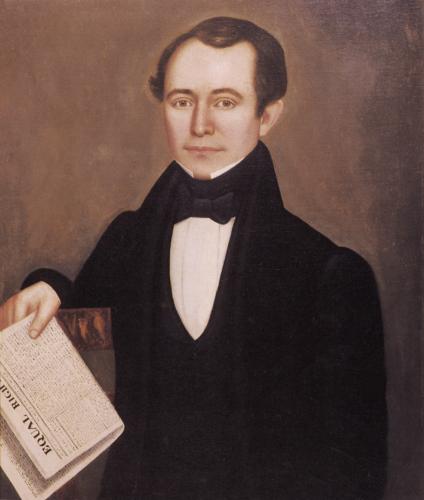
    William Leggett. By: Erastus Salisbury Field.

    With the emergence of the Democrats and the Whigs as the two main political parties in the late 1830s and early 1840s, this fostered significant tension on the issue of slavery.

    (more…)

  • The Aftermath of the Panics

    rmth-standingright
    Robert M.T. Hunter, Speaker of the House.

    Amidst the Panics of 1837 and 1839, the Whigs enjoyed significant gains in Congress, which led to Robert M.T. Hunter, a pro-states’ rights southerner, becoming Speaker of the House. Daniel Walker Howe, What Hath God Wrought: Transformation of America, 1815-1848, 506. Further, besides the changing composition of Congress, the federal government’s policies would change, as a result of the Panics.

    (more…)

  • The Panic of 1839

    martinvanburen
    Martin Van Buren.

    Not long after the Panic of 1837 had set in and gripped America’s economy, a second shock came: the Panic of 1839.

    (more…)

  • A First Test for Separation of Church and State

    cholera-1832
    A Depiction of the Cholera Outbreak in New York City in 1832.

    With the communications and transportation revolution came new, unforeseeable consequences. One such consequence was the spread of cholera and other contagious diseases, which would test the mettle of Americans.

    (more…)

  • The Supreme Court Under Jackson

    roger_b-_taney_-_brady-handy
    Roger B. Taney. Photograph by: Mathew Brady.

    John Marshall, perhaps the greatest Chief Justice of the Supreme Court of the United States, died on July 6, 1835. As his life was coming to a close, he wrote Joseph Story, “I yield slowly and reluctantly to the conviction that our constitution cannot last.” Daniel Walker Howe, What Hath God Wrought: Transformation of America, 1815-1848, 439 quoting John Marshall to Joseph Story, Sept. 22, 1832, quoted in Kent Newmyer, John Marshall and the Heroic Age of the Supreme Court (Baton Rouge, 2001), 386.

    (more…)

  • The Nullification Crisis

    edward_livingston2c_u-s-_secretary_of_state
    Edward Livingston as Secretary of State.

    John Calhoun and his like-minded supporters hoped that nullification would become a legitimate alternative to secession for the South. Nullification was the doctrine that Calhoun believed meant that states could nullify a federal law, on the basis that states had their own sovereignty and the federal government could not infringe on that sovereignty. See Daniel Walker Howe, What Hath God Wrought: Transformation of America, 1815-1848, 402. This approach was designed to primarily perpetuate the institution of slavery, without the conflict culminating in secession, or worse, civil war.

    (more…)

  • The Most Important Veto

    old_hickory_and_bully_nick
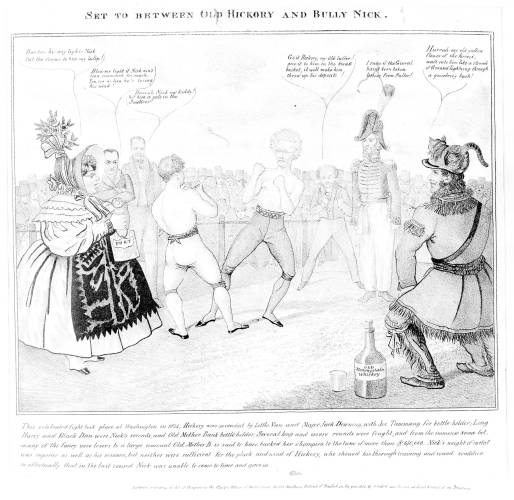
    Political Cartoon of Andrew Jackson and Nicholas Biddle. Published in Harpers Weekly in 1834.

    President Andrew Jackson did not want banknotes in the American economy, as he was an adherent to the gold standard. Daniel Walker Howe, What Hath God Wrought: Transformation of America, 1815-1848, 376. He would be forced to confront Nicholas Biddle, the President of the Second Bank of the United States.

    (more…)

  • The Second Bank of the United States

    second_bank_of_the_united_states_front
    The Second Bank of the United States. Photograph by: Beyond My Ken.

    In 1816, with James Monroe as president, Congress agreed to “charter a Second Bank for twenty years.” Daniel Walker Howe, What Hath God Wrought: Transformation of America, 1815-1848, 374.

    (more…)