Tag: Constitutional Convention

  • Constitution Sunday: On The Likely Failure Of Liberty, Robert Yates and John Lansing, Jr., to Governor George Clinton

    Constitution Sunday: On The Likely Failure Of Liberty, Robert Yates and John Lansing, Jr., to Governor George Clinton

    January 14, 1788

    Daily Advertiser (New York)

    Revising the Articles of Confederation was always going to be a difficult task. The system that the Articles erected was one where the states pulled the strings of a marionette puppet of a federal government; without the states, the federal government was nothing: for instance, although the Confederation Congress could impose a tax, it lacked any independent power of enforcement and would need unanimous approval of the state legislatures. Nonetheless, when delegates met in Philadelphia in a convention that resulted in the draft Constitution, they had originally set out to revise those Articles of Confederation, and, by amendment, to refine the existing system into a more functional, more effective government.

    (more…)
  • Constitution Sunday: Governor Samuel Huntington on the Need for Coercive National Power

    Connecticut Ratifying Convention.

    January 9, 1788

    When Connecticut’s Governor, Samuel Huntington, rose to speak at the state’s ratifying convention, he rose to second a motion by General Parsons to “assent to, ratify, and adopt the Constitution,” but in seconding the motion, Governor Huntington provided perspective and context for why he was asking the state’s delegates to ratify. To the Governor, the debate and potential ratification of the Constitution was “a new event in the history of mankind.—Heretofore, most governments have been formed by tyrants, and imposed on mankind by force.” This Constitution was being considered during a “time of peace and tranquility” and, “with calm deliberation,” the representatives were framing a novel system of government that accounted for the pitfalls that other governments had not avoided.

    (more…)
  • Constitution Sunday: “Publius,” The Federalist XXXVII [James Madison]

    “Publius,” The Federalist XXXVII [James Madison]

    Daily Advertiser (New York), January 11, 1788

    In the course of human history, there have been innumerable types of governments—all of which serve as examples for those seeking to devise their own system of government. When the Constitutional Convention gathered, there was consensus that the Articles of Confederation would no longer suffice, but it remained unclear what direction the convention should go when drafting its Constitution. James Madison, writing under the name Publius, detailed the monumental task that the convention assigned itself.

    (more…)
  • Constitution Sunday: “Publius,” The Federalist XVI

    “Publius,” The Federalist XVI [Alexander Hamilton]

    New-York Packet, December 4, 1787

    When any union or confederacy of states or provinces decide to form a nation, it does so with its citizens knowing that members may “alarm the apprehensions, inflame the passions, and conciliate the good will even” in those states that were not “chargeable with any violation, or omission of duty” but had influence to be obtained. As Alexander Hamilton wrote in the Federalist XVI, when there are associates not found “at home, recourse would be had to the aid of foreign powers, who would seldom be disinclined to encouraging the dissentions of a confederacy, from the firm Union of which they had so much to fear.” The consequences of such an event are substantial: “When the sword is once drawn, the passions of men observe no bounds of moderation. The suggestions of wounded pride, the instigations of irritated resentment, would be apt to carry the States, against which the arms of the Union were exerted to any extremes necessary to revenge the affront, or to avoid the disgrace of submission. The first war of this kind would probably terminate in a dissolution of the Union.” (more…)

  • Constitution Sunday: “Publius,” The Federalist XIV

    “Publius,” The Federalist XIV [James Madison]

    New-York Packet, November 30, 1787

    With the draft Constitution having been published for consideration by the residents of each state in 1787 came questions about whether and how the federal government would effectuate its responsibilities given the vast land that the states and territories had already comprised—which James Madison found to be framed by the Atlantic Ocean and the Mississippi River. Madison, in The Federalist XIV, articulated the reasoning behind the Constitution’s model for government, and at the heart of that reasoning was that this new form of government was not going to be a pure democracy of yore but rather a modern republic: “The true distinction” between a democracy and a republic is “that in a democracy, the people meet and exercise the government in person; in a republic they assemble and administer it by their representatives and agents. A democracy consequently will be confined to a small spot. A republic may be extended over a large region.” (more…)

  • The North’s Attempt at Salvation

    washington-dc
    Aerial Perspective of Washington DC in 1861.

    The Deep South’s animating of a Second American Revolution, by seceding from the Union and laying the foundation for an operational Confederate government, forced the North to either suppress the South’s uprising or craft a resolution. The likelihood of war would deter any widespread northern suppression, leaving the question: What compromise could the North propose that appeased the South and put both sections of the country on a path of coexistence? While variations of this question had been posed in the years leading up to 1860, at no prior point were states seceding from the Union en masse to form a rival government. (more…)

  • Constitution Sunday: Answers to Mason’s “Objections”: “Marcus” [James Iredell] I

    Answers to Mason’s “Objections”: “Marcus” [James Iredell] I

    Norfolk and Portsmouth Journal (Virginia), February 20, 1788

    Following are excerpts from James Iredell’s responses to George Mason’s “Objections” to the Constitution:

    IIId. [George Mason’s] Objection. ‘The Senate have the power of altering all money bills, and of originating appropriations of money, and the salaries of the officers of their own appointment, in conjunction with the President of the United States (more…)

  • Cap-Stone of the Great American Empire

    wilson
    James Wilson.

    The political theory that emerged from the Revolution and the debates surrounding the Constitution was not “a matter of deliberation as it was a matter of necessity.” Gordon Wood, The Creation of the American Republic: 1776-1787, 593.

    (more…)

  • Building the Bill of Rights

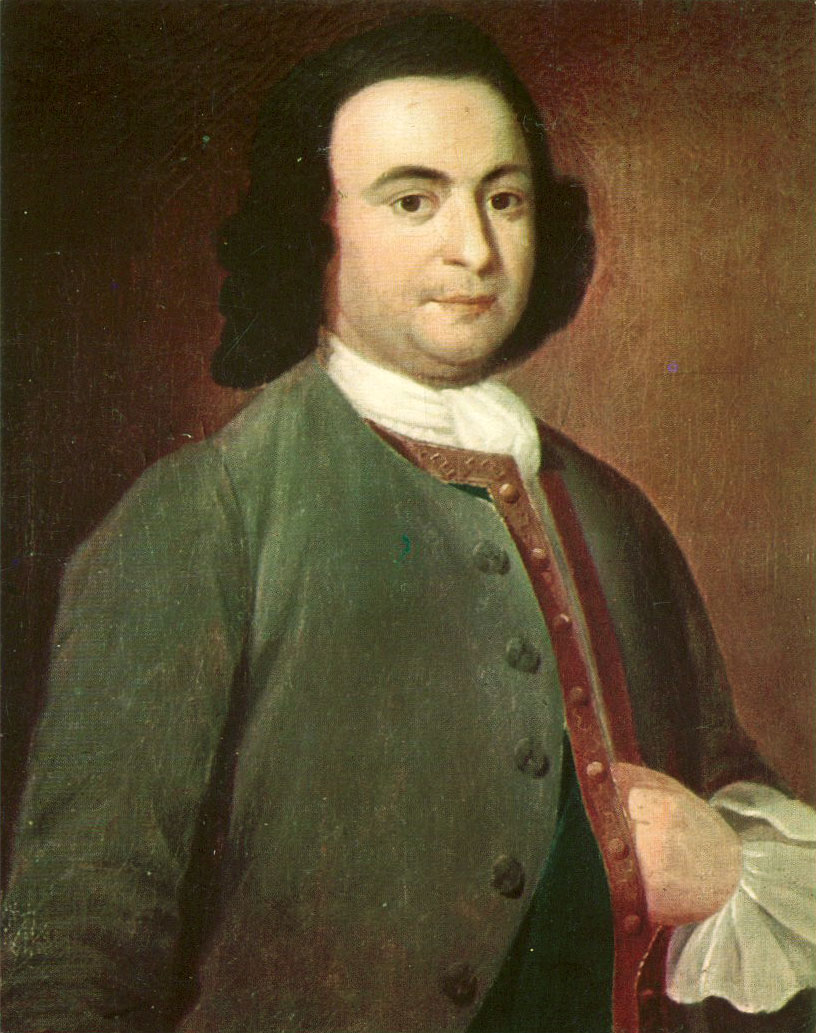
    georgemason-painting
    George Mason. By: Dominic W. Doubet.

    A bill of rights was not contemplated at the Constitutional Convention, until George Mason mentioned it in the last days of the Convention. Every state ruled it out. Rufus King, however, suggested that “as the fundamental rights of individuals are secured by express provisions in the State Constitutions; why may not a like security be provided for the Rights of the States in the National Constitution?” Gordon Wood, The Creation of the American Republic: 1776-1787, 536 quoting Farrand, ed., Records of the Federal Convention, II, 375-76, 378-79, I, 492-93.

    (more…)

  • Retention of the Supreme Power

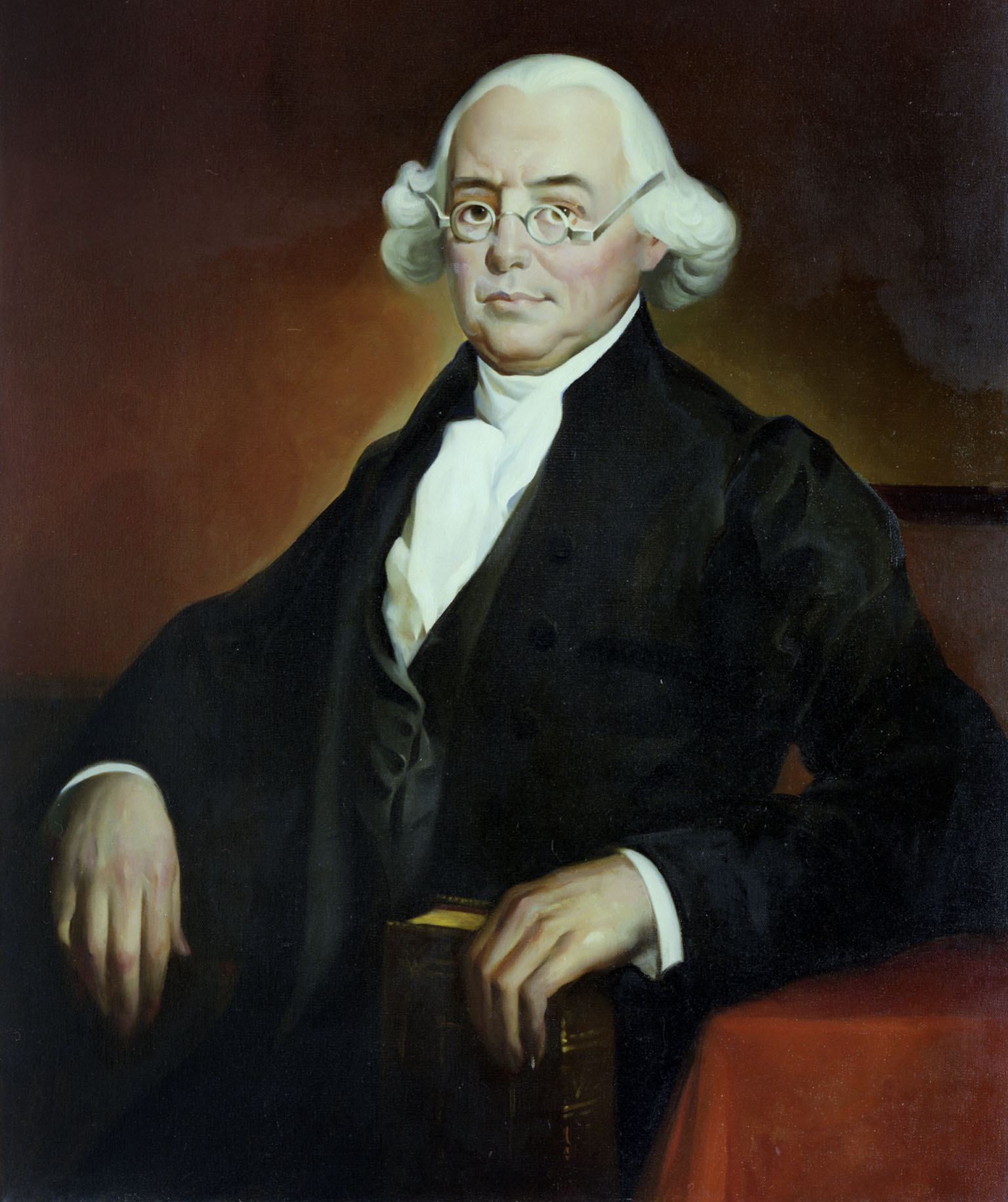
    1-2-2d4-25-explorepahistory-a0n0y8-a_349
    James Wilson, as Associate Justice of the Supreme Court. By: Robert S. Susan, after Leopold G. Seyffert, after Max Rosenthal.

    Capturing the spirit of the Declaration of Independence, the Constitution was expressing “the inherent and unalienable right of the people” to determine their system of government. Gordon Wood, The Creation of the American Republic: 1776-1787, 535 quoting Wilson, in McMaster and Stone, eds., Pennsylvania and the Federal Constitution, 317.

    (more…)