Tag: Democrats

  • Jackson’s Farewell

    78yo_andrew_jackson
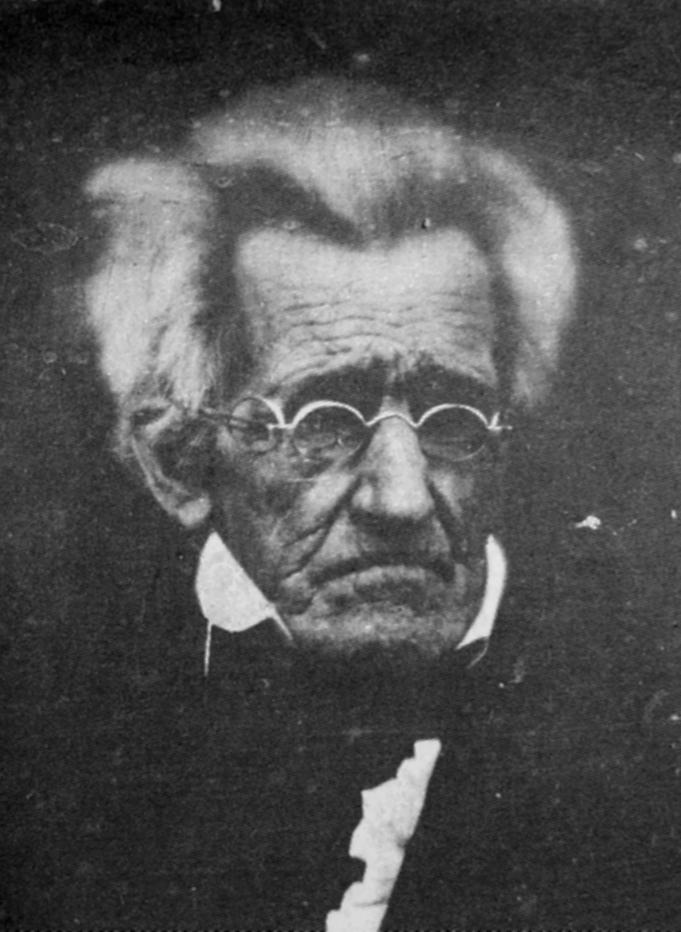
    Andrew Jackson.

    President Andrew Jackson, with his term coming to an end, commissioned the Chief Justice of the Supreme Court, Roger Taney, to write his farewell address. This was his imitation of George Washington, who had started the tradition of the farewell address. See Daniel Walker Howe, What Hath God Wrought: Transformation of America, 1815-1848, 500.

    (more…)

  • Andrew Jackson’s Third Term

    1447087312447-cached
    Martin Van Buren.

    Martin Van Buren, President Andrew Jackson’s hand-picked heir, would carry out many of Jackson’s policies, such as the removal of the Native Americans westward, as he was elected in the election of 1836. President Jackson also fundamentally changed the nature of the presidency.

    (more…)

  • The Prioritization of Education

    edward_everett
    Edward Everett.

    Education was not always such a prominent issue in every state and every American community in the way that modern Americans experience. Horace Mann, who was secretary of the Massachusetts State Board of Education in 1837, ensured that all schools would have in common: “tuition-free, tax-supported, meeting statewide standards of curriculum, textbooks, and facilities, staffed with teachers who had been trained in state normal schools, modeled on the French école normale.” Daniel Walker Howe, What Hath God Wrought: Transformation of America, 1815-1848, 453.

    (more…)

  • The Supreme Court Under Jackson

    roger_b-_taney_-_brady-handy
    Roger B. Taney. Photograph by: Mathew Brady.

    John Marshall, perhaps the greatest Chief Justice of the Supreme Court of the United States, died on July 6, 1835. As his life was coming to a close, he wrote Joseph Story, “I yield slowly and reluctantly to the conviction that our constitution cannot last.” Daniel Walker Howe, What Hath God Wrought: Transformation of America, 1815-1848, 439 quoting John Marshall to Joseph Story, Sept. 22, 1832, quoted in Kent Newmyer, John Marshall and the Heroic Age of the Supreme Court (Baton Rouge, 2001), 386.

    (more…)

  • The Aftermath of Jackson’s Bank Policies

    secondbank
    Illustration of the Second Bank of the United States.

    In the aftermath of President Andrew Jackson’s destroying the Second Bank of the United States, there were ramifications throughout the country, from top to bottom.

    (more…)

  • The Most Important Veto

    old_hickory_and_bully_nick
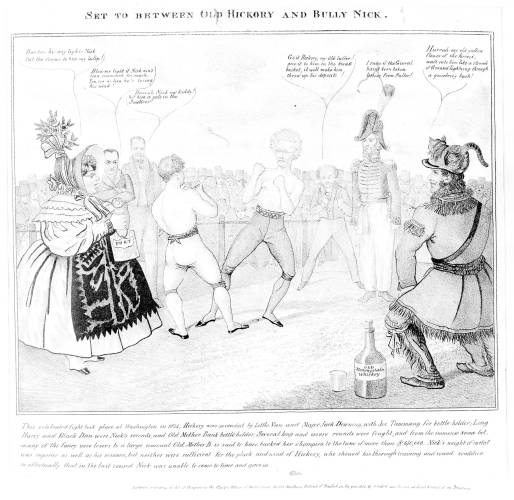
    Political Cartoon of Andrew Jackson and Nicholas Biddle. Published in Harpers Weekly in 1834.

    President Andrew Jackson did not want banknotes in the American economy, as he was an adherent to the gold standard. Daniel Walker Howe, What Hath God Wrought: Transformation of America, 1815-1848, 376. He would be forced to confront Nicholas Biddle, the President of the Second Bank of the United States.

    (more…)

  • Jackson’s Early Economic Success

    ralph_eleaser_whiteside_earl_andrew_jackson_ncmoa
    President Andrew Jackson. Circa 1830-32. By: Ralph Eleaser Whiteside Earl.

    President Andrew Jackson had good fortune as his presidency began with a wave of prosperity. See Daniel Walker Howe, What Hath God Wrought: Transformation of America, 1815-1848, 360.

    (more…)

  • Election of 1828: The Changing Politics

    stump-speaking
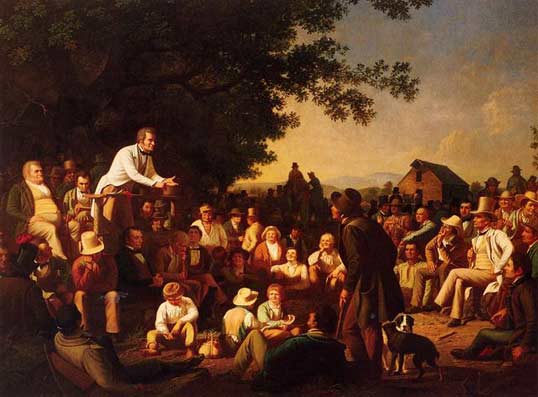
    Andrew Jackson Stump Speaking. By: George Caleb Bingham.

    Over the course of President John Quincy Adams’ term from 1824 to 1828, defenders of his administration began calling themselves National Republicans while opponents called themselves Democratic Republicans. Daniel Walker Howe, What Hath God Wrought: Transformation of America, 1815-1848, 275. The Election of 1828 served as a culmination of the changing politics of the country.

    (more…)

  • The Conception of the Democratic Party

    1824b
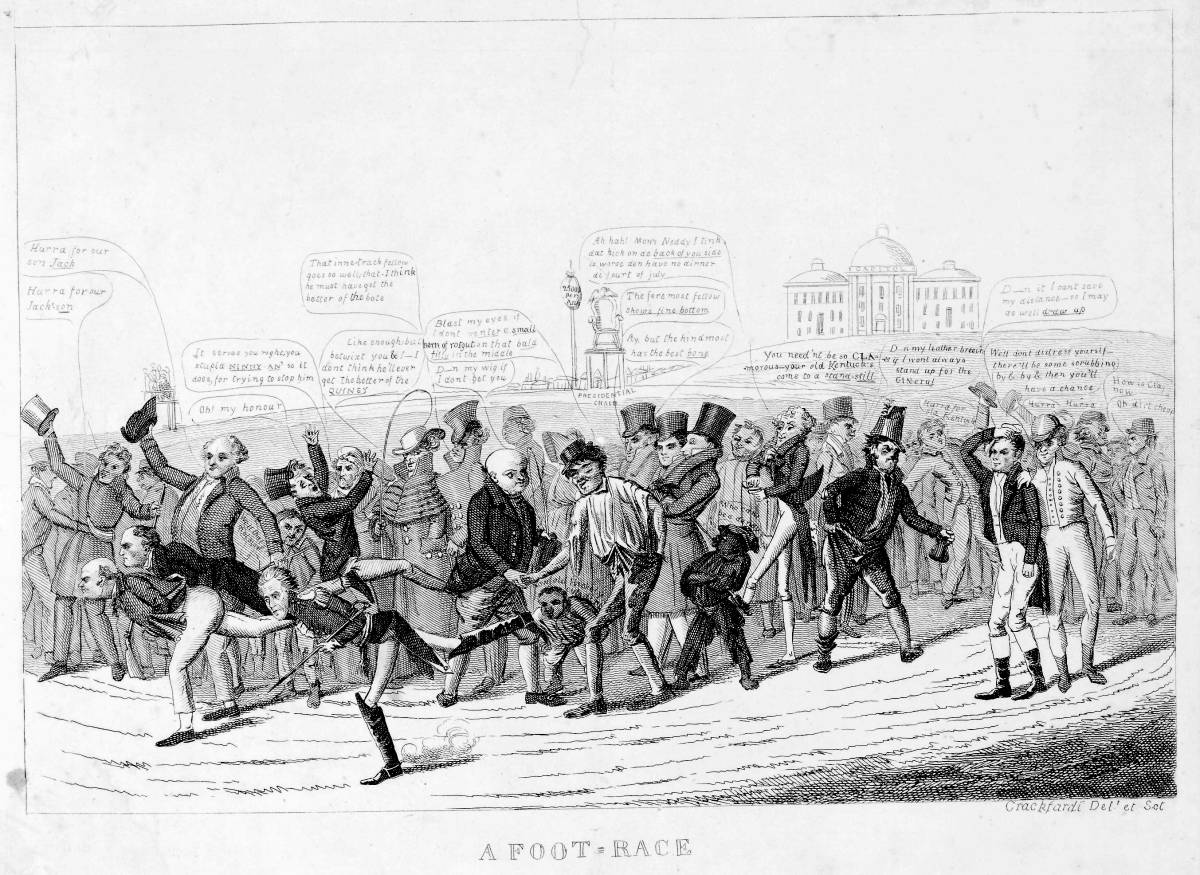
    A Foot Race. Political Cartoon of the Election of 1824.

    Following the Election of 1824, newly elected President John Quincy Adams went into the White House with a great deal of hope for the future. He was a lifelong student of Cicero and “envisioned the American republic as the culmination of the history of human progress and the realization of the potential of human nature.” Daniel Walker Howe, What Hath God Wrought: Transformation of America, 1815-1848, 245. In fact, historians have remarked that Quincy Adams was the “most learned president between [Thomas] Jefferson and [Woodrow] Wilson.” Id.

    (more…)

  • The Election of 1824

    m-9636
    William Harris Crawford.

    Not long after the election of 1820, an essentially uncontested election seeing the re-election of President James Monroe, the campaigning for the election of 1824 began. President Monroe had indicated that he would not seek an unprecedented third term as president, but that did not stop others from posturing for the election. As a journalist observed in the spring of 1822, “electioneering begins to wax hot.” Daniel Walker Howe, What Hath God Wrought: Transformation of America, 1815-1848, 203 quoting James F. Hopkins, “Election of 1824,” in History of American Presidential Elections, ed. Arthur M. Schlesinger Jr. (New York, 1985), 363.

    (more…)