Tag: Early Republic

  • The “Plebiscitarian Principle”

    U.S. Capitol. 1800.

    The president’s role in the government in the early Republic was different than today, and sometimes, it was unclear exactly what role the president would play in the federal government. With the election of 1800, the newly elected Republicans introduced the “plebiscitarian principle,” according to one scholar, Bruce Ackerman. Bruce Ackerman, The Failure of the Founding Fathers: Jefferson, Marshall, and the Rise of Presidential Democracy (Cambridge, MA, 2005), 85.

    The plebiscitarian principle was the new belief that the President of the United States owes a duty to the voters who gave him the electoral mandate to rise to the prestigious office. See id.

    Thomas Jefferson had a similar belief. See Thomas Jefferson to John Garland Jefferson, Papers of Jefferson: Retirement Ser., 2, (Jan. 25, 1810), 183. Jefferson stated that the president’s duty was “to unite in himself the confidence of the whole people” so he could “produce an union of the powers of the whole, and point them in a single direction, as if all constituted but one body & one mind.” Id.

    This principle, that the President of the United States was to owe a duty to the entire population of the country and lead them as one, helped form the presidency that we recognize today. It created a balance between the monarchical principles that the Federalists had come to admire about England and the decentralized, less powerful federal government that the Republicans had advocated for in the early Republic.

    Even as the power of the presidency has expanded, few would question that the President of the United States should only serve a portion of the population. Undoubtedly, the vast majority of Americans hold tight the belief that a president should represent the entire country and lead the entire country.

    The critical question that has existed and will always exist is what direction each president should take in leading the country. Some would argue that the reason we can have that healthy debate is because of the election of 1800 and the creation of the plebiscitarian principle.

  • The Fall of the Federalists

    Thomas Jefferson.

    The election of 1800 ushered in a new era of American politics. Thomas Jefferson won the election to become America’s third president, but also, it was a defeat for the Federalists, who had dominated politics in the first few decades of the country’s life. This was not just any defeat, however. This would mark the beginning of the end for the once powerful Federalist party.

    By this point, Gordon Wood explains in Empire of Liberty, the Federalists had come to believe that ordinary people did not have “a direct role to play in ruling the society. They were so confident that the future belonged to them, that the society would become less egalitarian and more hierarchical, that they treated the people with condescension and lost touch with them.” Gordon Wood, Empire of Liberty, 276. Wood concludes by stating that the Federalists “were so out of touch with the developing popular realities of American life . . . .” Id. Noah Webster, at the time, concluded that the Federalists had led to their own demise by resisting “the force of public opinion . . . .” David Hackett Fischer, The Revolution of American Conservatism: The Federalist Party in the Era of Jeffersonian Democracy, (New York 1965), 151-52.

    The fall of the Federalist party in the early Republic provides lessons to the modern political parties of the Republicans and the Democrats. The most obvious lesson is: Avoid public opinion at your own risk. The Federalists held onto the traditions of the monarchical republic, despite public opinion becoming increasingly more Republican-minded (the old Republican, that is).  Public opinion undoubtedly can be illogical, unreasonable, and misinformed, but the social compact that the government only is as legitimate as its people allow it to be highlights the importance of public opinion, whether it is right or wrong on any given issue.

    Looking at recent news, the resignation of Speaker of the House John Boehner, and the subsequent announcement by his presumptive replacement, Representative Kevin McCarthy, that he will not be seeking the Speaker’s chair, draws an interesting parallel between the modern Republican party and the Federalist party of centuries ago. The Republican party is currently fractured between its most conservative segment and the relatively moderate segment, both of which agree on some fundamental ideals, but the conservatives holding tightly to traditional beliefs socially, legally, and fiscally.

    Recently, some of those positions held by the most conservative political figures have begun to be behind the curve of public opinion. While this is only a segment of the Republican party, it is also a vocal, active segment that has considerable sway in the party. Most analysts agree that John Boehner’s resignation is due to that vocal, active segment of the party.

    Regardless, it is food for thought how the Republican party’s future may be shaped by its proclivity to maintain the traditional nature of the party, despite the changes in public opinion, socially and otherwise. While some have speculated the end of the Republican party may be nearing, this is unlikely barring significantly more turmoil and further clinging to traditional beliefs that have become outdated and antiquated from decades past. It is unlikely the Republicans will split, considering the party has been in existence for approximately 160 years. But it is possible.

  • The Newspaper Revolution

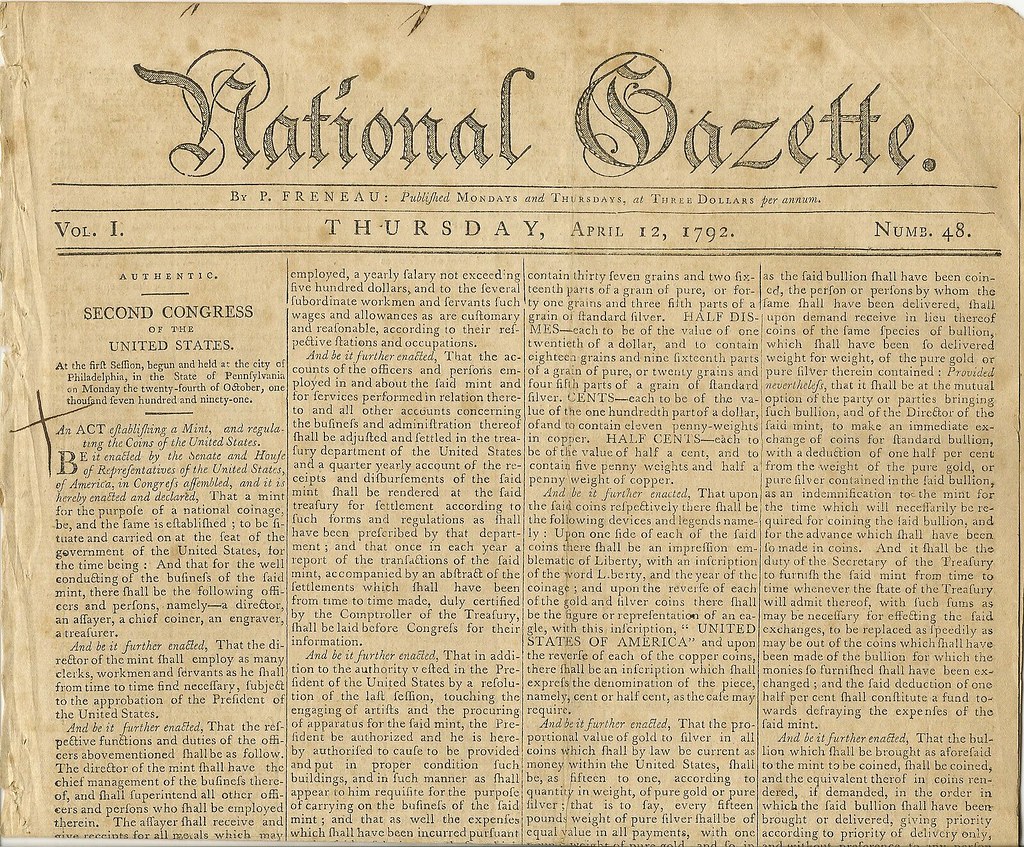
    National Gazette, April 12, 1792.

    Newspapers are a source that many turn to even now for getting their news. The craze for newspapers in America began in the early years of the Republic, with the proliferation of newspapers to nearly every town in the country.

    Then and now, newspapers had political slants. In the early Republic, most newspapers had a Federalist slant generally, but there were a set of newspapers that had a Republican perspective. Those Republican newspapers were not just delivering the news to their readers, however. Reading those newspapers became part of participating in the politics of the young Republican party. See Jeffrey L. Pasley, The Tyranny of the Printers: Newspaper Politics in the Early American Republic, (Charlottesville, 2001), 1-47.

    Experts have estimated that approximately three-quarters of Americans received newspapers in the 1790s. See Donald H. Stewart, The Opposition Press of the Federalist Period, (Albany, 1969), 13.

    The biggest difference between the readership of 1790s and present readership is that newspapers are far from the only source for news or opinion. Now, television, radio, magazines, blogs, apps, all compete for the attention of the average American, and that attention is generally spread amongst those forms of media. With that being said, there is no question that party affiliation and party participation are entirely disconnected from newspapers. However, the slants still very much exist. Just as the New York Times is known to favor Democratic-leaning readers, the Wall Street Journal is known to favor Republican-leaning readers.

    The fact that American public opinion is now shaped by so many varied forms of media is perhaps better for a healthy political discourse. It allows for wide dispersal of information throughout the country, but public opinion is likely more scattered now than the early Republic. In the early Republic, each town’s newspaper would be the one reliable source for information about what was happening in the town, the state, the country, and the world, both politically and otherwise.

    While it is difficult to quantify the effect of the diversification of media in American news, there is no question it has changed how Americans learn events, view the world around them, and participate in politics.

  • The American Fear?

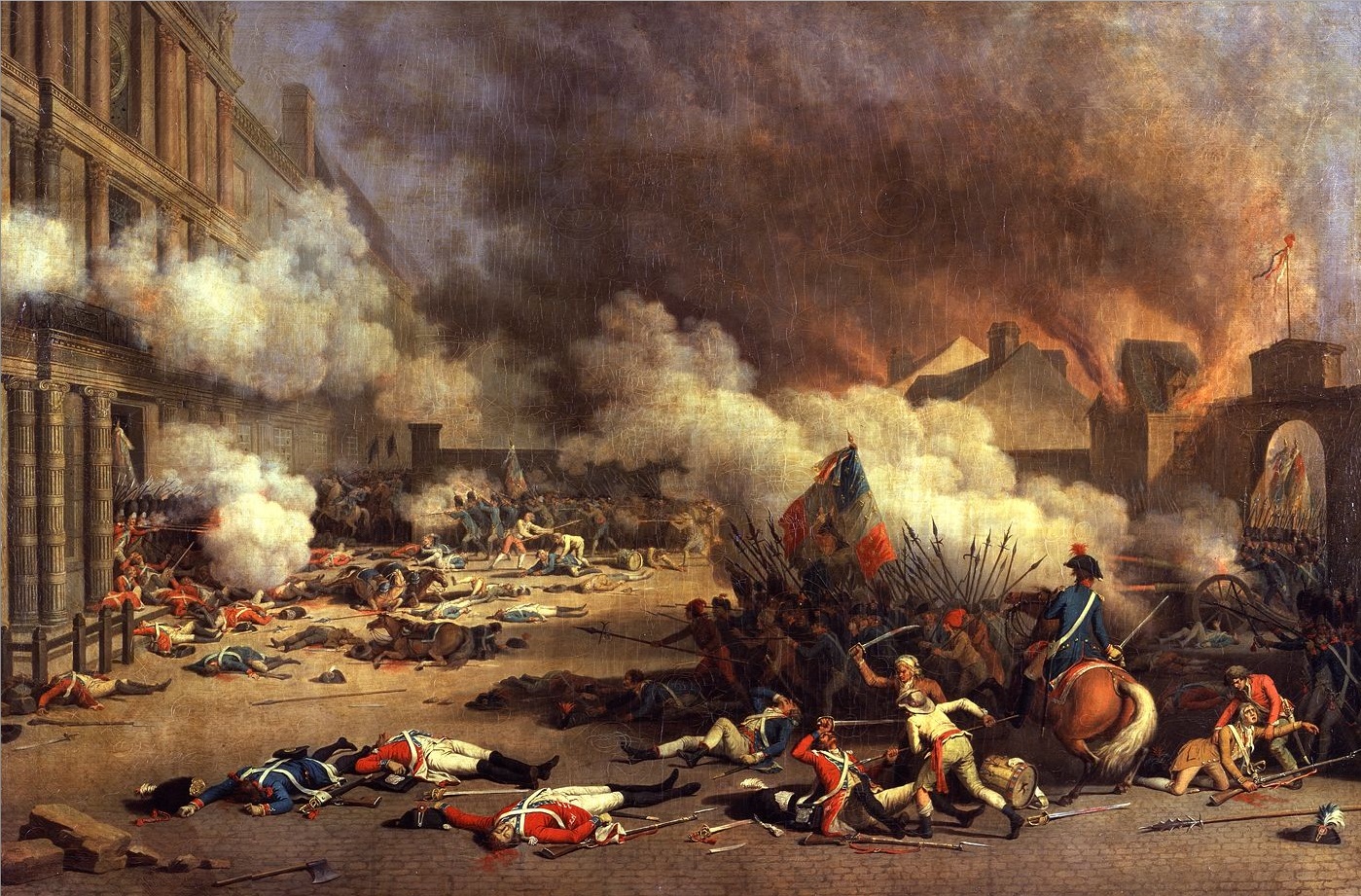
    Prise du Palais des Tuileries. By: Jacques Bertaux.

    Jedidiah Morse, an author and Congregational minister in the United States, spread a rumor that the French Revolution was part of an international conspiracy to both eliminate Christianity and civil government altogether. See Gordon S. Wood, Empire of Liberty, 244. Morse explained his theory that the French were infiltrating the Republican party “to subvert America’s government and religion.” Id.

    Gordon Wood explains in Empire of Liberty that Morse’s conspiracy theories “were believed by a large number of distinguished and learned American clergymen, including Timothy Dwight, president of Yale College, and David Tappan, Hollis Professor of Divinity at Harvard.” Id.

    If those types of fears sound familiar, it is because some individuals in modern American society have similar views about various groups and movements all over the world.

    But why? Why do prominent figures in religion have so much sway within the church and throughout the country in convincing others to believe their conspiracy theories?

    It could be engrained in the American psyche. Americans have valued freedom of religion since the earliest of the days of the Republic. It could also be a common tactic for changing the public opinion about a particular development within the country or internationally.

    Whatever the case may be, it is one example of the notable parallels existing between modern America and the early Republic. It does not require a vivid imagination to imagine hearing words similar to Morse’s in modern day media. For some, that may be troubling, but it should serve as a reminder that some of the most common collective fears in the United States are the most predictable, most repeated, and perhaps most easily disproven.

  • The Somewhat Representative Democracy

    Federal Hall, New York City. The seat of the federal government in 1790.

    William Findley, a man of Irish descent who came to play a powerful role in Pennsylvanian politics, had an idea about what a politician should be. He said that politicians should be able to advocate for their own cause when they take the floor, that politicians should openly support their interests. Gordon Wood, Empire of Liberty, 221. As Gordon Wood explained in Empire of Liberty, this idea challenged “the entire classical tradition of disinterested public leadership and set[] forth a rationale for a competitive interest-laden politics . . . .” id.

    James Madison, in Federalist No. 10, feared such a thing: that politicians may be deciding issues that directly affect their interests.

    Nonetheless, the American system has undoubtedly embraced such a principle. Politicians, perhaps now more than ever, are influenced by their own interests, which are shaped by various donations, gifts, and promises of future favors.

    There is a significant question underlying all of this: Did the Founding Fathers contemplate that a representative democracy could transform itself into a system where the politicians are only representative of their constituencies to the extent those constituencies benefit from the donations, gifts, and promises of future favors?

    Some may argue that the representative nature of the republic was and still is affected by this system. Politicians are elected based on their promises of what they will do for others, but when in office, perhaps their self-interests are the only ones that matter. Then, to the extent those self-interests align with their constituency, their record serves as a platform for re-elections.

    Perhaps it is simply too idealistic to expect politicians to put their self-interests aside and govern with an even hand, representing the best interests of their constituents, not themselves. Regardless, there appears to be no question that Findley’s ideal politician has become the norm for politicians.

    Had Madison known what would happen to politicians, he may not have been surprised, but he would have been disappointed.

  • Economic Sanctions

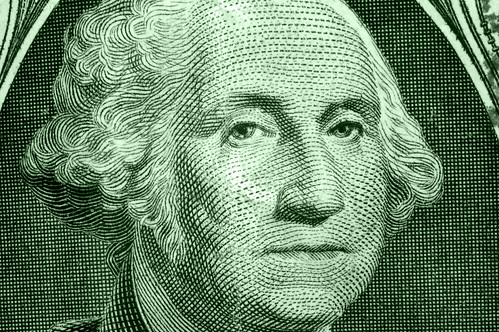
    George Washington, as portrayed on the $1 note.

    Washington’s writings are replete with revelations about the hopes and aspirations for the country. Often, it is common for modern Americans to think that the Founding Fathers, despite all of their wisdom, could hardly imagine what the United States would become. For instance, now, the world is interconnected in a way as never before. One may be tempted to posit that the world has become a more complicated place, and our recent leaders have created new tactics to deal with geopolitical issues. One such tactic that one may imagine is newly created is the use of economic sanctions.

    In fact, the Founding Fathers not only contemplated the use of economic sanctions, but sought for the implementation of sanctions in lieu of going to war. In George Washington’s letter to Lafayette, dated August 15, 1786, he noted “the probable influence that commerce may hereafter have on human manners and society in general,” hoping that it could lead to the demise of “the devastation and horrors of war.” Fitzpatrick, ed., Writings of Washington, 28: 520. Nor was Washington alone in this belief. Far from it.

    Thomas Jefferson and James Madison had consistently hoped for the same, aspiring for the day where American sanctions would divert wars but preserve American interests. Gordon S. Wood, Empire of Liberty, (New York, 2009), 138.

    As is clear from modern history, economic sanctions have shown their utility, whether they be imposed for ideological differences, such as against Russia and former Soviet Union countries or imposed to discourage nuclear development and proliferation, such as against Iran. The use of economic sanctions is of course premised on America having a fundamental role in the world economy, which has certainly been the case in the last century and continuing until now.

    Presently, the United States accounts for 23% of global gross domestic product and 12% of merchandise trade. The Economist, Vol. 417, No. 8958 (October 3, 2015). Having such a significant role in the world economy gives the United States the “soft power” of influencing other countries to act in accordance with America’s best interests, without America committing significant resources.

    The Founding Fathers, in their wisdom and their grand hopes for the United States, hoped to see this day, where the sheer size and power of the economy would force others to bend to American interests. Their imagined use, or the threat of use, of economic sanctions has come to fruition. Just another instance of the prescience of the Founding Fathers.

  • Political Parties

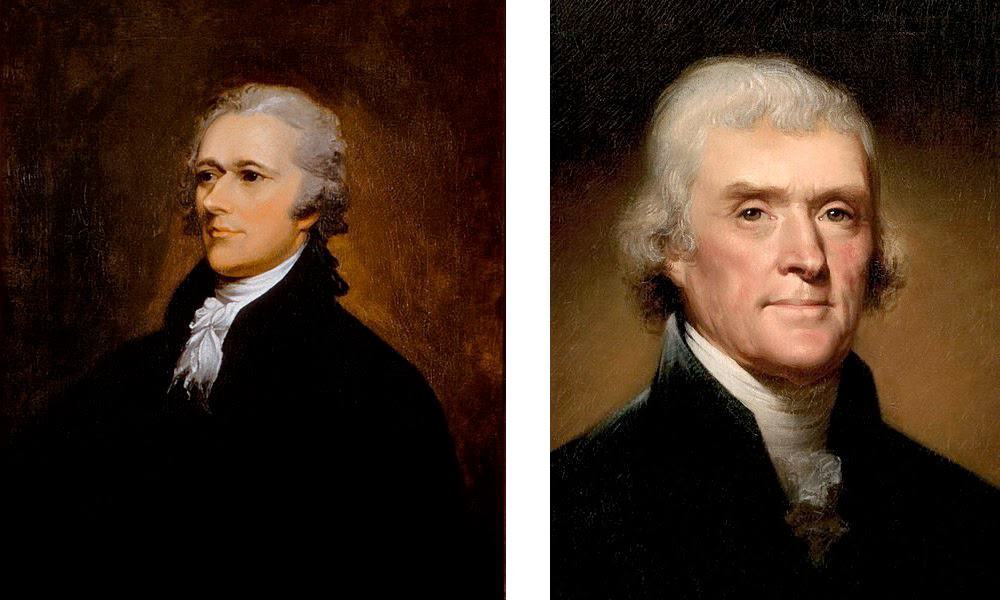
    Alexander Hamilton, L. Thomas Jefferson, R.

    Alexander Hamilton and Thomas Jefferson had a contentious relationship, from their time serving as Secretaries in Washington’s administration forward. That contentious relationship manifested itself, at least partially, in the fact that they had crucial ideological differences. At first, those ideological differences were not reflected by different memberships in political parties. During the time they were Secretaries in Washington’s administration, there were no political parties.

    When the two political parties, the Federalists and the Republicans, were created, Hamilton and Jefferson both had overblown ideas of what would each other’s party intended. Jefferson feared that Hamilton wished to implement a monarchy, and Hamilton feared that Jefferson intended to overthrow the government of the United States. As a general matter, the Federalist government feared that any Republicans or individuals with different views were determined to undermine the existence of the government and determined to bring an end to the system that the majority of Americans had worked so hard to create.

    In fact, however, the Republican party did not see itself as a political party, and the Federalists did not view themselves as members of a political party in those early years. For example, the Federalists saw themselves as the vast majority of people who were concerned about the state of the country. Those in the Republican party ultimately began making Democratic-Republican Societies throughout the country, which demanded changes from the status quo of the predominantly Federalist government.

    What a change the political party system has undergone since the late 1790s. Many would attribute the success of America’s political system to the fact that two main parties, now the Democrats and Republicans, have consistently vied against each other, generally agreeing to move the country forward by meeting in the middle. As Hamilton and Jefferson exaggerated the intentions and beliefs of the opposing party, modern Democrats and Republicans tend to do the same, at least to an extent.

    That healthy debate between two adversaries has sustained not only the court system from ancient days to modern days but also the American system of politics. An adversarial contest between two parties prevents a cacophony of voices that tend to overwhelm multi-party political systems. Rather, it places two parties against each other, creating competition, encouraging debate, and having the net effect of putting the country on a moderate path, with gradual changes coming over the course of decades. Perhaps that gradual, conservative nature of progress has been the cause of America’s prolonged success.

  • East Versus West?

    Pittsburgh, Pennsylvania – Late 1700s, Early 1800s.

    In 1790, President Washington implemented an excise tax on spirits distilled within the United States. A bold move for the Federalists, who were seeking to create a more assertive, more organized, more cohesive federal government. The maverick states did not take kindly to it, nor did the citizens affected by this newly created tax.

    What was their reaction? Seek secession. The Federalists, including Washington and his Secretary of State, Alexander Hamilton, had a dilemma on their hands. The federal government needed legitimacy, but it also needed to maintain the peace amongst the ever-expanding states and their differing populations. It seems to be forgotten in modern discourse that there were more fractures in American history than just North versus South in the Civil War era. In the early 1790s, the fracture split East between West, as the Eastern aristocrats and monied individuals sought to impose taxes and other restrictions on the Western settlers.

    Washington and Alexander had differing views. Hamilton advocated for an immediate use of force by a militia, while Washington sent a peace commission, hoping to resolve the rebellion in the West without force. Ultimately, the peace commission failed, and a force of 15,000 men quelled the rebellion with only a few arrests and presidential pardons of those convicted of treason. John C. Miller, The Federalist Era, (New York, 1960), 158; Gordon S. Wood, Empire of Liberty, (New York, 2009), 138.

    Ultimately, the rebellion, now known as the Whiskey Rebellion, was perhaps the first test of the federal government’s role. The states had become accustomed to policing themselves, free of interference, and Washington’s action of assembling a militia and sending the militia to Western Pennsylvania set the clear, stern tone of the federal government.

    It is tempting to speculate what could have happened had Washington not taken such decisive action to quell the rebellion. Would there have been a secession? Was the Western economy sufficient to sustain itself? Would it have led to a first Civil War, only to be followed by a second? Less dramatically, would not taking decisive action have led to a weak federal government, similar to the one that prompted the drafting and adoption of the Constitution in the first place?

    Setting aside the potentials and the speculation, the Whiskey Rebellion foreshadowed the problems to come for the United States and set the stage for the role of the federal government. Even now, Americans debate how involved the federal government should be in the individual affairs of states, but by setting an early example, Washington and Hamilton made it more likely than not that the federal government would take decisive action when necessary to protect the health and wellbeing of the Union.

  • Seeds of Success

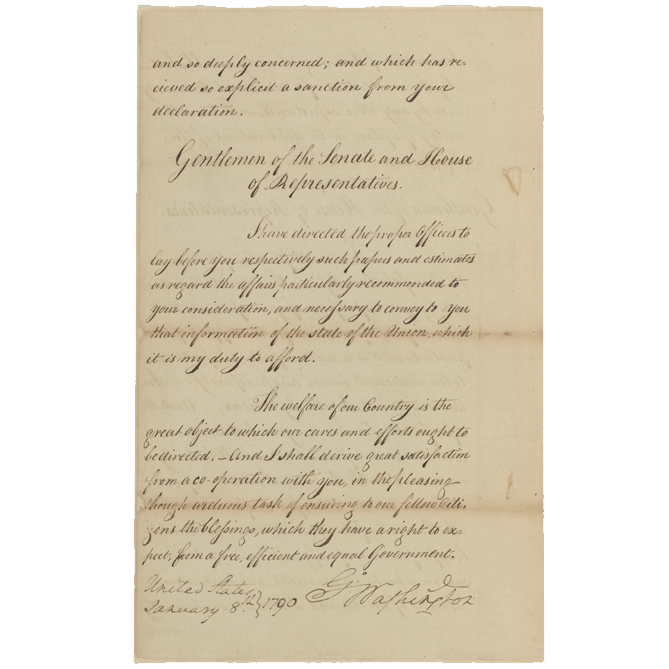
    George Washington’s First Annual Message to Congress. January 8, 1790.

    In George Washington’s First Annual Message to Congress, he looked beyond the largely then-agricultural states and expressed his aspiration that the United States would be self-sufficient for its agricultural, manufacturing, and military needs. At the time, this was a Federalist-backed belief, so that the United States could become a rival to the powers of Europe.

    But it planted the seeds for the transformation of America. Then-Secretary of Treasury Alexander Hamilton took Washington’s message to heart, drawing up the Report on the Subject of Manufactures on December 5, 1791. In his report, Hamilton recognized that the building of the American powerhouse economy would take “three or four decades,” but he sketched out the basic economic keys to enabling the transformation to occur. For example, Hamilton explained the necessity of establishing banks, a national mint, and a uniform, paper currency.

    These actions by Hamilton and Washington planted the seeds for the United States to take full advantage of the Industrial Revolution’s seismic changes, which of course would place the United States among the leading nations in the world. Considering what was to come in the next three to four decades, and the two centuries since then, Hamilton and Washington have shown their wisdom and vision for the country.

    Looking more broadly at American history, it is difficult to identify a more pivotal moment in setting the trajectory for the country. The gravity of policy decisions seldom have the long term consequences that the early decisions of the first presidents had. One could speculate that the Americans’ preparedness for the Spanish American War, World War I, and World War II was bolstered by Washington’s and Hamilton’s idea to transition the economy from a largely agricultural society to a manufacturing, military-focused society.

    Regardless, it does not require speculation to conclude that we are certainly the beneficiaries of their wisdom.

  • The Monarchical Republic

    George Washington. By: Gilbert Stuart.

    At the time of George Washington’s presidency, the role, image, and traditions surrounding the executive office was unclear. It was a new concept entirely, particularly in light of the numerous, well-established monarchies of Europe. In fact, during this time, Poland had an elected monarchy.

    For clarity as to the role of the president, many Americans looked to the monarchs of Europe, demanding that the presidency must carry with it a level of regality, tradition, and pomp that was intended to invoke honor and dignity. However much Americans wished to dispose of the monarchical system and replace it with a republic, Americans had little guidance outside of Europe for how a leader should conduct himself or herself.

    Many of the traditions first established during Washington’s presidency, such as formal dinners with the powder-haired president where no individual was permitted to speak, have fallen by the wayside in the past two centuries. This is despite the power of the president consistently growing since the days of Washington. However, it seems that Americans now would not tolerate a stiff, overly dignified president who appears to be far superior to the common person. Why is that? Perhaps it’s American pragmatism? Or a collective fear of having a Messianic leader?

    Probably a little bit of both. Underlying much of the American sentiment, now and then, is the fear that the republic will slowly become either an empire or a kingdom, in the way that Rome did. These fears underlie the American pragmatism and create a collective feeling that any person with too much power, and any government with too much power, is undesirable.

    It is safe to say that Americans have always been keen to avoid both the English and Roman ways of declining in power. Avoiding monarchy, while still flirting with its decorum, characterized the early years of the American republic. Now, it is all but forgotten.