
In the early 1800s, America was expanding in many ways. Part of that expansion was the education of Americans both in the classroom and otherwise.
In the early 1800s, America was expanding in many ways. Part of that expansion was the education of Americans both in the classroom and otherwise.

Education was not always such a prominent issue in every state and every American community in the way that modern Americans experience. Horace Mann, who was secretary of the Massachusetts State Board of Education in 1837, ensured that all schools would have in common: “tuition-free, tax-supported, meeting statewide standards of curriculum, textbooks, and facilities, staffed with teachers who had been trained in state normal schools, modeled on the French école normale.” Daniel Walker Howe, What Hath God Wrought: Transformation of America, 1815-1848, 453.
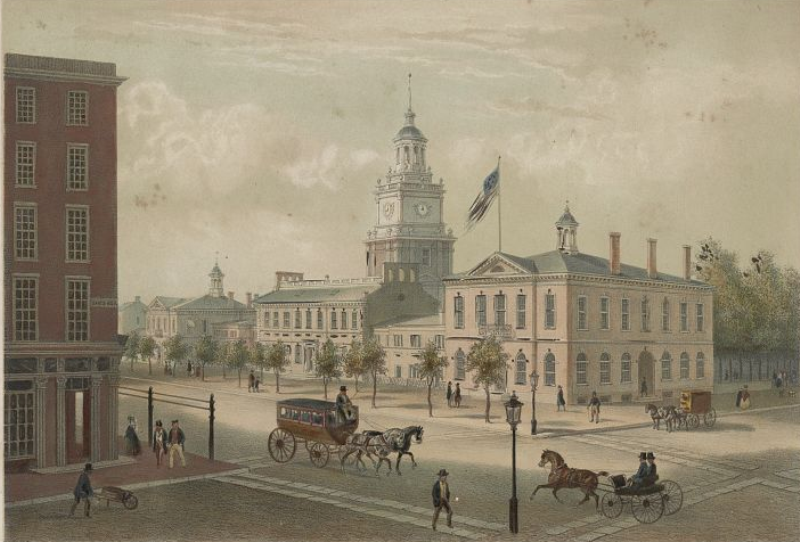
Throughout the development of early civil society in America, the familiar infrastructure to contemporary Americans rapidly developed. For example, as a result of new postal roads and turnpikes throughout the country, the postal system was able to achieve remarkable speeds for the time. For example, in 1790, “it had taken more than a month for news to travel from Pittsburgh to Philadelphia . . . .” Gordon Wood, Empire of Liberty, 479. Just four years later, the time was reduced to ten days. Id.
This improvement in the postal system would have a resulting effect on the proliferation of newspapers throughout America. Congress’s Post Office Act of 1792 ensured low rates for the mailing of newspapers, by virtue of letter-writers effectively subsidizing the postage for newspapers. Id.
This proliferation of newspapers created a widespread access to information, from small towns to big cities, and it did so rather quickly. For example, “[i]n 1800 the postal system transmitted 1.9 million newspapers a year; by 1820 it was transmitting 6 million a year.” Id. citing Richard R. John, Spreading the News: The American Postal System from Franklin to Morse (Cambridge, MA, 1995), 36-42.
Newspapers became an American obsession. During George Washington’s presidency, the entire country had 92 newspapers, but by 1810, there were sales in excess of 22 million copies of 376 newspapers annually, the “largest aggregate circulation of newspapers of any country in the world.” Gordon Wood, Empire of Liberty, 479 citing Alfred M. Lee, The Daily Newspaper in America (New York, 1937), 715-17; Frank Luther Mott, American Journalism: A History of American Newspapers in the United States Through 250 Years, 1690-1940 (New York, 1941), 159, 167; Merle Curti, The Growth of American Thought, 3rd ed. (New York, 1964), 209; Donald H. Stewart, The Opposition Press of the Federalist Period (Albany, 1969), 15, 624.
The fear that many of the Founding Fathers held that Americans would become as ignorant as their English counterparts, leading to all of the plaguing problems of government and society that ignorance brings, quickly proved to be an unfounded fear. Americans had a thirst for knowledge and were eager to get access to the crucial medium of the newspaper.
This thirst for knowledge has continued to today. As discussed in The Newspaper Revolution, Americans now enjoy the privilege of accessing many forms of media, all of which contain a volume of information that cannot all be feasibly read and understood. Setting aside the allegations of bias that many have about modern media, which surely has always permeated media to varying extents, this access to knowledge is undoubtedly crucial for the continuation of the Republic and the health of the democracy of America.
It allows any individual to learn what is happening in the world and to adopt positions regarding both domestic and foreign policy, which presumably will lead to a more informed decision in elections and more active participation in politics and discourse of issues.
The thirst of the early Americans for knowledge and information about what was happening in the world, combined with the early government’s understanding that a robust infrastructure was necessary for the dissemination of information (and travel), allowed for the development of the society we recognize today. As is clear from modern society, Americans are certainly obsessed with media, whether they enjoy it, attack it, or just simply listen to it.
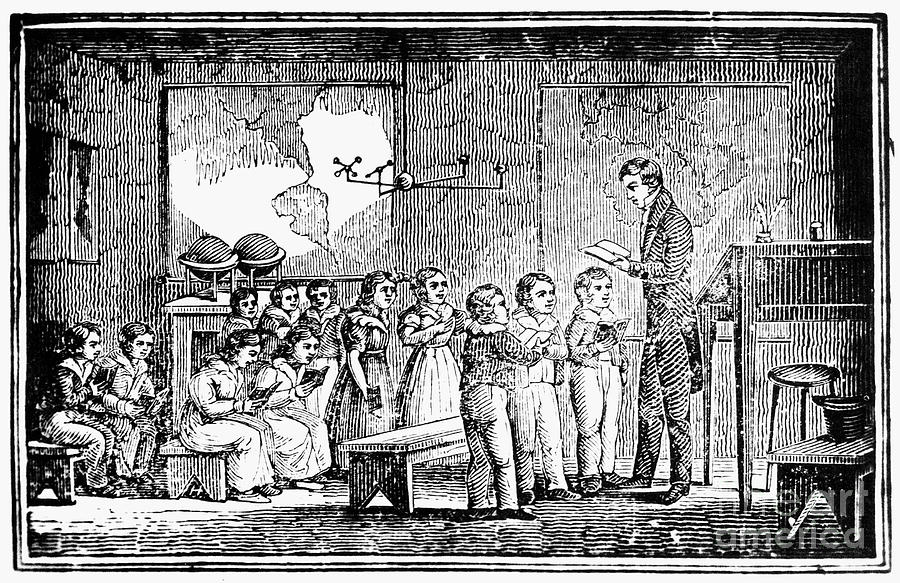
The early Republic were the years where American civil society was developing its own distinctive character. One component of that civil society was the newly created educational institutions, which many early Americans viewed as one of the safeguards against the dangerous ignorance that was supposed to allow a monarchy to continue.
For example, Simeon Doggett stated in Discourse on Education “that the mode of government in any nation will always be moulded by the state of education. The throne of tyranny is founded on ignorance. Literature and liberty go hand in hand.” Simeon Doggett, Discourse on Education (1797), in Frederick Rudolph, ed., Essays on Education in the Early Republic (Cambridge, MA, 1965), 155-56.
These ideals were captured in Massachusetts’ constitution: “Wisdom and knowledge, as well as virtue diffused generally among the people . . . [are] necessary for the preservation of their rights and liberties.”
Thomas Jefferson was also a proponent of these ideals, and he developed a plan for the education system in Virginia in the 1779 Bill for the More General Diffusion of Knowledge. In this bill, he proposed a “three-tiered pyramid of local education. At the base would be three years of free elementary schools for all white children, boys and girls. The next level offered twenty regional academies with free tuition for selected boys . . . Finally, the state would support the best ten needy academic students at the university level, the aristocracy of talent that he described as ‘the most precious gift of nature.’” Gordon Wood, Empire of Liberty, 473 quoting Dumas Malone, Jefferson the Virginian (Boston, 1948), 282-83.
While Jefferson’s system, and other similar systems dreamed up by intellectuals, ultimately were not implemented in their imagined forms, it set the groundwork for the familiar system we know today to be created in the late 1800s. See Daniel Walker Howe, Church, State, and Education in the Young American Republic, JER, 22 (2002), 1-24.
The early Republicans imagined a universal education system throughout the country that would provide high quality education but notably only for white children. This backward thinking unfortunately characterized many of the early Americans, who had no regard for minorities. Despite that shortcoming, many of the Republicans’ dreams for the educational system in the country came to fruition.
While the American education system has come under intense scrutiny and questioned for its position in the world, the early ideals of having an informed, educated population raised from a young age has generally come true. Most importantly, it may be debatable, but most would agree that the widespread ignorance that permitted tyranny in the late 1700s has all but disappeared.
 Last Best Hope of Earth