
In celebrating America’s first centennial, on July 4, 1876, one must have recalled the tumult of that century: a war to secure independence, a second war to defend newly-obtained independence, and then a civil war the consequences of which the country was still grappling with eleven years after its end. But there also had been extraordinary success in that century, albeit not without cost; by the 100-year mark, the country had shown itself and the world that its Constitution—that centerpiece of democracy—was holding strong (with 18 Presidents, 44 Congresses, and 43 Supreme Court justices already having served their government by that time), and the country had expanded several times over in geographic size, putting it in command of a wealth of resources as its cities, industries, and agriculture prospered. Several months after the centennial celebration was the next presidential election, and during the life of the country, while most elections had gone smoothly, some had not—the elections of 1800 and 1824 were resolved by the House of Representatives choosing the victor as no candidate secured a majority of Electoral College votes and the election of 1860 was soon followed by the secession of Southern states. And yet, even with those anomalous elections in view, the upcoming election of 1876 was to become one unlike any other in American history.
(more…)Tag: Electoral College
-
Election of 1844: Polk Prevails
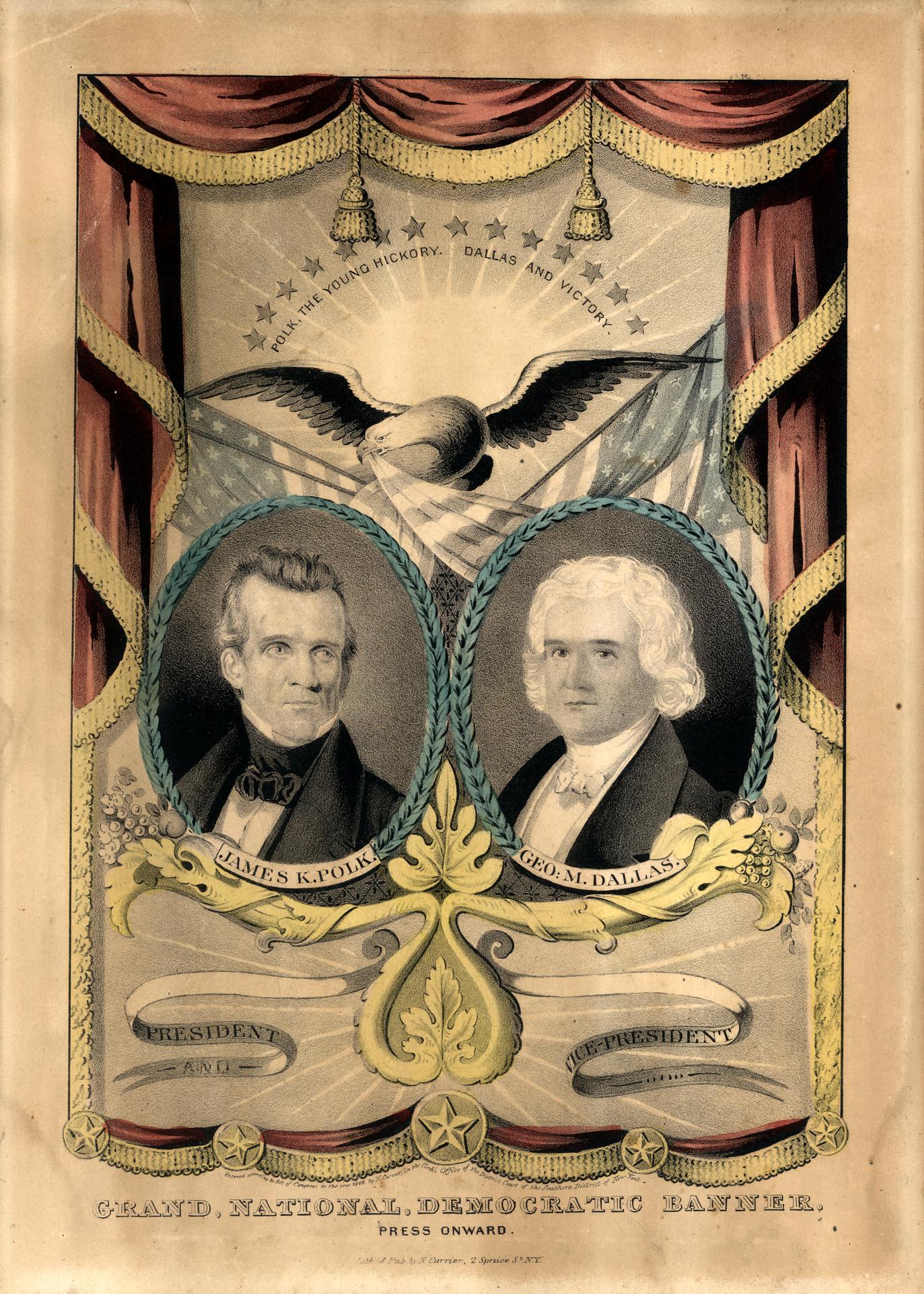
Campaign Banner for James Polk and George Dallas. Throughout the first twelve days of November of 1844, the population voted for the next president. Voters had to pick between the Democrat, James Polk, the Whig, Henry Clay, and the Liberty Party’s candidate, James Birney. See Daniel Walker Howe, What Hath God Wrought: Transformation of America, 1815-1848, 688.
-
Election of 1828: The Changing Politics

Andrew Jackson Stump Speaking. By: George Caleb Bingham. Over the course of President John Quincy Adams’ term from 1824 to 1828, defenders of his administration began calling themselves National Republicans while opponents called themselves Democratic Republicans. Daniel Walker Howe, What Hath God Wrought: Transformation of America, 1815-1848, 275. The Election of 1828 served as a culmination of the changing politics of the country.
 Last Best Hope of Earth