Prior to the American Revolution, the colonists had become familiar with the concept of charters. Charters, whether royal, corporate, or proprietary, operated “as the evidence of a compact between an English King and the American subjects.” Gordon Wood, The Creation of the American Republic: 1776-1787, 268; see also Leonard Krieger, The Politics of Discretion: Pufendorf and the Acceptance of Natural Law (Chicago, 1965), 121.
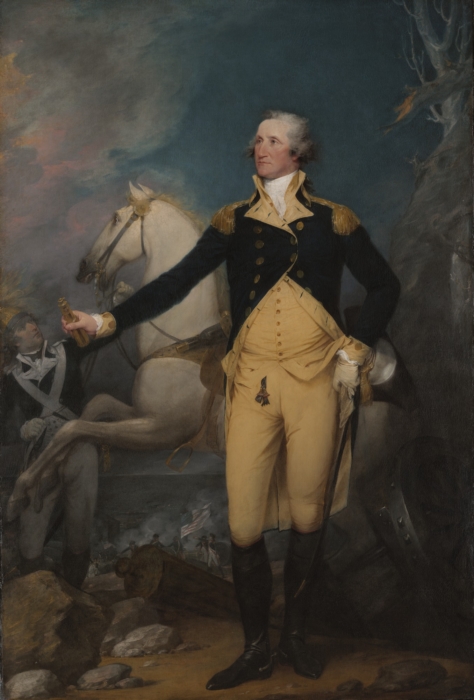
General George Washington at Trenton. By: John Trumbull.
Corruption was rife in England in the decades leading up to the American Revolution, and Americans were keenly aware of that fact. For many individuals, the English Constitution was viewed as a hollow document, as the crown had taken the power away from all other sources. See Gordon Wood, The Creation of the American Republic: 1776-1787, 34-35. Americans knew that this corruption “always begins amongst the Rich and the Great” and would spread to the common people, leaving them “enfeebled and their souls depraved.” Id. at 35 quoting Pinkney’s Wmsbg. Va. Gazette, June 15, 1775; Phila. Pa. Packet, May 29, 1775, Aug. 8, 1774; Purdie and Dixon’s Wmsbg. Va. Gazette, Sept. 5, 1771. (more…)
Involvement in government is crucial to the success of government as a whole. During the American Revolution, it was clear that participation in the political process would continue to be valued. Since those years, much has changed.
Thomas Paine’s Common Sense was a hugely influential pamphlet that has been cherished by several generations of Americans. However, it had its detractors who did not believe that “republicanism for America was a matter of common sense.” Gordon Wood, The Creation of the American Republic: 1776-1787, 94.
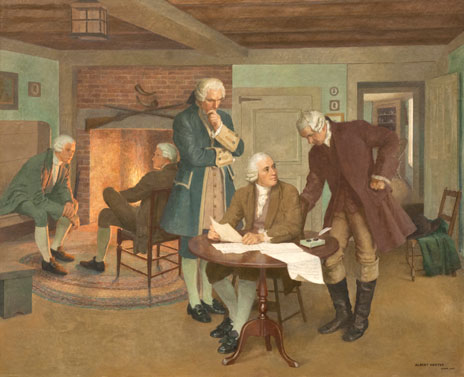
John Adams, Samuel Adams, and James Bowdoin Drafting the Massachusetts Constitution of 1780. By: Albert Herter.
As the colonies went through the Revolution, it became clear that republicanism would take the place of English imperialism. Americans were aware that republicanism put “social and moral demands” upon the people, which would change how people lived. Gordon Wood, The Creation of the American Republic: 1776-1787, 91.
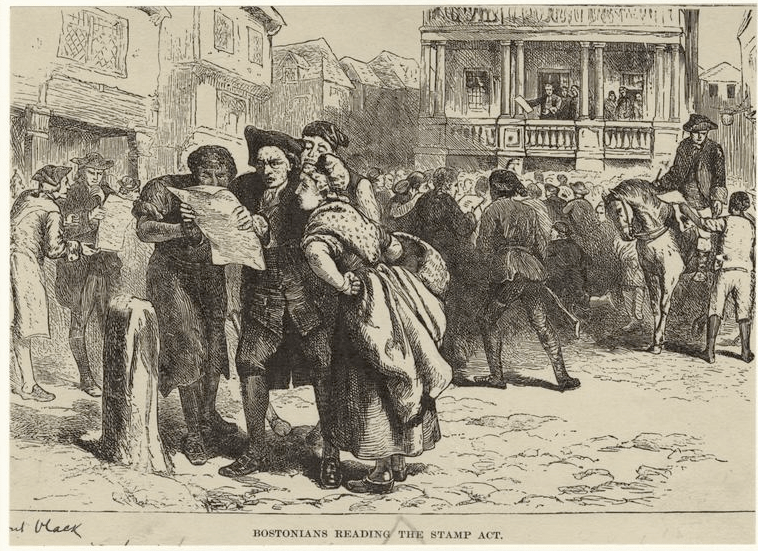
Depiction of Bostonians Reading the Stamp Act of 1765. Courtesy of New York Public Library Digital Image Gallery.
While one could find numerous causes of the American Revolution, perhaps none was a more proximate cause than the Stamp Act of 1765. The Stamp Act was the English Parliament’s taxation on every American’s use of paper, and this was perhaps the greatest manifestation of the idea of virtual representation.
The Peale Family, 1771-1773. By: Charles Willson Peale.
In the 1760s and 1770s, Americans had a complicated relationship with the English constitution. The English constitution was both a model for government, in some respects, and the strongest wedge being driven between the colonists and the English.
In the months leading up to the Declaration of Independence, the states began the process of adopting their own constitutions. These constitutions, being drafted in 1776, approximately 13 years before the United States Constitution would be ratified, had to confront many of the same issues as the United States Constitution, with various approaches being taken. (more…)
There are myriad examples of individuals coming to the United States to enjoy extraordinary success. Some have come to call that the “American Dream.” Perhaps nobody better embodies the American Dream than Thomas Paine, the famous pamphleteer of the late 1700s. (more…)
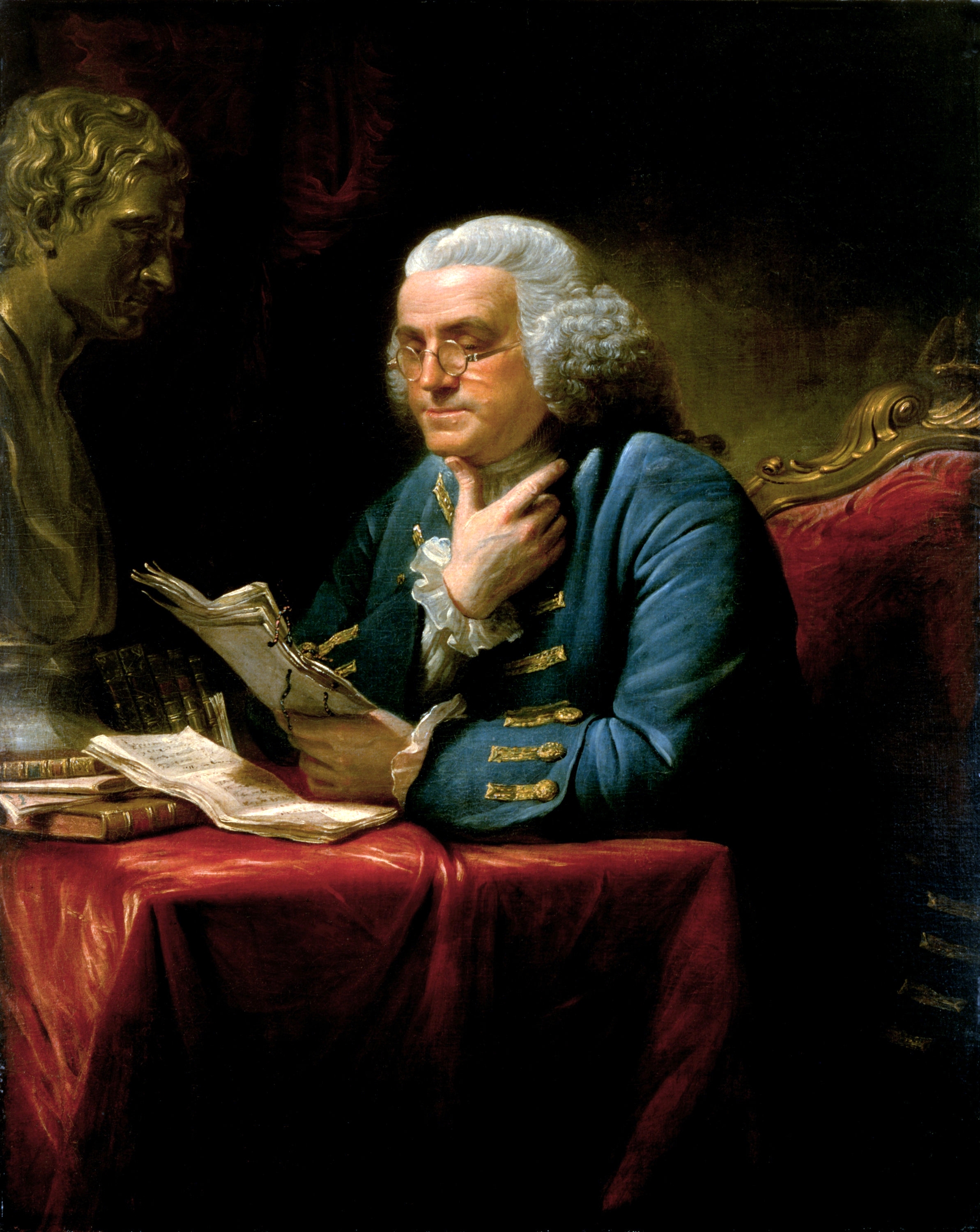
Benjamin Franklin, depicted in London in 1767. By: David Martin.
Benjamin Franklin, one of the most well-known and most revered Founding Fathers, had a more controversial history than most modern Americans realize.
In the late 1750s and early 1760s, Franklin was a “complete Anglophile.” Gordon Wood, Revolutionary Characters: What Made the Founders Different, 79. He made “disparaging comments about the provinciality and vulgarity of America in contrast with the sophistication and worthiness of England.” Id. He also believed that America, not England, was “corrupt and luxury-loving.” Id.
While living in England, Franklin was becoming more influential and had become a deputy postmaster. Id. at 84. In 1772, Franklin came into possession of some damning letters that would change his life. In the late 1760s, Thomas Hutchinson, the then-lieutenant governor of Massachusetts, had written letters to an Englishman advocating taking away liberties from the colonists so as to “maintain the colonies’ dependency on Great Britain.” Id. at 83. Franklin sent these letters to Massachusetts, prompting a crisis that would result in Franklin being terminated as deputy postmaster. Id.
In March 1775, he came back to America a changed man: a passionate patriot. Some of this passion was feigned, so as to show his fellow colonists that he was not an Englishman masquerading as a revolutionary. Id. at 84. He would become one of the most popular and widely respected Americans in the world, with only George Washington outshining him.
By the time of his death in 1790, Benjamin Franklin had created a legacy that lasts to this day. In the early Republic, that legacy was predicated on him showing that being self-made in America was not only possible, it was downright glamorous. Often forgotten or lost after those years of the early Republic, however, is that Franklin was not the same as the other Founding Fathers.
While Alexander Hamilton was not a full-blooded American and Thomas Jefferson spent a significant amount of time in Europe, Franklin so fully affiliated himself with England that it is difficult to draw a parallel to a contemporary American figure. In modern times, such an affiliation would certainly spell doom to a legacy.
Nonetheless, Franklin is remembered for his genius, his relatable nature, and his embodiment of the most American of ideals. Modern Americans’ forgiveness is likely warranted, but some may wonder: What if Franklin had not sent those letters? What would his legacy be then?




 Last Best Hope of Earth