Tag: England

  • The Emerging Middle Class and Entrepreneurial Spirit

    16a
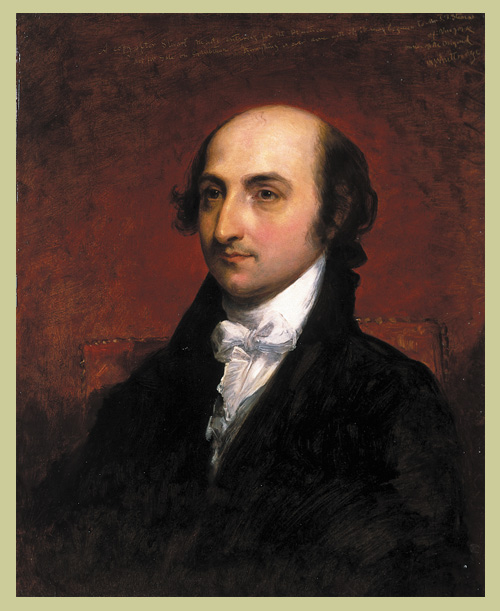
    Albert Gallatin.

    Albert Gallatin knew as early as 1799 that the United States “had become commercially and socially different from the former mother country” England. Gordon Wood, Empire of Liberty, 704. At that time, Gallatin was a Congressman, but he would later serve as Secretary of the Treasury from 1801 to 1814.

    In realizing that America was different, he said that Britain had “trades and occupations” that were “so well distinguished that a merchant and a farmer are rarely combined in the same person; a merchant is a merchant and nothing but a merchant; a manufacturer is only a manufacturer; a farmer is merely a farmer; but this is not the case in this country.” Id. at 704-05 quoting Annals of Congress, 5th Congress, 3rd session (Jan. 1799), 9: 2650.

    He said that if one were to venture into the middle of America, that individual would “scarcely find a farmer who is not, to some degree, a trader. In a grazing part of the country, you will find them buying and selling cattle; in other parts you will find them distillers, tanners, or brick-makers. So that, from one end of the United States to the other, the people are generally traders.” Annals of Congress, 5th Congress, 3rd session (Jan. 1799), 9: 2650.

    This meant that Thomas Jefferson’s dream of Americans being a nation of agriculture and avoiding the industrialization that Europe had experienced was not a dream to be realized, even after the transformative War of 1812.

    While this may have been troubling to Jefferson, Gallatin’s observations showed that Americans were developing a collective entrepreneurial spirit. Trading became an integral part of the American economy.

    Part of this was inevitably by necessity, where some had to supplement their income by engaging in trading that perhaps they did not have experience in. On the other hand, part of this change from England must have been that there was a wealth of natural resources and a middle class emerging in America.

    This early development after the War of 1812 should sound familiar to most modern Americans. First, although the middle class may change in size and wealth generation-by-generation, it has continually existed since the early Republic. Second, and most notably, Americans still carry an entrepreneurial spirit with them. Many would cite that entrepreneurial spirit for the success of America. It is certainly a factor.

  • Setting the Stage for the War of 1812

    Landscape Painting of Georgia.

    In the early Republic, trading became a staple of the American economy, which affected American relations with other countries in drastic ways.

    American merchants “brought home products from Canton, China, and ports in the Indian Ocean, including teas, coffee, chinaware, spices, and silks, before shipping them on to Europe . . . .” Gordon Wood, Empire of Liberty, 623. America imported goods from Europe only to export them to “the West Indies, South America, and elsewhere.” Id. However, perhaps most surprisingly, between 1795 and 1805, “American trade with India was greater than that of all the European nations combined.” Id. citing Ted Widmer, Ark of the Liberties: America and the World (New York, 2008), 66.

    Much of this trading arose out of the fact that America had not transformed into a purely industrial, manufacturing economy as much of Europe had during this time period. Rather, many Americans maintained their farming and picked up trading and other practices to make virtually all Americans participants in a massive national and international economic system. See Gordon Wood, Empire of Liberty, 627. These changes had domestic political implications, with the Republicans satisfied with the economic system and the Federalists believing it was an underachieving system. Id.

    The Republicans wanted to raise America’s status in the world, rather than solely focus on the state of the economy like the Federalists. Id. at 629. The Republicans wanted to create a system that prevented war from occurring and would also make America a recognized force to be reckoned with on the international stage. Id.

    Republicans ultimately took actions that surprised other countries’ officials. For example, the Republicans replaced diplomatic missions with consuls who handled international trade. A Russian official commented that Americans were “singular,” and wanted “commercial ties without political ties,” which was widely considered an impossibility at the time. Id. at 632 citing Irving Brant, James Madison: The President, 1809-1812 (Indianapolis, 1956), 69.

    These actions by the early Americans were largely intended to distinguish America as a player on the international stage. Perhaps out of a desire to show the world that America was not England and certainly was its own country who had its own policies, the Republicans underwent this course of action, much to the chagrin of the English and to some other government officials.

    The Americans were eager to distinguish themselves and to build an economy that was sustainable. The ongoing war between Napoleonic France and England partially allowed America to use its resources to build its trade routes and grow its economy.

    Some may look to these events as some of the earliest examples of American exceptionalism, which would perhaps be a keen observation. These early years of the Republic would ultimately set the stage for the War of 1812, but for the time being, Americans would have been content knowing that the economy was growing, trade was blossoming, and they were building the new country.