Signing of the Constitution. By: Louis S. Glanzman.
John Adams had strong opinions about federalism. He believed that the government should be structured similarly to the British Empire, given the British Empire’s extraordinary success.
At the time of the signing of the Constitution, Adams firmly believed that the Constitution had secured a national government, as opposed to a government dividing its sovereignty into states and a federal government. Gordon Wood, Revolutionary Characters: What Made the Founders Different, 191. (more…)
In the early 1800s, America underwent a campaign of infrastructure building. The building of new roads, bridges, and canals were done in a spirit of “national grandeur and individual convenience.” Gordon Wood, Empire of Liberty, 730 quoting Charles G. Haines, Considerations on the Great Western Canal (Brooklyn, 1818), 11.
In 1806, Samuel Blodgett, an economist and architect, concluded that commerce held together the Americans. Gordon Wood, Empire of Liberty, 730. Blodgett believed that commerce was “the most sublime gift of heaven, wherewith to harmonize and enlarge society.” Id.quoting Samuel Blodgett, Economica: A Statistical Manual for the United States of America (Washington, DC, 1806), 102.
Blodgett believed that if America were to surpass Europe, it could not be done with the policies of Alexander Hamilton and the Federalists. Id. Instead, it had to be done with the Republicans, led by Thomas Jefferson. Id. Blodgett believed that only the Republican policies had the “capacity to further the material welfare of” America’s citizens. Id. citing Samuel Blodgett, Economica: A Statistical Manual for the United States of America (Washington, DC, 1806), 102.
If commerce is the “most sublime gift of heaven,” as Blodgett said, then the manifestation of commerce in the United States as being carried out with the spirit of “national grandeur and individual convenience” is the reason that America has economically surpassed the individual states of Europe. Since the days of the early Republic, Americans have taken actions that both contributed to their individual benefit and have had the aggregate effect of creating national grandeur.
In this sense, America has distinguished itself both historically and currently from other countries. Many countries, for example the Soviet Union in the past and China currently, have attempted to create national grandeur not through individual innovation but through government involvement. In doing so, those other countries have created the facade of success and grandeur that they hope to achieve. That is not to say that those countries have not developed sophisticated, successful economies. But the sustainability of those countries’ economies is debatable.
One of America’s best qualities is that it has had prolonged economic success. Of course, there have been tumultuous times, like the Great Depression, and the so-called “Great Recession” and the panics and scares that are all but forgotten in modern times.
However, America from the earliest days has encouraged individual success through its institutions, its culture, and its laws. The American people have believed in that opportunity and have taken risks, worked hard, and created an economy characterized by its national grandeur. Preserving the institutions, culture, and laws that foster such grandeur is crucial for America’s continued success.
In large part, the War of 1812 was brought about by necessity but also by politics.
In terms of necessity, the British were executing a policy of impressment where the British would inspect American ships for contraband or material support for the French. America’s foreign policy adopted in reaction to these events was to create commercial warfare through trading, bringing the conflict to a head. In terms of politics, however, the Republicans saw the likely potential of war as a second war for independence and a defense of republicanism. Gordon Wood, Empire of Liberty, 669. On the other side of the aisle, the Federalists, such as Alexander Hanson of Maryland, welcomed the war believing that the Republicans would mismanage the war “so to discredit their party and bring the Federalists back into power.” Id.
Despite the oncoming war, the Republicans were aware that the country’s military was not prepared for a war, much less with one of the world’s supreme powers: Great Britain. In 1807, the Republicans strengthened the army and navy, but in 1810, the Republicans questioned themselves and did not further strengthen the military. Id. at 671. John Taylor, a Republican senator, stated that armies and navies “only serve to excite wars, squander money, and extend corruptions.” Id.
Ultimately, the army was expanded prior to the war but the navy was not, for fear that its permanent establishment was unnecessary and would only endanger the longevity of the Republic. There was a large group of Republicans “who in the early months of 1812 voted against all attempts to arm and prepare the navy, who opposed all efforts to beef up the War Department, who rejected all tax increases, and yet who in June 1812 voted for the war.” Id. at 672.
These years prior to the War of 1812 reflect the early Americans’ desire to not just proclaim independence but prove that independence and not take the risk of being viewed as a client state of England. The war was not inevitable, but it became so when the Republicans so strongly opposed impressment by the British and created a foreign policy of disrupting the commerce of England. The war was not necessary for the short term health of the United States, as England and France were embroiled in a long war that left America to be a secondary concern.
But for the long term health of the United States, the War of 1812 was absolutely necessary. America needed to become a country unto itself, capable of asserting its presence and becoming a leader in the world. If it had not taken a strong stance against England, there was a serious danger that one of two things would happen: England, after its war with France, would invade the United States to take back “the colonies” or America would always be seen as England’s brash client state.
The Republicans, although disorganized in executing their policies, effectively preserved the long term wellbeing of the United States in bringing on the War of 1812. But that would only become clear after significant casualties, damage, and perseverance.
In the early Republic, trading became a staple of the American economy, which affected American relations with other countries in drastic ways.
American merchants “brought home products from Canton, China, and ports in the Indian Ocean, including teas, coffee, chinaware, spices, and silks, before shipping them on to Europe . . . .” Gordon Wood, Empire of Liberty, 623. America imported goods from Europe only to export them to “the West Indies, South America, and elsewhere.” Id. However, perhaps most surprisingly, between 1795 and 1805, “American trade with India was greater than that of all the European nations combined.” Id. citing Ted Widmer, Ark of the Liberties: America and the World (New York, 2008), 66.
Much of this trading arose out of the fact that America had not transformed into a purely industrial, manufacturing economy as much of Europe had during this time period. Rather, many Americans maintained their farming and picked up trading and other practices to make virtually all Americans participants in a massive national and international economic system. See Gordon Wood, Empire of Liberty, 627. These changes had domestic political implications, with the Republicans satisfied with the economic system and the Federalists believing it was an underachieving system. Id.
The Republicans wanted to raise America’s status in the world, rather than solely focus on the state of the economy like the Federalists. Id. at 629. The Republicans wanted to create a system that prevented war from occurring and would also make America a recognized force to be reckoned with on the international stage. Id.
Republicans ultimately took actions that surprised other countries’ officials. For example, the Republicans replaced diplomatic missions with consuls who handled international trade. A Russian official commented that Americans were “singular,” and wanted “commercial ties without political ties,” which was widely considered an impossibility at the time. Id. at 632 citing Irving Brant, James Madison: The President, 1809-1812 (Indianapolis, 1956), 69.
These actions by the early Americans were largely intended to distinguish America as a player on the international stage. Perhaps out of a desire to show the world that America was not England and certainly was its own country who had its own policies, the Republicans underwent this course of action, much to the chagrin of the English and to some other government officials.
The Americans were eager to distinguish themselves and to build an economy that was sustainable. The ongoing war between Napoleonic France and England partially allowed America to use its resources to build its trade routes and grow its economy.
Some may look to these events as some of the earliest examples of American exceptionalism, which would perhaps be a keen observation. These early years of the Republic would ultimately set the stage for the War of 1812, but for the time being, Americans would have been content knowing that the economy was growing, trade was blossoming, and they were building the new country.
The early Republic years were filled with hope and optimism for what the new country could achieve. The Republicans, through the 1790s and into the first decade of the 1800s, had a new idea about what government should be and how it should fit into the citizens’ lives.
Republicans imagined “that people’s natural sociability and willingness to sacrifice their selfish interests for the sake of the whole would be sufficient social adhesives,” and a powerful federal government would not be necessary. See Gordon Wood, Empire of Liberty, 301.
Alexander Hamilton and the Federalists thought these ideas were merely “pernicious dreams” of the Republicans and were surely too radical to be true. See id.
Since those early years of the Republic, there has been a continuation of this debate. Undoubtedly, at least part of Thomas Jefferson’s and the Republicans’ view regarding Americans’ compassion and charity is true. Americans, as a collective, are charitable to a number of causes and organizations around the world, and Americans reinforce that principle that they are willing to occasionally sacrifice their selfish interests for the betterment of others.
However, that compassion and charity does not supplant the need for a federal government to take some actions that could not have been contemplated by the Republicans or the Federalists. The Federalists’ misguided notion that a bureaucracy was necessary for the perpetuation of the country was just as incorrect as the Republicans’ belief that the people would inherently be willing to sacrifice their selfish interests in all regards.
This would later become evident as the federal government’s intrusion was necessary to eradicate slavery, prevent discriminatory laws from being enforced, and ensure minorities’ rights, among a myriad of other examples.
Some of what the Republicans believed and some of what the Federalists believed ultimately has proven to be true. Both Hamilton and Jefferson would be satisfied in knowing that their debate has vigorously continued, even if they would not be elated to know some of their ideals have been eroded.
From its declaration of independence to the start of Thomas Jefferson’s first term as president in 1800, the federal government had consistently taken on a significant amount of debt: $80 million in total.See Gordon Wood, Empire of Liberty, 298. Prior to that, the federal government had taken out millions of dollars from Europe, including from the French government and from Dutch bankers, to finance the Revolutionary War effort. United States Department of State, available at https://history.state.gov/milestones/1784-1800/loans.
By the time Thomas Jefferson took office in 1800, the Revolutionary War debt had been paid off, however, Thomas Jefferson and the Republicans were especially concerned about the growing debt that the United States had taken on. In fact, in 1798, Jefferson considered the idea of amending the Constitution to take the power of borrowing away from the federal government. See Gordon Wood, Empire of Liberty, 298. While Jefferson never accomplished such a drastic step, he prioritized paying the debt down each year. He foretold that the United States would “be committed to the English career of debt, corruption and rottenness, closing with revolution. The discharge of the debt, therefore, is vital to the destinies of our government.” See Gordon Wood, Empire of Liberty, 298.
Throughout the 1790s, the United States shifted all of its obligations from the governments of Europe to private investors. By 1795, America only owed money to private investors. United States Department of State, available at https://history.state.gov/milestones/1784-1800/loans. This, combined with the federal government’s payments created a solid credit rating in Europe, which enabled taking low-interest loans from European lenders for the Louisiana Purchase. Id.
By 1810, the Republicans reduced the debt to approximately $40 million, even after having spent $15 million in cash on the Louisiana Purchase. See Gordon Wood, Empire of Liberty, 298. Thomas Jefferson had made significant progress in moving the federal government away from its borrowing spree. Perhaps Jefferson was fearful that the federal government would default on its obligations as it had in 1785 on interest payments to France and further installments in 1787. United States Department of State, available at https://history.state.gov/milestones/1784-1800/loans.
This brief history of the federal government’s debt illustrates the difficulty of balancing spending with saving. Few would question significant investments like borrowing for the financing a war for independence or for a purchase that effectively doubled the size of the country. The question that arises nearly every year is rather, how much discretionary spending is necessary?
Jefferson’s fear of corruption leading to revolution is likely at the furthest end of the spectrum of possibilities. Regardless, a default on indebtedness held by the federal government would have significant consequences that could not be ignored in the early Republic and cannot be ignored now. Where there are benefits to be gained, investments are necessary.
While some may be opposed to debt as a matter of principle, Jefferson’s concerns show the true threat of excessive liability for the federal government. Simply having debt to pay down is not a threat to the future of the country. When America’s wellbeing is endangered or America’s credit rating is threatened, action is unquestionably necessary to prevent those results.
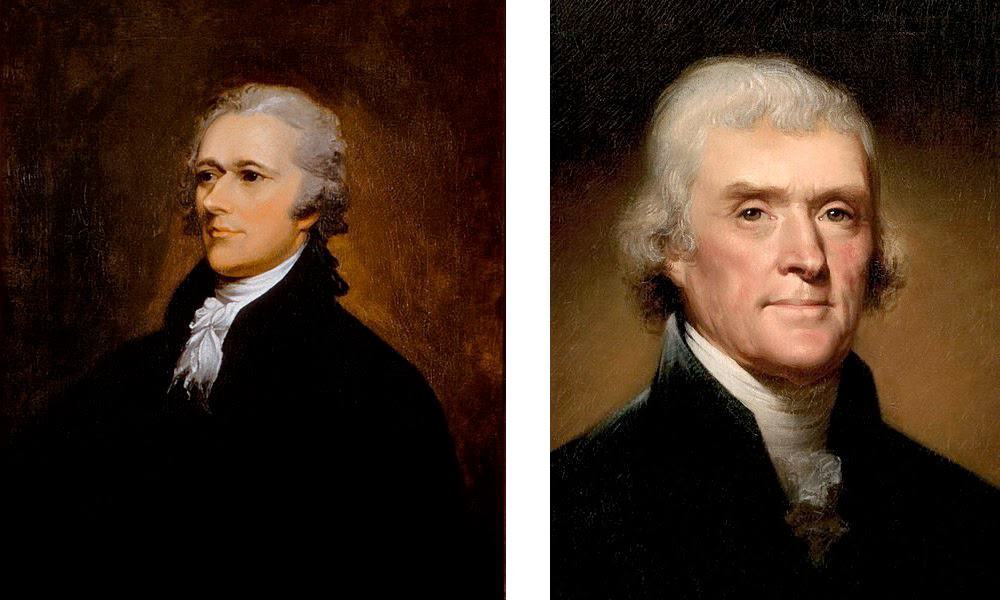
Portrait of Thomas Jefferson. By: Rembrandt Peale. 1805.
When Thomas Jefferson and the Republicans came to power in 1800, they had a major priority: reverse the Federalist trend of expanding the federal government.
In Thomas Jefferson’s first message to Congress, in 1801, Jefferson framed the role of the federal government as only being “charged with the external and mutual relations only of these states.” All other matters were to be left to the states.
In 1800, the American federal government was “small even by eighteenth-century European standards.” Gordon Wood, Empire of Liberty, 291. Gordon Wood explains in Empire of Liberty that in “1801 the headquarters of the War Department, for example, consisted of only the secretary, an accountant, fourteen clerks, and two messengers. The secretary of state had a staff consisting of a chief clerk, six other clerks (one of whom ran the patent office), and a messenger. The attorney general did not yet even have a clerk.” Id.
Throughout the 1790s, there was significant growth in the governmental offices, so the numbers cited for 1801 would have appeared to be a major jump from those in the first years after the adoption of the Constitution. Nonetheless, Jefferson and the Republicans were determined to reverse the trend of a growing federal government that began to resemble the bureaucratic monarchies of Europe.
Jefferson’s perspective of the role of government, and the tension between the Federalists and Republicans on the desirable and proper size of the federal government continue to be relevant today. Obviously, the federal government has grown to include numerous other departments and agencies since the early Republic, but the same question is still discussed amongst common people, analysts, and politicians: how much of a presence should the federal government have in the common person’s life?
While Jefferson and the early Republicans sought to limit the presence of the federal government to essentially handling the mail and foreign relations, the belief that the federal government needed to be involved in crucial aspects of Americans’ lives undoubtedly won the contest.
Few Americans now would advocate abolishing Social Security, taxes, downsizing of federal agencies, and having a more passive, impotent federal government overall. These federal responsibilities feel necessary to the average American. Justifiably so, as the federal government is uniquely positioned to oversee the implementation of policies that benefit all Americans.
Perhaps the gradual growth in the federal government, with occasionally growing under liberal-leaning presidents and Congresses and occasionally diminishing under conservative-leaning presidents and Congresses, was the best way for the United States to progress from a small republic to a global superpower.
It seems that the healthy debate between the parties over the past two centuries of what the federal government should be is what kept the United States on a moderate path, never straying too far from its principles.
The president’s role in the government in the early Republic was different than today, and sometimes, it was unclear exactly what role the president would play in the federal government. With the election of 1800, the newly elected Republicans introduced the “plebiscitarian principle,” according to one scholar, Bruce Ackerman. Bruce Ackerman, The Failure of the Founding Fathers: Jefferson, Marshall, and the Rise of Presidential Democracy (Cambridge, MA, 2005), 85.
The plebiscitarian principle was the new belief that the President of the United States owes a duty to the voters who gave him the electoral mandate to rise to the prestigious office. See id.
Thomas Jefferson had a similar belief. See Thomas Jefferson to John Garland Jefferson, Papers of Jefferson: Retirement Ser., 2, (Jan. 25, 1810), 183. Jefferson stated that the president’s duty was “to unite in himself the confidence of the whole people” so he could “produce an union of the powers of the whole, and point them in a single direction, as if all constituted but one body & one mind.” Id.
This principle, that the President of the United States was to owe a duty to the entire population of the country and lead them as one, helped form the presidency that we recognize today. It created a balance between the monarchical principles that the Federalists had come to admire about England and the decentralized, less powerful federal government that the Republicans had advocated for in the early Republic.
Even as the power of the presidency has expanded, few would question that the President of the United States should only serve a portion of the population. Undoubtedly, the vast majority of Americans hold tight the belief that a president should represent the entire country and lead the entire country.
The critical question that has existed and will always exist is what direction each president should take in leading the country. Some would argue that the reason we can have that healthy debate is because of the election of 1800 and the creation of the plebiscitarian principle.
The election of 1800 ushered in a new era of American politics. Thomas Jefferson won the election to become America’s third president, but also, it was a defeat for the Federalists, who had dominated politics in the first few decades of the country’s life. This was not just any defeat, however. This would mark the beginning of the end for the once powerful Federalist party.
By this point, Gordon Wood explains in Empire of Liberty, the Federalists had come to believe that ordinary people did not have “a direct role to play in ruling the society. They were so confident that the future belonged to them, that the society would become less egalitarian and more hierarchical, that they treated the people with condescension and lost touch with them.” Gordon Wood, Empire of Liberty, 276. Wood concludes by stating that the Federalists “were so out of touch with the developing popular realities of American life . . . .” Id. Noah Webster, at the time, concluded that the Federalists had led to their own demise by resisting “the force of public opinion . . . .” David Hackett Fischer, The Revolution of American Conservatism: The Federalist Party in the Era of Jeffersonian Democracy, (New York 1965), 151-52.
The fall of the Federalist party in the early Republic provides lessons to the modern political parties of the Republicans and the Democrats. The most obvious lesson is: Avoid public opinion at your own risk. The Federalists held onto the traditions of the monarchical republic, despite public opinion becoming increasingly more Republican-minded (the old Republican, that is). Public opinion undoubtedly can be illogical, unreasonable, and misinformed, but the social compact that the government only is as legitimate as its people allow it to be highlights the importance of public opinion, whether it is right or wrong on any given issue.
Looking at recent news, the resignation of Speaker of the House John Boehner, and the subsequent announcement by his presumptive replacement, Representative Kevin McCarthy, that he will not be seeking the Speaker’s chair, draws an interesting parallel between the modern Republican party and the Federalist party of centuries ago. The Republican party is currently fractured between its most conservative segment and the relatively moderate segment, both of which agree on some fundamental ideals, but the conservatives holding tightly to traditional beliefs socially, legally, and fiscally.
Recently, some of those positions held by the most conservative political figures have begun to be behind the curve of public opinion. While this is only a segment of the Republican party, it is also a vocal, active segment that has considerable sway in the party. Most analysts agree that John Boehner’s resignation is due to that vocal, active segment of the party.
Regardless, it is food for thought how the Republican party’s future may be shaped by its proclivity to maintain the traditional nature of the party, despite the changes in public opinion, socially and otherwise. While some have speculated the end of the Republican party may be nearing, this is unlikely barring significantly more turmoil and further clinging to traditional beliefs that have become outdated and antiquated from decades past. It is unlikely the Republicans will split, considering the party has been in existence for approximately 160 years. But it is possible.
Alexander Hamilton and Thomas Jefferson had a contentious relationship, from their time serving as Secretaries in Washington’s administration forward. That contentious relationship manifested itself, at least partially, in the fact that they had crucial ideological differences. At first, those ideological differences were not reflected by different memberships in political parties. During the time they were Secretaries in Washington’s administration, there were no political parties.
When the two political parties, the Federalists and the Republicans, were created, Hamilton and Jefferson both had overblown ideas of what would each other’s party intended. Jefferson feared that Hamilton wished to implement a monarchy, and Hamilton feared that Jefferson intended to overthrow the government of the United States. As a general matter, the Federalist government feared that any Republicans or individuals with different views were determined to undermine the existence of the government and determined to bring an end to the system that the majority of Americans had worked so hard to create.
In fact, however, the Republican party did not see itself as a political party, and the Federalists did not view themselves as members of a political party in those early years. For example, the Federalists saw themselves as the vast majority of people who were concerned about the state of the country. Those in the Republican party ultimately began making Democratic-Republican Societies throughout the country, which demanded changes from the status quo of the predominantly Federalist government.
What a change the political party system has undergone since the late 1790s. Many would attribute the success of America’s political system to the fact that two main parties, now the Democrats and Republicans, have consistently vied against each other, generally agreeing to move the country forward by meeting in the middle. As Hamilton and Jefferson exaggerated the intentions and beliefs of the opposing party, modern Democrats and Republicans tend to do the same, at least to an extent.
That healthy debate between two adversaries has sustained not only the court system from ancient days to modern days but also the American system of politics. An adversarial contest between two parties prevents a cacophony of voices that tend to overwhelm multi-party political systems. Rather, it places two parties against each other, creating competition, encouraging debate, and having the net effect of putting the country on a moderate path, with gradual changes coming over the course of decades. Perhaps that gradual, conservative nature of progress has been the cause of America’s prolonged success.


 Last Best Hope of Earth