Tag: Founding Fathers

  • Virtue as a Principle and Foundation

    gilbert_stuart_john_adams
    John Adams. By: Gilbert Stuart.

    At the time of the Revolution, republicanism was permeating political discourse and political theory. John Adams asked in 1776 that “[i]f there is a form of government, then, whose principle and foundation is virtue, will not every sober man acknowledge it better calculated to promote the general happiness than any other form?” He continued by explaining that a republican constitution “introduces knowledge among the people, and inspires them with a conscious dignity becoming freemen; a general emulation takes place, which causes good humor, sociability, good manners, and good morals to be general. That elevation of sentiment inspired by such a government, makes the common people brave and enterprising. That ambition which is inspired by it makes them sober, industrious, and frugal.” John Adams, Thoughts on Government, Adams, ed., Works of John Adams, IV, 194, 199.
    (more…)

  • Preserving the Health of the Constitution

    general_george_washington_at_trenton_by_john_trumbull
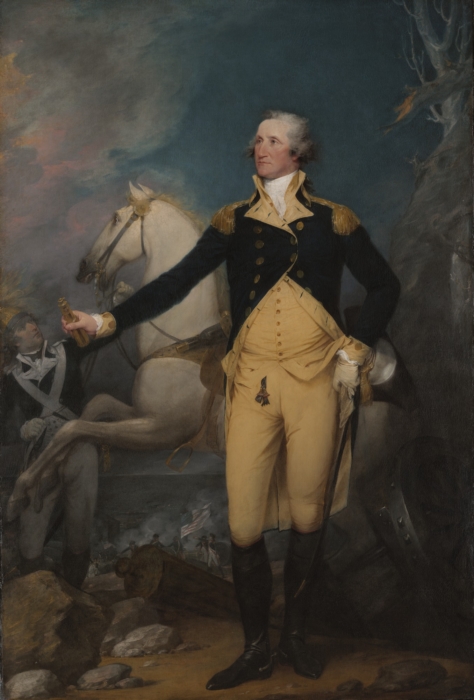
    General George Washington at Trenton. By: John Trumbull.

    Corruption was rife in England in the decades leading up to the American Revolution, and Americans were keenly aware of that fact. For many individuals, the English Constitution was viewed as a hollow document, as the crown had taken the power away from all other sources. See Gordon Wood, The Creation of the American Republic: 1776-1787, 34-35. Americans knew that this corruption “always begins amongst the Rich and the Great” and would spread to the common people, leaving them “enfeebled and their souls depraved.” Id. at 35 quoting Pinkney’s Wmsbg. Va. Gazette, June 15, 1775; Phila. Pa. Packet, May 29, 1775, Aug. 8, 1774; Purdie and Dixon’s Wmsbg. Va. Gazette, Sept. 5, 1771. (more…)

  • The Nobility of the Founding Fathers

    committee_of_five_1776
    The “Committee of Five,” composed of John Adams, Thomas Jefferson Benjamin Franklin, Roger Sherman, and Robert Livingston, presenting the Declaration of Independence. The Declaration of Independence. By: John Trumbull.

    Much of the progress that America experienced during the Revolution happened as a result of the Founding Fathers’ contradictory actions. The Founding Fathers, predominantly privileged, in some ways paid the price of the Revolution in the most noble way.

    (more…)

  • Bringing the Revolution into Focus

    yorktown80
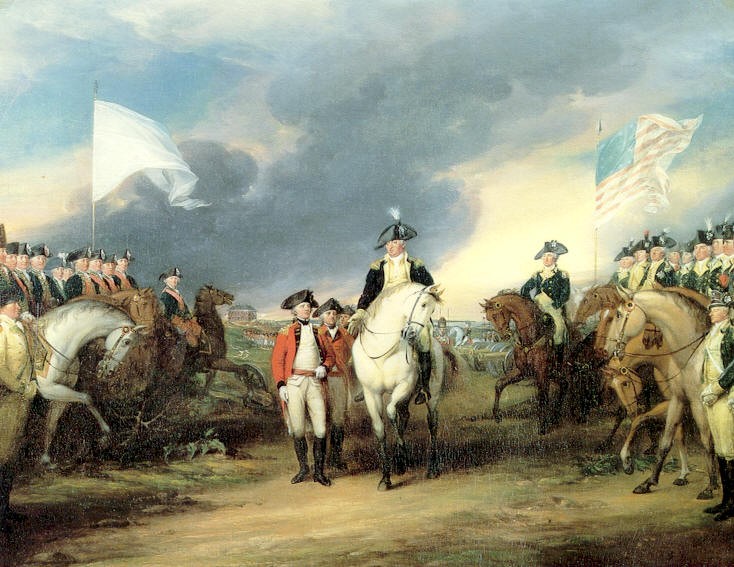
    Siege of Yorktown. By: John Trumbull.

    To fully understand the magnitude and impact of the American Revolution, context is crucial. While the Enlightenment was the process of society learning “the sources of a flourishing society and human happiness,” the Revolution was the process of finding the best form of government perhaps the world has ever known. See Gordon Wood, The Idea of America: Reflections on the Birth of the United States, 59.

    (more…)

  • The Greatest Republic

    draftingtheconstitution
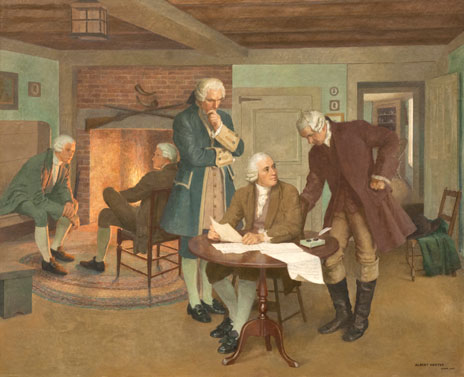
    John Adams, Samuel Adams, and James Bowdoin Drafting the Massachusetts Constitution of 1780. By: Albert Herter.

    As the colonies went through the Revolution, it became clear that republicanism would take the place of English imperialism. Americans were aware that republicanism put “social and moral demands” upon the people, which would change how people lived. Gordon Wood, The Creation of the American Republic: 1776-1787, 91.

    (more…)

  • The Birth of the Senate

    new_york_city_hall_1789
    City Hall of New York City in 1789, where Congress convened during the 1790s.

    In the earliest years of the American Republic, theories were abound about the proper structure of government to best balance equality and wise decision-making. John Adams stated, in his Thoughts on Government, that “a people cannot be long free, nor ever happy, whose government is in one assembly.” Gordon Wood, The Creation of the American Republic: 1776-1787, 208-09 quoting John Adams, Thoughts on Government, Adams, ed., Works of John Adams, IV, 194, 196. These theories became tested throughout the young country, in each of the state’s constitutions.

    (more…)

  • The One, the Few, and the Many

    portraitofjohnadamsbywilliamwinstanley1798
    Portrait of John Adams. By: William Winstanley.

    At the time of the American Revolution, it was commonly believed amongst Americans that formulating the ideal government would require a different system than any previously conceived. The Founding Fathers had their own ideas.

    (more…)

  • A First Principle of Free Government

    constitutional_convention_4_630_pxlw
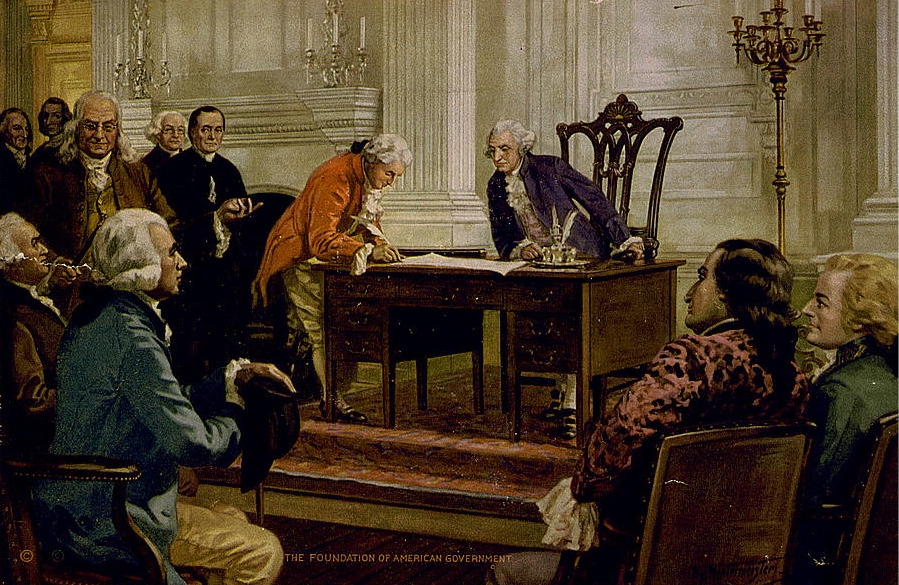
    The Signing of the Constitution of the United States.

    The separation of powers in the government of the United States has “come to define the very character of the American political system.” Gordon Wood, The Creation of the American Republic: 1776-1787, 151. (more…)

  • Laboratories of Democracy

    colonial_williamsburg_governors_palace_front_dscn7232
    Governor’s Palace. Williamsburg, Virginia.

    In the months leading up to the Declaration of Independence, the states began the process of adopting their own constitutions. These constitutions, being drafted in 1776, approximately 13 years before the United States Constitution would be ratified, had to confront many of the same issues as the United States Constitution, with various approaches being taken. (more…)

  • The Birth of the House

    Image of Washington's inauguration at Philadelphia by J.L.G. Fer
    Painting of the Inauguration of President George Washington. By: Jean Leon Gerome Ferris.

    For many of the Founding Fathers, the biggest threat to the stability and success of the United States was tyranny. Tyranny was a force that could bring down the most free and just societies. Underlying much of the creation of the institutions that now define the American government, the judiciary, the legislature, and the executive, are precautionary and prophylactic measures to prevent tyranny. (more…)