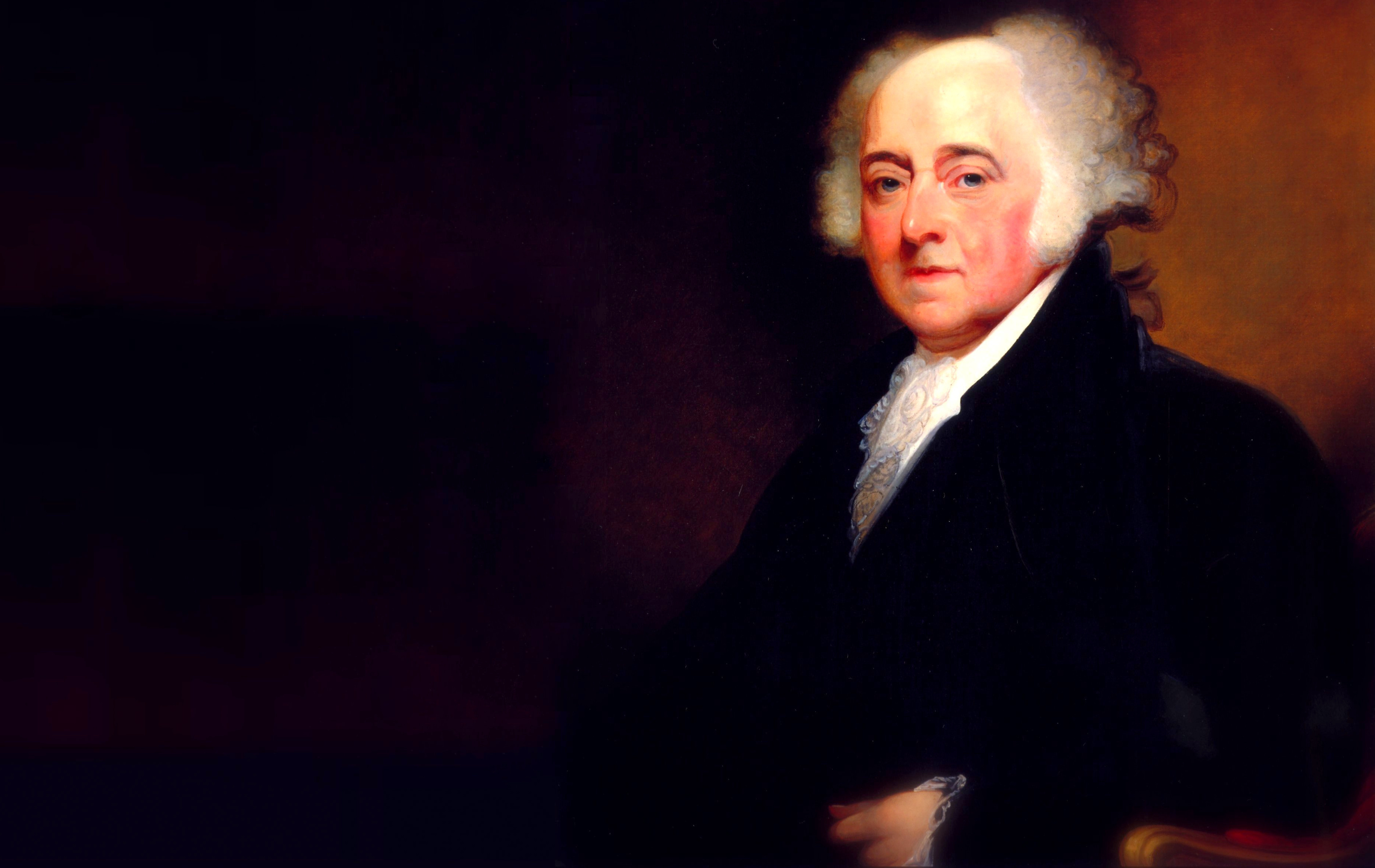
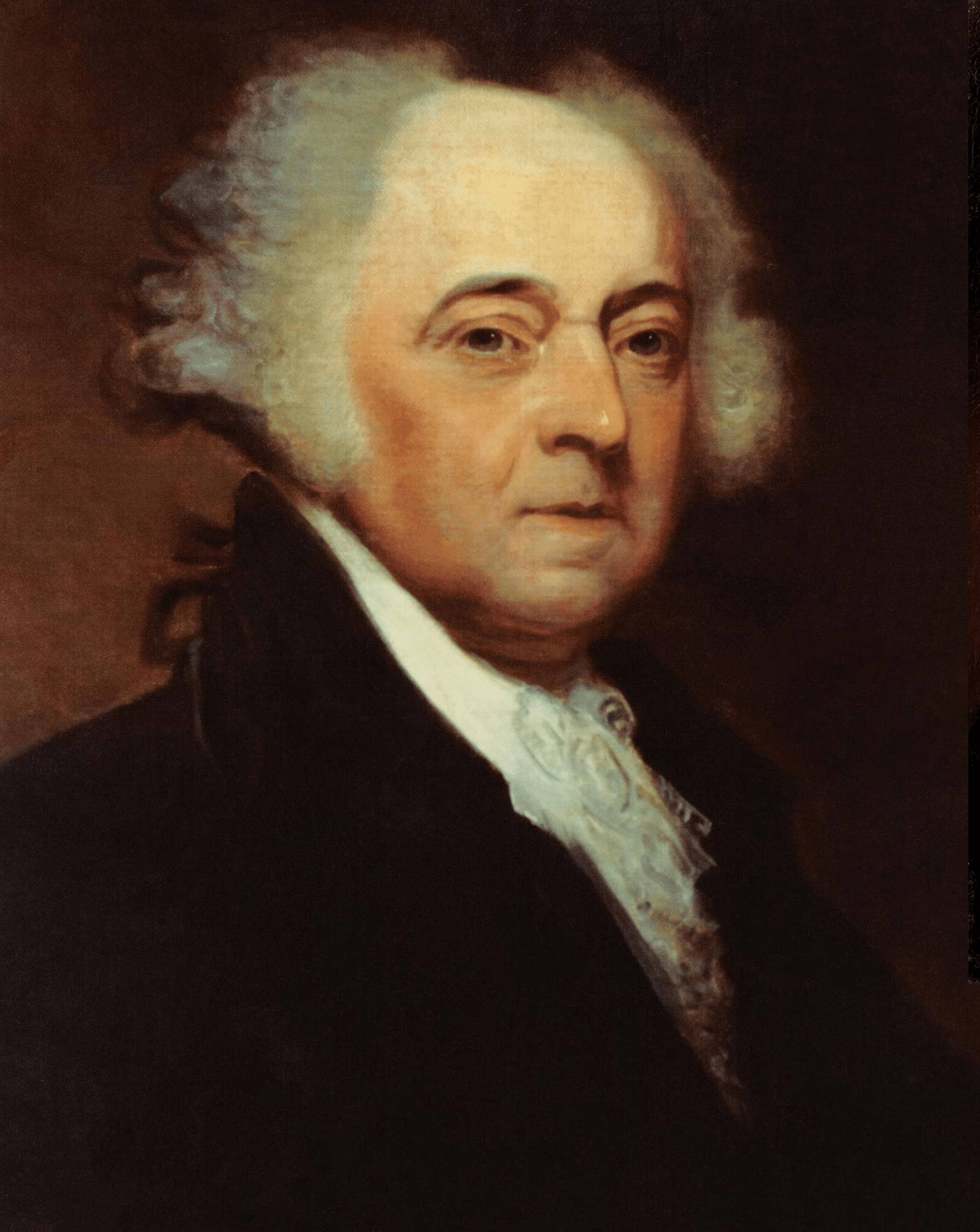
John Adams was amongst the most hopeful about America’s prospects for the future. At the time of the Declaration of Independence and the years of the American Revolution, he believed America could avoid the pitfalls of the European nations.
But just ten years later, Adams was of a different mind. In 1787, he wrote his Defenceof the Constitutions, where he concluded that “his countrymen were as corrupt as any nation in the world.” Gordon Wood, Revolutionary Characters: What Made the Founders Different, 181. (more…)
John Trumbull’s Depiction of the Drafting Committee of the Declaration of Independent Presenting the Draft to Congress.
The Founding Fathers have a complicated legacy, and that legacy is constantly undergoing change. While the reverence of the Founding Fathers fluctuates generation-by-generation, certain questions emerge about the Founding Fathers’ effectiveness in setting the foundation for the United States.
Gordon Wood, in Revolutionary Characters: What Made the Founders Different, presented the Founding Fathers’ legacy as: “If it was the intense commitment of this generation of founders to new enlightened values that separates it from other generations, why, it might be asked, and indeed, as it has been asked by recent critical historians, did these so-called enlightened and liberally educated gentlemen not do more to reform their society? Why did they fail to enhance the status of women? Eliminate slavery entirely? Treat the Indians in a more humane manner?” Gordon Wood, Revolutionary Characters: What Made the Founders Different, 26.
It has become popular, glamorous even, to question the principles and integrity of the Founding Fathers in recent years, for their lack of ridding the country of its most foul traits. The Founding Fathers lived in a much different world than contemporary Americans.
To be fair to the Founding Fathers, accomplishing any of the goals similar to abolishing slavery, ensuring equality of men and women, and treating Indians in a humane manner, must have come after ensuring the creation of a government that would last ages. As Thomas Jefferson drafted the Declaration of Independence and James Madison drafted the Constitution, and the Founding Fathers came to sign and approve those documents, their priority was creating an environment and a country that would facilitate future successes and ensure equality in for future generations.
The Founding Fathers were not in a position to contemplate every injustice and inequality, amidst the Revolutionary War, the tumultuous years of the early Republic, and the rapid growth of the country.
To expect them to have addressed and resolved every issue that was perhaps foreseeable at the time of the Revolution is to ignore their extraordinary accomplishments. The Founding Fathers collectively deliberated what the best form of government should be. They created the most extraordinary government that has thrived for over two centuries and has been a model for successful government.
While it is popular to question the Founding Fathers’ accomplishments, the context of their work must be remembered. We remember each American icon for their accomplishments, given the circumstances that existed during their respective times. The Founding Fathers’ time was perhaps the most tumultuous and contentious in American history, and yet they devised a system that has allowed one of the most free and just societies known to the world.
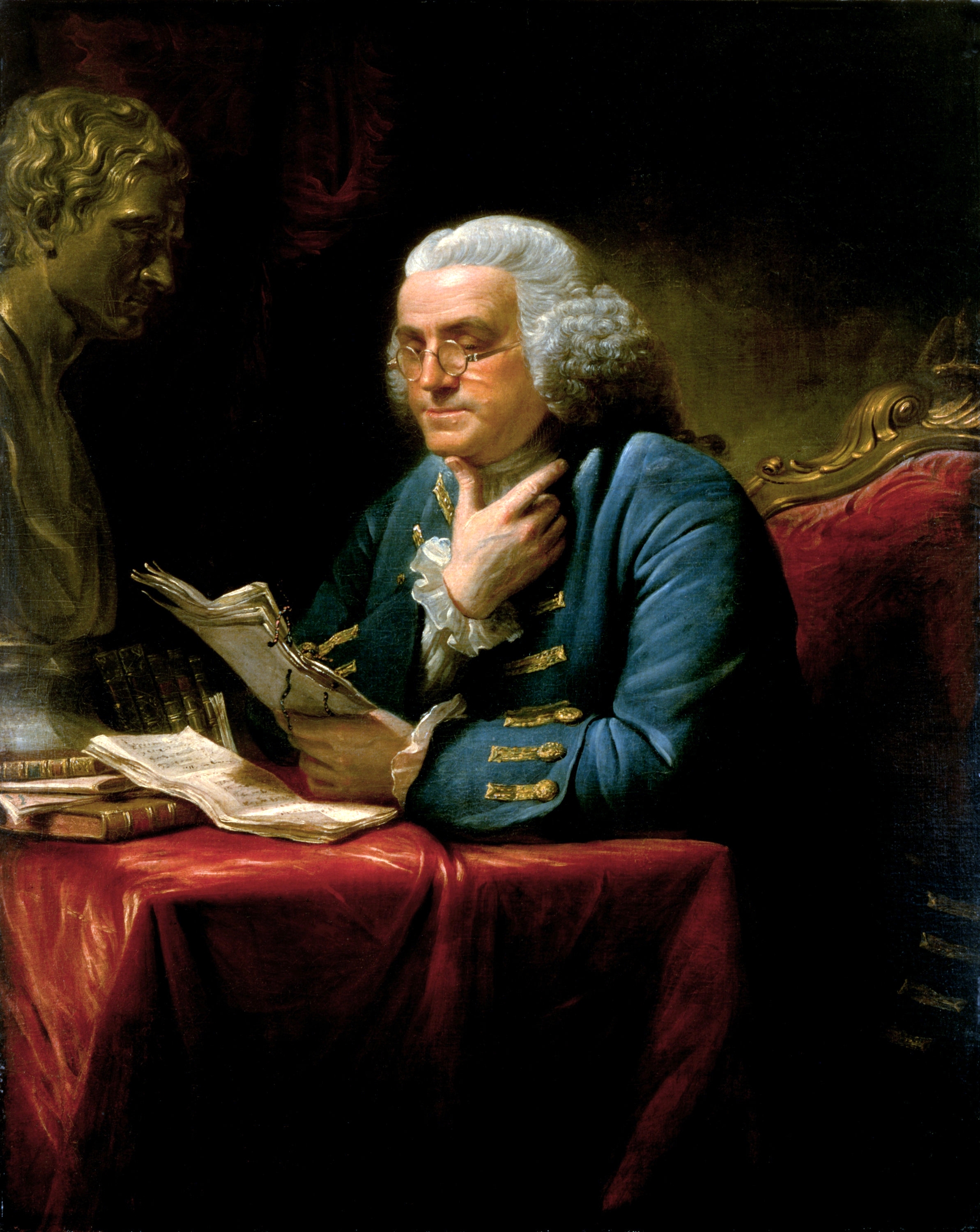
Benjamin Franklin, depicted in London in 1767. By: David Martin.
Benjamin Franklin, one of the most well-known and most revered Founding Fathers, had a more controversial history than most modern Americans realize.
In the late 1750s and early 1760s, Franklin was a “complete Anglophile.” Gordon Wood, Revolutionary Characters: What Made the Founders Different, 79. He made “disparaging comments about the provinciality and vulgarity of America in contrast with the sophistication and worthiness of England.” Id. He also believed that America, not England, was “corrupt and luxury-loving.” Id.
While living in England, Franklin was becoming more influential and had become a deputy postmaster. Id. at 84. In 1772, Franklin came into possession of some damning letters that would change his life. In the late 1760s, Thomas Hutchinson, the then-lieutenant governor of Massachusetts, had written letters to an Englishman advocating taking away liberties from the colonists so as to “maintain the colonies’ dependency on Great Britain.” Id. at 83. Franklin sent these letters to Massachusetts, prompting a crisis that would result in Franklin being terminated as deputy postmaster. Id.
In March 1775, he came back to America a changed man: a passionate patriot. Some of this passion was feigned, so as to show his fellow colonists that he was not an Englishman masquerading as a revolutionary. Id. at 84. He would become one of the most popular and widely respected Americans in the world, with only George Washington outshining him.
By the time of his death in 1790, Benjamin Franklin had created a legacy that lasts to this day. In the early Republic, that legacy was predicated on him showing that being self-made in America was not only possible, it was downright glamorous. Often forgotten or lost after those years of the early Republic, however, is that Franklin was not the same as the other Founding Fathers.
While Alexander Hamilton was not a full-blooded American and Thomas Jefferson spent a significant amount of time in Europe, Franklin so fully affiliated himself with England that it is difficult to draw a parallel to a contemporary American figure. In modern times, such an affiliation would certainly spell doom to a legacy.
Nonetheless, Franklin is remembered for his genius, his relatable nature, and his embodiment of the most American of ideals. Modern Americans’ forgiveness is likely warranted, but some may wonder: What if Franklin had not sent those letters? What would his legacy be then?
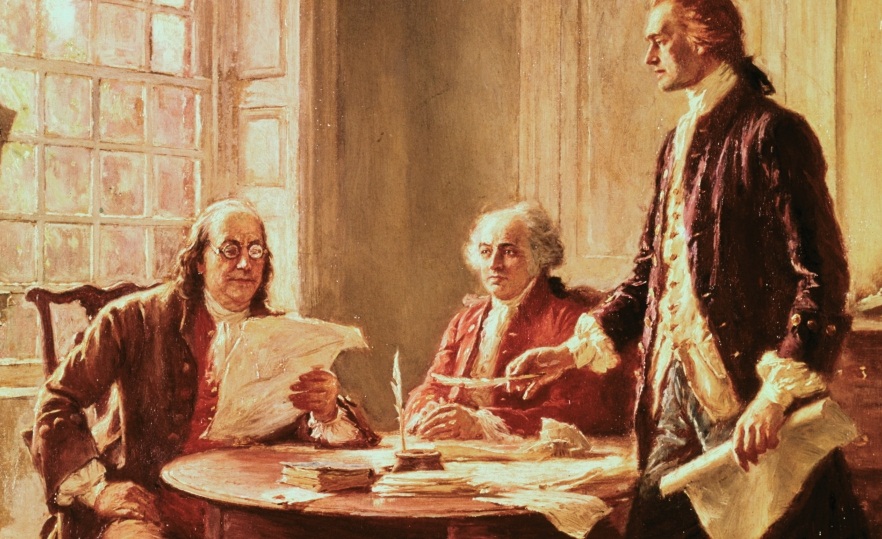
Depiction of Benjamin Franklin, John Adams, and Thomas Jefferson.
Gordon Wood began his 2006 book Revolutionary Characters: What Made the Founders Different by stating that “[n]o other major nation honors its past historical characters, especially characters who existed two centuries ago, in quite the manner we Americans do.” Gordon Wood, Revolutionary Characters: What Made the Founders Different, 3.
He continued, stating that Americans “want to know what Thomas Jefferson would think of affirmative action, or George Washington of the invasion of Iraq.” Id.
Scholars apparently have varying views as to why modern Americans revere the Founding Fathers, over two centuries after they first acquired their fame. Id. at 4.
Some scholars believe that it is because Americans are concerned “with constitutional jurisprudence and original intent” forming the basis for the Constitution. Id.
Other scholars posit that analyzing the Founding Fathers allows modern Americans to “recover what was wise and valuable in America’s past.” Id.
Another set of scholars explain that Americans look to the Founding Fathers to define the American identity. Id.
As Gordon Wood explained, this was not always the case. Toward the late 1800s and early 1900s, some Americans questioned the wisdom, accomplishments, and place of the Founding Fathers. Id. at 5. Nonetheless, for a significant portion of the 1900s and continuing into the 2000s, Americans look to the Founding Fathers for guidance.
While scholars may disagree as to the underlying purpose for modern Americans to honor the Founding Fathers, it can likely be explained by two points: (1) the Founding Fathers rigorously worked to create the best form of government possible and (2) the Founding Fathers knew adversity, difficulty, and hardship and yet held the country together.
As to the first point, the Founding Fathers engaged in one of the most substantial debates in history as to how a country should be best governed by its people to best ensure their happiness and prosperity. The resulting government was not only revolutionary and coherent, it has facilitated America’s success for two centuries with only 27 amendments to the Constitution being necessary.
The second point weighs a little heavier. The United States has endured many wars, tragedies, and difficulties. Few rival the tumultuous, uncertain times of the Revolution. Regardless, in both stable times and otherwise, America and its leaders have looked to the Founding Fathers for guidance. The logic underlying that goes “If the Founding Fathers could lead a revolution and fight a war against a mighty empire successfully, how would they deal with this scenario?”
All of the scholars’ views as to why Americans honor the Founding Fathers feeds into this point. When Americans ask these questions, like “What would the Founding Fathers do?”, they do so out of a wishful curiosity that leads to no clear answer.
This is a result that would likely please the Founding Fathers. The Founding Fathers did not have a secret to making the right decisions or coming to the right conclusions. They only did so through vigorous debate with each other and unyielding optimism about America’s future. That contentious debate spawned the system, institutions, beliefs, and ideals that define America.
Those debates should rage on with vigor. It is the least that modern Americans can do to repay the Founding Fathers.
As the 1800s progressed, the era of the Founding Fathers was coming to an end. Thomas Jefferson and John Adams would outlast most of the Founding Fathers, only to die on the same date: July 4, 1826. The Founding Fathers would leave a profoundly different country than the one they created.
Common Americans had created the sense that the United States was “a land of enterprising, optimistic, innovative, and equality-loving” people. Gordon Wood, Empire of Liberty, 733. The entrepreneurial, ambitious American spirit was born and permeating the entire country.
Particularly after the resolution of the War of 1812, manifested in the Treaty of Ghent, Americans began to feel a permanent independence from Europe and a separation from European ideals. Gordon Wood, Empire of Liberty, 735. Americans began to look at themselves as worthy of analysis, introspection, and recognition.
Thomas Jefferson believed that, as of 1823, America would serve “as a light to the world showing that mankind was capable of self-government.” Gordon Wood, Empire of Liberty, 737 citing Thomas Jefferson to Lafayette, 4 Nov. 1823, in Ford, ed., Writings of Jefferson, 10: 280. Jefferson confessed that his ideals for America “may be an Utopian dream, but being innocent, I have thought I might indulge in it till I go to the land of dreams, and sleep there with the dreams of all past and future times.” Id. at 738 citing Thomas Jefferson to J. Correa de Serra, 25 Nov. 1817, in L and B, eds. Writings of Jefferson, 15: 157.
Jefferson’s dream of America may not have been achieved in exactly the way he imagined, but the country was becoming a player on the global stage. Americans had shown that they would not be a British colony, twice, and that Americans would create their own spirit which was loosely based on Europe and the classical civilizations of Greece and Rome.
With the success of America increasing, the specter of slavery began to loom over the country. It presented an ideological divide for the North and South, but it also economically divided the country. In retrospect, the Civil War seemed inevitable, but as the sun was setting on the Founding Fathers’ America, there was hope that a major conflict could be avoided.
At the beginning of the 1800s, the American economy was becoming an unconventionally successful economy. Domestic commerce was “incalculably more valuable” than foreign commerce and “the home market for productions of the earth and manufactures is of more importance than all foreign ones.” Gordon Wood, Empire of Liberty, 707 quoting Nathan Miller, The Enterprise of a Free People: Aspects of Economic Development in New York State During the Canal Period, 1792-1838 (Ithaca, 1962), 42.
Meanwhile, a middle class was emerging in the United States. In the 1780s, Benjamin Franklin predicted “the almost mediocrity of fortune that prevails in America . . . [made] its people to follow some business for subsistence,” which made the United States “the land of labor.” Gordon Wood, Empire of Liberty, 709 quoting Benjamin Franklin, “Information to Those Who Would Remove to America” (1784), Franklin: Writings, 975-83. This new middle class was gaining “a powerful moral hegemony over the society, especially in the North.” Gordon Wood, Empire of Liberty, 709.
Both Benjamin Franklin and J. Hector St. John de Crevecoeur hoped a society could exist that lacked “both an aristocracy and a lower class.” Id. at 711. As Charles Ingersoll observed in 1810, “Were it not for the slaves of the south, there would be one rank.” Id. quoting Charles Jared Ingersoll, Inchiquin, the Jesuit’s Letters (1810), in Gordon S. Wood, ed., The Rising Glory of America, 1760-1820 (New York, 1971), 387.
These developments would lead to some to conclude that the Americans in the North were “probably the happiest people upon the earth.” J.M. Opal, Beyond the Farm: National Ambitions in Rural New England (Philadelphia, 2008), 135, 136.
These early years of the Republic, where prosperity was so widely spread that a seemingly universal middle class existed is of course a bit of an exaggeration in that there were poor and rich segments of society. But, on the other hand, the fact that so many individuals during that time commented on the subject reflects that it was a phenomenon occurring. A more cohesive, more uniform society was emerging. It was a society free from the highest highs and lowest lows that had come to characterize Europe.
Since those early years, there has been a fluctuation in the strength and size of the middle class. One thing has not changed, however. The notion of a prosperous middle class has come to be an aspiration for all Americans. The early aspirations of Benjamin Franklin and other Founding Fathers transformed this dream into a reality. That reality is one that Americans hope to carry forward for many generations to come.
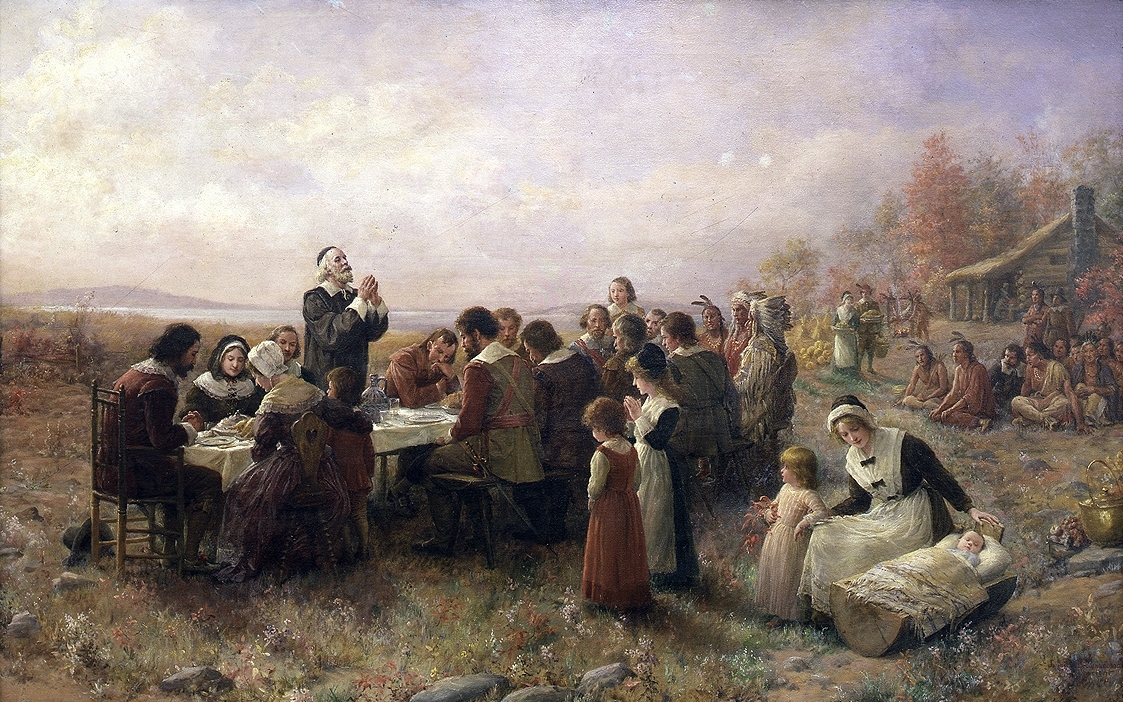
Thanksgiving. By: Jennie Augusta Brownscombe. (1914)
In the early Republic, religion took on a new role in society. In some segments of American society, religion became fervent. For example, in Cane Ridge, Kentucky in 1801, dozens of ministers of different denominations congregated with approximately 15,000-20,000 in a week-long conversion session. Gordon Wood, Empire of Liberty, 596. Amongst the “heat, the noise, and the confusion” were ministers, sometimes six preaching at a time, shouting “sermons from wagons and tree stumps.” Id. Many in the crowd “fell to the ground moaning and wailing in remorse; and they sang, laughed, barked, rolled, and jerked in excitement.” Id.
Meanwhile, the states took varying approaches to dealing with religion in government. New Hampshire, Connecticut, New Jersey, North Carolina, and Georgia “required officeholders to be Protestant,” while “Maryland and Delaware [required] Christians,” while “Pennsylvania and Souther Carolina officials had to believe in one God and in heaven and hell,” while “Delaware required a belief in the Trinity.” Id. at 583 citing James H. Smylie, “Protestant Clergy, the First Amendment and Beginnings of a Constitutional Debate, 1781-91,” in Elwyn A. Smith, The Religion of the Republic (Philadelphia, 1971), 117.
On the federal level, the Constitution of course provided protection for individuals to freely exercise their religion and also prohibited laws respecting an establishment of religion. U.S. Constitution, First Amendment. In 1802, Thomas Jefferson wrote that the First Amendment created a “wall of separation between church and state.” Thomas Jefferson to Messrs. Nehemiah Dodge and Others, 1 Jan. 1802, Jefferson: Writings, 510.
The role that religion would ultimately play in American society was not clear in the early years of the Republic. The hysteria that surrounded some of the religious ceremonies like described in Cane Ridge made clear that religion would play a central role to many. Thomas Jefferson, and the drafters of the Constitution realized that while religion may play a central role to the lives of many Americans, it could neither be endorsed nor prohibited by the government.
This careful move by the Founding Fathers ensured that while religion would be freely exercised and even ubiquitous in society, it would not be a democracy characterized by religion and certainly not a theocracy. The system embraced individual freedom and excluded government involvement where unnecessary. Fortunately, this system has largely been preserved by subsequent generations of Americans. Current and future public officials would do well to ignore any populist notions of the role religion should play in society and be keen on preserving the status quo of this effective system.
Thomas Jefferson Seated at His Desk. By: Gilbert Stuart, 1805.
The religious beliefs of the Founding Fathers may serve as a surprise to some modern Americans. However, it is important to put into context that the Founding Fathers lived in an era that was not filled with the religious fervor that would become commonplace in the 1800s. See Gordon Wood, Empire of Liberty, 576.
Thomas Jefferson hated “the clergy and organized religion.” Id. at 577. He said that the Trinity was “Abracadabra” and “hocus-pocus . . . so incomprehensible to the human mind that no candid man can say he has any idea of it,” and thus, ridiculing it was the best option. Id. quoting Thomas Jefferson to Horatio Spafford, 17 Mar. 1814, to James Smith, 8 Dec. 1822, in James H. Hutson, ed., The Founders on Religion: A Book of Quotations (Princeton, 2005), 68, 218.
Benjamin Franklin also appeared to harbor at least some dissension about religion, as he advised a friend in 1786 to not publish “anything attacking traditional Christianity” as “[he] that spits against the wind . . . spits in his own face.” Gordon Wood, Empire of Liberty, 589. Franklin was keenly aware of the fact that Thomas Paine had “destroyed his reputation” by writing “scathing comments about Christianity in his Age of Reason (1794).” Id. citing Thomas Paine, The Age of Reason (1794), in Eric Foner, ed., Thomas Paine: Collected Writings (Library of America, 1995), 825.
George Washington, however, “had no deep dislike of organized religion or of the clergy as long as they contributed to civic life.” Gordon Wood, Empire of Liberty, 585. In fact, during the Revolutionary War, “he had required all troops to attend religious services and had prescribed a public whipping for anyone disturbing those services.” Gordon Wood, Revolutionary Characters: What Made the Founders Different (New York, 2006), 35; Forrest Church, So Help Me God: The Founding Fathers and the First Great Battle over Church and State (New York, 2007), 36.
Underlying these early views was a key concept: the early American public would not tolerate its individuals, in government or not, undermining the sanctity of religion. Thomas Paine’s alienation, after his massive success of Common Sense highlights this fact.
It should also be noted that there were varying views about religion amongst the Founding Fathers. This diverse group of interests would ensure that the early Republic would not become a purely religious nation and not a purely secular nation.
As is evident in so many areas of American history, and world history for that matter, where diverse interests converge and the byproduct is moderation, success is much more likely. The role of religion in America was passed through this filter of moderation, which has ebbed and flowed for the past two centuries but has remained somewhere near the middle of the two options. That moderation has prevented religion from becoming a significant, schismatizing issue.
The Great Seal of the United States, as depicted on the one-dollar note.
In the earliest years of the Republic, the Founding Fathers sought to design the symbols and designs that would characterize the United States. One of the most prominent symbols of the early Republic is the Great Seal of the United States. Benjamin Franklin, Thomas Jefferson, and John Adams all tried to design the Great Seal. Gordon Wood, Empire of Liberty, 554.
Benjamin Franklin proposed “a biblical scene, that of Moses” dividing the Red Sea. Id. Jefferson also wanted a depiction of a biblical scene, “the Children of Israel in the Wilderness.” Id. Adams, however, “proposed Hercules surveying the choice between Virtue and Sloth, the most popular of emblems in the eighteen century.” Id.
Ultimately, Congress gave the job of designing the Great Seal to Charles Thomson, who designed the Great Seal familiar to all Americans. The eagle “on one side was a symbol of empire.” Id. The pyramid “represented the strength of the new nation,” and the “all-seeing eye on the reverse stood for providence.” Id.
The Latin mottoes also brought meaning to the new Republic. Novus Ordo Seclorum means “a new order of the ages,” and Annuit Coeptis means “He has looked after us.” These mottoes were taken from Virgil, the ancient Roman poet. Id. citing Frank H. Sommer, “Emblem and Device: The Origin of the Great Seal of the United States,” Art Quarterly, 24 (1961), 57-77; Steven C. Bullock, “‘Sensible Signs’: The Emblematic Education of Post-Revolutionary Freemasonry,” in Donald R. Kennon, ed., A Republic for the Ages: The United States Capitol and the Political Culture of the Early Republic (Charlottesville, 1999), 203, 210.
Meanwhile, others, like Jefferson, oversaw completion of buildings reminiscent of the ancient Roman buildings of many centuries ago. He sought to make the Virginia capitol building to be a copy of the Maison Carrée, an ancient Roman temple from the first century. Gordon Wood, Empire of Liberty, 558. Jefferson believed that buildings modeled after ancient Rome would “improve the taste of my countrymen, to increase their reputation, and to reconcile to them the respect of the world, and procure them its praise.” Thomas Jefferson to William Buchanan and James Hay, 26 Jan. 1786, to James Madison, 20 Sept. 1785, Papers of Jefferson, 9: 220-22, 8: 534-35.
These early actions by the Founding Fathers inform modern students of history, and modern Americans generally, of the grandeur and splendor that the Founding Fathers hoped America would enjoy. The Founding Fathers understood that the creation of the Republic provided the greatest hope for the country, and perhaps the world, to be the most well-functioning, egalitarian society since ancient Rome.
The aspirations of the Founding Fathers for America must have helped Americans to propel the country ahead of others and to maintain its stature. The Founding Fathers began the narrative that America was destined for greatness. While those beginnings were modest, and much turmoil was to unfold over the course of the young country’s history, Americans will recognize that those symbols of centuries ago and the accompanying mottoes are not just meaningless symbols. They are symbols that remind all Americans of the humble, hopeful beginning of the United States.




 Last Best Hope of Earth