
At the birth of the Republic, the contrast with the European monarchies became clear. The ideals of the Republic represented a fundamental shift in the role of government in individuals’ lives.
At the birth of the Republic, the contrast with the European monarchies became clear. The ideals of the Republic represented a fundamental shift in the role of government in individuals’ lives.

George Washington, to some, is revered as a brilliant general. To others, he is to be remembered because in his will drafted in the summer of 1799, he freed all of his slaves and took the extra step of ensuring that the slaves would be taught to read and write and be prepared for “some useful occupation.” Gordon Wood, Revolutionary Characters: What Made the Founders Different, 40. (more…)
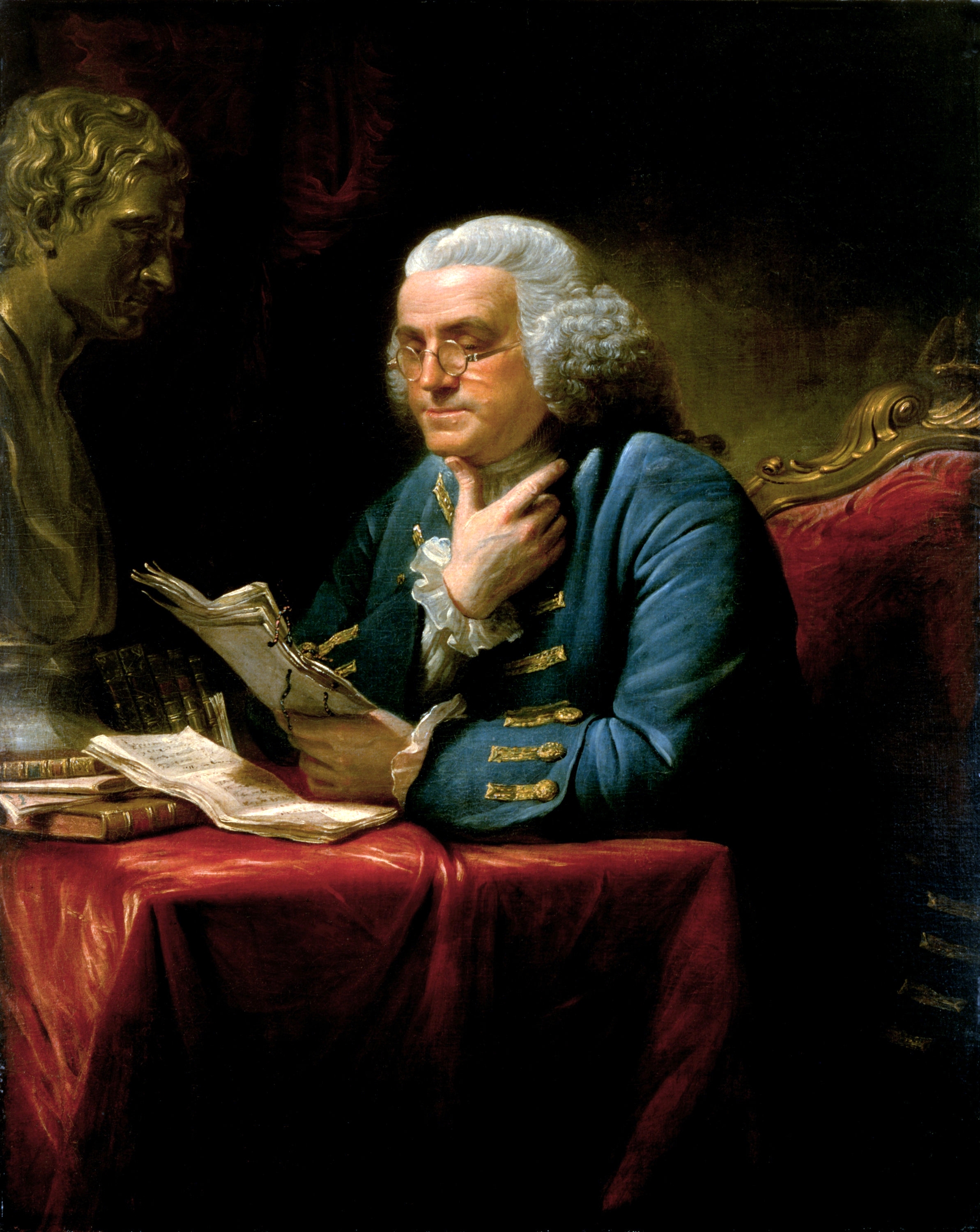
Benjamin Franklin, one of the most well-known and most revered Founding Fathers, had a more controversial history than most modern Americans realize.
In the late 1750s and early 1760s, Franklin was a “complete Anglophile.” Gordon Wood, Revolutionary Characters: What Made the Founders Different, 79. He made “disparaging comments about the provinciality and vulgarity of America in contrast with the sophistication and worthiness of England.” Id. He also believed that America, not England, was “corrupt and luxury-loving.” Id.
While living in England, Franklin was becoming more influential and had become a deputy postmaster. Id. at 84. In 1772, Franklin came into possession of some damning letters that would change his life. In the late 1760s, Thomas Hutchinson, the then-lieutenant governor of Massachusetts, had written letters to an Englishman advocating taking away liberties from the colonists so as to “maintain the colonies’ dependency on Great Britain.” Id. at 83. Franklin sent these letters to Massachusetts, prompting a crisis that would result in Franklin being terminated as deputy postmaster. Id.
In March 1775, he came back to America a changed man: a passionate patriot. Some of this passion was feigned, so as to show his fellow colonists that he was not an Englishman masquerading as a revolutionary. Id. at 84. He would become one of the most popular and widely respected Americans in the world, with only George Washington outshining him.
By the time of his death in 1790, Benjamin Franklin had created a legacy that lasts to this day. In the early Republic, that legacy was predicated on him showing that being self-made in America was not only possible, it was downright glamorous. Often forgotten or lost after those years of the early Republic, however, is that Franklin was not the same as the other Founding Fathers.
While Alexander Hamilton was not a full-blooded American and Thomas Jefferson spent a significant amount of time in Europe, Franklin so fully affiliated himself with England that it is difficult to draw a parallel to a contemporary American figure. In modern times, such an affiliation would certainly spell doom to a legacy.
Nonetheless, Franklin is remembered for his genius, his relatable nature, and his embodiment of the most American of ideals. Modern Americans’ forgiveness is likely warranted, but some may wonder: What if Franklin had not sent those letters? What would his legacy be then?
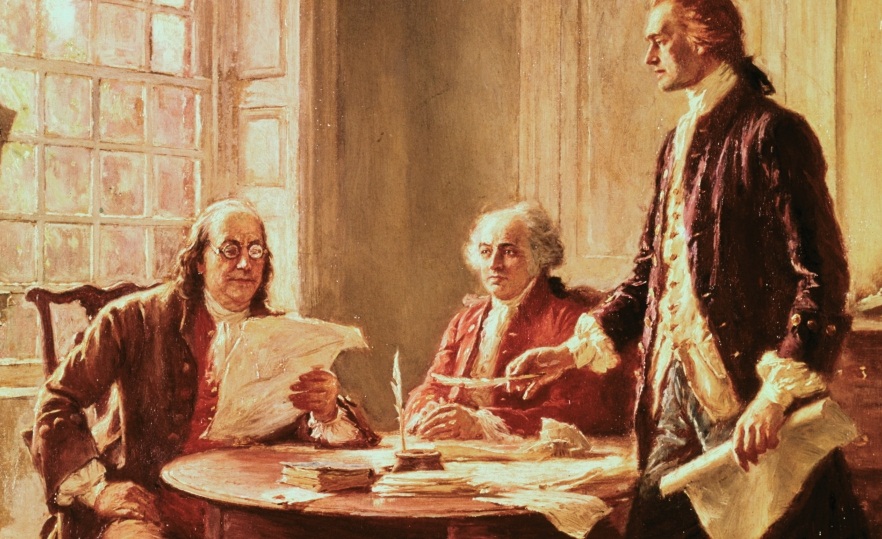
Gordon Wood began his 2006 book Revolutionary Characters: What Made the Founders Different by stating that “[n]o other major nation honors its past historical characters, especially characters who existed two centuries ago, in quite the manner we Americans do.” Gordon Wood, Revolutionary Characters: What Made the Founders Different, 3.
He continued, stating that Americans “want to know what Thomas Jefferson would think of affirmative action, or George Washington of the invasion of Iraq.” Id.
Scholars apparently have varying views as to why modern Americans revere the Founding Fathers, over two centuries after they first acquired their fame. Id. at 4.
Some scholars believe that it is because Americans are concerned “with constitutional jurisprudence and original intent” forming the basis for the Constitution. Id.
Other scholars posit that analyzing the Founding Fathers allows modern Americans to “recover what was wise and valuable in America’s past.” Id.
Another set of scholars explain that Americans look to the Founding Fathers to define the American identity. Id.
As Gordon Wood explained, this was not always the case. Toward the late 1800s and early 1900s, some Americans questioned the wisdom, accomplishments, and place of the Founding Fathers. Id. at 5. Nonetheless, for a significant portion of the 1900s and continuing into the 2000s, Americans look to the Founding Fathers for guidance.
While scholars may disagree as to the underlying purpose for modern Americans to honor the Founding Fathers, it can likely be explained by two points: (1) the Founding Fathers rigorously worked to create the best form of government possible and (2) the Founding Fathers knew adversity, difficulty, and hardship and yet held the country together.
As to the first point, the Founding Fathers engaged in one of the most substantial debates in history as to how a country should be best governed by its people to best ensure their happiness and prosperity. The resulting government was not only revolutionary and coherent, it has facilitated America’s success for two centuries with only 27 amendments to the Constitution being necessary.
The second point weighs a little heavier. The United States has endured many wars, tragedies, and difficulties. Few rival the tumultuous, uncertain times of the Revolution. Regardless, in both stable times and otherwise, America and its leaders have looked to the Founding Fathers for guidance. The logic underlying that goes “If the Founding Fathers could lead a revolution and fight a war against a mighty empire successfully, how would they deal with this scenario?”
All of the scholars’ views as to why Americans honor the Founding Fathers feeds into this point. When Americans ask these questions, like “What would the Founding Fathers do?”, they do so out of a wishful curiosity that leads to no clear answer.
This is a result that would likely please the Founding Fathers. The Founding Fathers did not have a secret to making the right decisions or coming to the right conclusions. They only did so through vigorous debate with each other and unyielding optimism about America’s future. That contentious debate spawned the system, institutions, beliefs, and ideals that define America.
Those debates should rage on with vigor. It is the least that modern Americans can do to repay the Founding Fathers.

The religious beliefs of the Founding Fathers may serve as a surprise to some modern Americans. However, it is important to put into context that the Founding Fathers lived in an era that was not filled with the religious fervor that would become commonplace in the 1800s. See Gordon Wood, Empire of Liberty, 576.
Thomas Jefferson hated “the clergy and organized religion.” Id. at 577. He said that the Trinity was “Abracadabra” and “hocus-pocus . . . so incomprehensible to the human mind that no candid man can say he has any idea of it,” and thus, ridiculing it was the best option. Id. quoting Thomas Jefferson to Horatio Spafford, 17 Mar. 1814, to James Smith, 8 Dec. 1822, in James H. Hutson, ed., The Founders on Religion: A Book of Quotations (Princeton, 2005), 68, 218.
Benjamin Franklin also appeared to harbor at least some dissension about religion, as he advised a friend in 1786 to not publish “anything attacking traditional Christianity” as “[he] that spits against the wind . . . spits in his own face.” Gordon Wood, Empire of Liberty, 589. Franklin was keenly aware of the fact that Thomas Paine had “destroyed his reputation” by writing “scathing comments about Christianity in his Age of Reason (1794).” Id. citing Thomas Paine, The Age of Reason (1794), in Eric Foner, ed., Thomas Paine: Collected Writings (Library of America, 1995), 825.
George Washington, however, “had no deep dislike of organized religion or of the clergy as long as they contributed to civic life.” Gordon Wood, Empire of Liberty, 585. In fact, during the Revolutionary War, “he had required all troops to attend religious services and had prescribed a public whipping for anyone disturbing those services.” Gordon Wood, Revolutionary Characters: What Made the Founders Different (New York, 2006), 35; Forrest Church, So Help Me God: The Founding Fathers and the First Great Battle over Church and State (New York, 2007), 36.
Underlying these early views was a key concept: the early American public would not tolerate its individuals, in government or not, undermining the sanctity of religion. Thomas Paine’s alienation, after his massive success of Common Sense highlights this fact.
It should also be noted that there were varying views about religion amongst the Founding Fathers. This diverse group of interests would ensure that the early Republic would not become a purely religious nation and not a purely secular nation.
As is evident in so many areas of American history, and world history for that matter, where diverse interests converge and the byproduct is moderation, success is much more likely. The role of religion in America was passed through this filter of moderation, which has ebbed and flowed for the past two centuries but has remained somewhere near the middle of the two options. That moderation has prevented religion from becoming a significant, schismatizing issue.
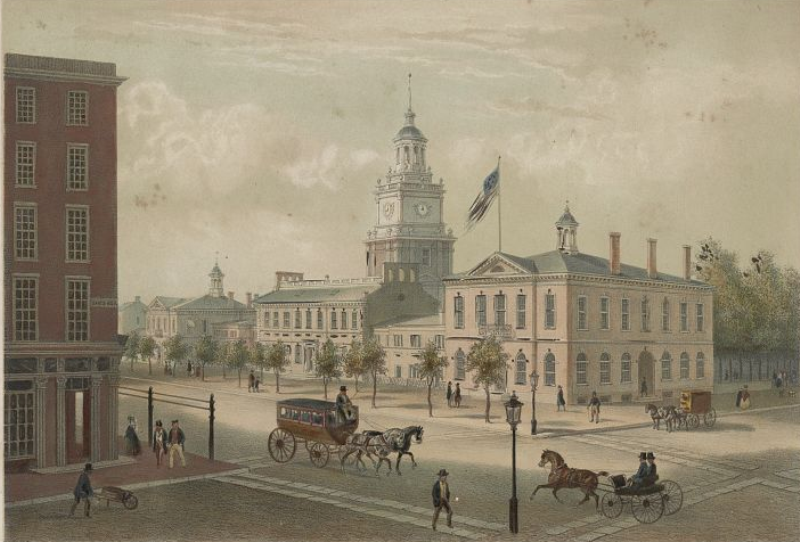
Throughout the development of early civil society in America, the familiar infrastructure to contemporary Americans rapidly developed. For example, as a result of new postal roads and turnpikes throughout the country, the postal system was able to achieve remarkable speeds for the time. For example, in 1790, “it had taken more than a month for news to travel from Pittsburgh to Philadelphia . . . .” Gordon Wood, Empire of Liberty, 479. Just four years later, the time was reduced to ten days. Id.
This improvement in the postal system would have a resulting effect on the proliferation of newspapers throughout America. Congress’s Post Office Act of 1792 ensured low rates for the mailing of newspapers, by virtue of letter-writers effectively subsidizing the postage for newspapers. Id.
This proliferation of newspapers created a widespread access to information, from small towns to big cities, and it did so rather quickly. For example, “[i]n 1800 the postal system transmitted 1.9 million newspapers a year; by 1820 it was transmitting 6 million a year.” Id. citing Richard R. John, Spreading the News: The American Postal System from Franklin to Morse (Cambridge, MA, 1995), 36-42.
Newspapers became an American obsession. During George Washington’s presidency, the entire country had 92 newspapers, but by 1810, there were sales in excess of 22 million copies of 376 newspapers annually, the “largest aggregate circulation of newspapers of any country in the world.” Gordon Wood, Empire of Liberty, 479 citing Alfred M. Lee, The Daily Newspaper in America (New York, 1937), 715-17; Frank Luther Mott, American Journalism: A History of American Newspapers in the United States Through 250 Years, 1690-1940 (New York, 1941), 159, 167; Merle Curti, The Growth of American Thought, 3rd ed. (New York, 1964), 209; Donald H. Stewart, The Opposition Press of the Federalist Period (Albany, 1969), 15, 624.
The fear that many of the Founding Fathers held that Americans would become as ignorant as their English counterparts, leading to all of the plaguing problems of government and society that ignorance brings, quickly proved to be an unfounded fear. Americans had a thirst for knowledge and were eager to get access to the crucial medium of the newspaper.
This thirst for knowledge has continued to today. As discussed in The Newspaper Revolution, Americans now enjoy the privilege of accessing many forms of media, all of which contain a volume of information that cannot all be feasibly read and understood. Setting aside the allegations of bias that many have about modern media, which surely has always permeated media to varying extents, this access to knowledge is undoubtedly crucial for the continuation of the Republic and the health of the democracy of America.
It allows any individual to learn what is happening in the world and to adopt positions regarding both domestic and foreign policy, which presumably will lead to a more informed decision in elections and more active participation in politics and discourse of issues.
The thirst of the early Americans for knowledge and information about what was happening in the world, combined with the early government’s understanding that a robust infrastructure was necessary for the dissemination of information (and travel), allowed for the development of the society we recognize today. As is clear from modern society, Americans are certainly obsessed with media, whether they enjoy it, attack it, or just simply listen to it.
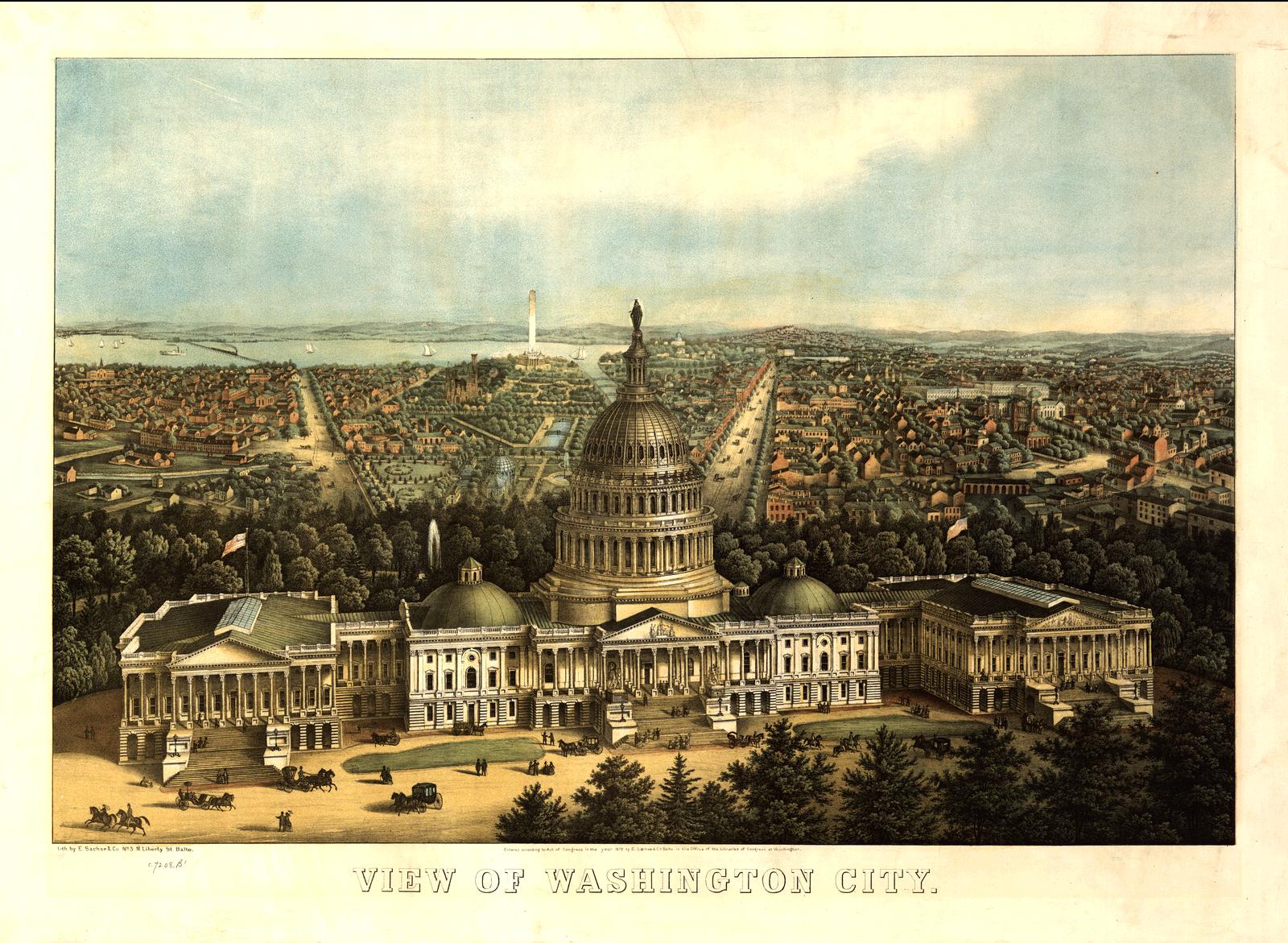
In the late 1790s, Constantin Francois Volney published Ruins; or, Meditations on the Revolution of Empires, one of the most popular publications of its day. This publication not only attacked monarchical tyranny, but it reinforced amongst Americans ideals familiar to Americans then and now: that nations are fragile and seem to inevitably decay and decline. Gordon Wood, Empire of Liberty, 552.
This keen awareness to the “mortality of all states” reinforced Americans’ “desire to build in stone and marble and to create depositories in order to leave to the future durable monuments of America’s cultivation and refinement.” Id.
Further, Comte de Volney’s book hinted that “an uncorrupted republican government might evade the decline and decay that had beset all other governments.” Id. citing Constantin Francois Volney, A New Translation of Volney’s Ruins; or, Meditations on the Revolution of Empires (Paris, 1802).
There are two points of analysis from the popularity of Comte de Volney’s book in the years of the early Republic.
First, this book and underlying American beliefs combined to form the nearly uniform desire for America to not just be a powerful country in the modern world but to perpetuate itself and to be in the annals of the world as one of the most extraordinary countries to have existed. From the beginning, Americans have been keen on memorializing its most important buildings to stand the test of time. This is most obviously evidenced in the government buildings both on the federal and state levels. Washington DC itself is testament to America’s desire to build a legacy to last.
Second, Comte de Volney’s book reinforces the notion that nearly all Americans share: that somehow, the United States can avoid inevitable decline. In support of that hope, many look to the fact that in the history of the world, there has never been such a democracy on the scale of the United States with the emphasis on rights and values that characterize America. On the other side of the argument, many would argue that success breeds complacency which breeds inefficiency, leading to decline.
The truth about decline is probably somewhere in between the two positions. Neither success nor decline is inevitable, particularly in light of the fact that America’s model has never been tested before.
The words of George Washington could not be truer: “The establishment of our new Government seemed to be the last great experiment for promoting human happiness.” George Washington, January 9, 1790. That experiment is ongoing and hopefully will be for many centuries to come.

Early Americans had varying views on slavery, which would set the course for slavery to become a main point of contention for Americans by the time the Civil War erupted.
For example, in the late 1700s, many Chesapeake farmers hired out their slaves to other farmers. Gordon Wood, Empire of Liberty, 511. This development led some to believe that slavery would eventually be replaced by wage labor. Sarah S. Hughes, “Slaves for Hire: The Allocation of Black Labor in Elizabeth City County, Virginia, 1782 to 1810,” WMQ, 35 (1978), 260-86. Consequently, some Americans believed that slavery was but a passing trend that would evolve and no confrontation would emerge on the issue.
Both George Washington and Thomas Jefferson were slave owners, but each had their own view on the subject. George Washington saw that slaves “had no incentive to work hard and develop ‘a good name’ for themselves,” which he saw as slavery’s biggest flaw. Gordon Wood, Empire of Liberty, 513. This led to the question of what slaves could accomplish had they had opportunities for advancement in both reputation and respect, which was a subject Washington pondered. Robert F. Dalzell Jr. and Lee Baldwin Dalzell, George Washington’s Mount Vernon: At Home in Revolutionary America (New York, 1998), 129, 212-13. Jefferson, meanwhile, owned one of the largest plantations in Virginia at the time, holding around 200 slaves at any given time. While he infamously condemned slavery and yet maintained a plantation with slaves, he was known as a compassionate owner, comparatively speaking. He would prescribe lighter work for women, children, the elderly, and the sick. Gordon Wood, Empire of Liberty, 515. Nonetheless, his slaves would inevitably receive lashings for misbehavior. The fact that Jefferson could be viewed as a compassionate owner speaks volumes about the severity of slavery, where the most inhumane and cruelest treatment was viewed as normal.
Finally, there were those who opposed slavery and spread an egalitarian message hoping to abolish slavery. Gordon Wood in Empire of Liberty theorizes that the spread of this message essentially forced slave owners who wished to preserve their livelihood to “fall back on the alleged racial deficiencies of blacks as a justification for an institution that hiterto they had taken for granted and had never before needed to justify.” Id. at 508. Thus, Wood concluded, “[t]he anti-slavery movement that arose out of the Revolution inadvertently produced racism in America.” Id.
As we now know, the early Americans’ views would ultimately collide and culminate in the Civil War some decades later. Retrospectively, it seems that it would have been naive to expect slave owners like Jefferson and Washington to truly advocate for the cause of abolishing slavery. While they were part of the group of Americans who realized that slavery was ultimately a wrong that must be righted, their personal observations about and actions toward their own slaves seem to show their mentality being akin to “This is hindering the country and its people, but someone else in the future is going to have to solve it.” And so it happened that way. But it deserves mention that the early Republic was replete with significant, fundamental issues that would shape the future of the country, many of which have been minimized or forgotten compared to the issue of slavery. Thus, to squarely blame Jefferson and Washington for not ending slavery would be unfair.
As to Wood’s conclusion that the anti-slavery movement ultimately created racism, this deserves a great deal of consideration and analysis. The first and most obvious question is: Wouldn’t racism always have been the slave owners’ justification? Whether it was the anti-slavery movement or some other external pressure, such as economic inefficiency of slavery, slave owners would have been forced to one day justify the existence of slavery. For the slave owners, it seems that the quickest defense would have been race. While Wood may not have intentionally implied that the anti-slavery movement was solely at fault for creating racism, most would take issue with that conclusion.
Regardless, the massive issue of slavery, with its lengthy, disturbing history, was set on a new course in the earliest days of the Republic. While this course would result in the Civil War, it also would result in the abolishment of slavery. That is the result Jefferson wanted, the result Washington wanted, and the result that helped America to move forward.
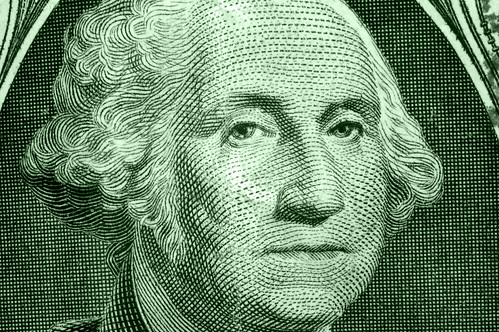
Washington’s writings are replete with revelations about the hopes and aspirations for the country. Often, it is common for modern Americans to think that the Founding Fathers, despite all of their wisdom, could hardly imagine what the United States would become. For instance, now, the world is interconnected in a way as never before. One may be tempted to posit that the world has become a more complicated place, and our recent leaders have created new tactics to deal with geopolitical issues. One such tactic that one may imagine is newly created is the use of economic sanctions.
In fact, the Founding Fathers not only contemplated the use of economic sanctions, but sought for the implementation of sanctions in lieu of going to war. In George Washington’s letter to Lafayette, dated August 15, 1786, he noted “the probable influence that commerce may hereafter have on human manners and society in general,” hoping that it could lead to the demise of “the devastation and horrors of war.” Fitzpatrick, ed., Writings of Washington, 28: 520. Nor was Washington alone in this belief. Far from it.
Thomas Jefferson and James Madison had consistently hoped for the same, aspiring for the day where American sanctions would divert wars but preserve American interests. Gordon S. Wood, Empire of Liberty, (New York, 2009), 138.
As is clear from modern history, economic sanctions have shown their utility, whether they be imposed for ideological differences, such as against Russia and former Soviet Union countries or imposed to discourage nuclear development and proliferation, such as against Iran. The use of economic sanctions is of course premised on America having a fundamental role in the world economy, which has certainly been the case in the last century and continuing until now.
Presently, the United States accounts for 23% of global gross domestic product and 12% of merchandise trade. The Economist, Vol. 417, No. 8958 (October 3, 2015). Having such a significant role in the world economy gives the United States the “soft power” of influencing other countries to act in accordance with America’s best interests, without America committing significant resources.
The Founding Fathers, in their wisdom and their grand hopes for the United States, hoped to see this day, where the sheer size and power of the economy would force others to bend to American interests. Their imagined use, or the threat of use, of economic sanctions has come to fruition. Just another instance of the prescience of the Founding Fathers.
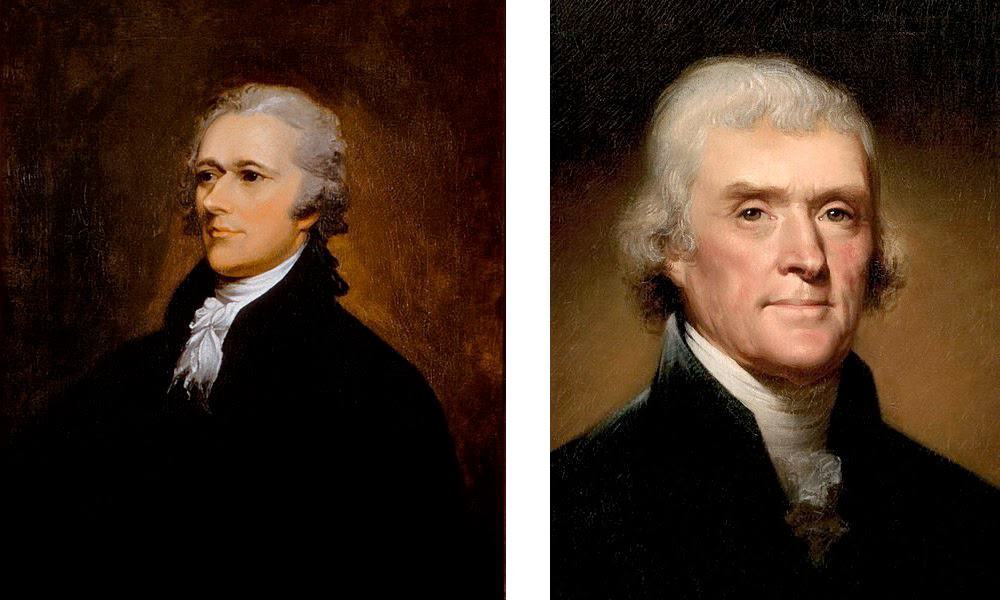
Alexander Hamilton and Thomas Jefferson had a contentious relationship, from their time serving as Secretaries in Washington’s administration forward. That contentious relationship manifested itself, at least partially, in the fact that they had crucial ideological differences. At first, those ideological differences were not reflected by different memberships in political parties. During the time they were Secretaries in Washington’s administration, there were no political parties.
When the two political parties, the Federalists and the Republicans, were created, Hamilton and Jefferson both had overblown ideas of what would each other’s party intended. Jefferson feared that Hamilton wished to implement a monarchy, and Hamilton feared that Jefferson intended to overthrow the government of the United States. As a general matter, the Federalist government feared that any Republicans or individuals with different views were determined to undermine the existence of the government and determined to bring an end to the system that the majority of Americans had worked so hard to create.
In fact, however, the Republican party did not see itself as a political party, and the Federalists did not view themselves as members of a political party in those early years. For example, the Federalists saw themselves as the vast majority of people who were concerned about the state of the country. Those in the Republican party ultimately began making Democratic-Republican Societies throughout the country, which demanded changes from the status quo of the predominantly Federalist government.
What a change the political party system has undergone since the late 1790s. Many would attribute the success of America’s political system to the fact that two main parties, now the Democrats and Republicans, have consistently vied against each other, generally agreeing to move the country forward by meeting in the middle. As Hamilton and Jefferson exaggerated the intentions and beliefs of the opposing party, modern Democrats and Republicans tend to do the same, at least to an extent.
That healthy debate between two adversaries has sustained not only the court system from ancient days to modern days but also the American system of politics. An adversarial contest between two parties prevents a cacophony of voices that tend to overwhelm multi-party political systems. Rather, it places two parties against each other, creating competition, encouraging debate, and having the net effect of putting the country on a moderate path, with gradual changes coming over the course of decades. Perhaps that gradual, conservative nature of progress has been the cause of America’s prolonged success.
 Last Best Hope of Earth