Tag: Georgia

  • The Civil War: Alexander H. Stephens: “Corner-Stone” Speech

    The Civil War: Alexander H. Stephens: “Corner-Stone” Speech

    March 21, 1861

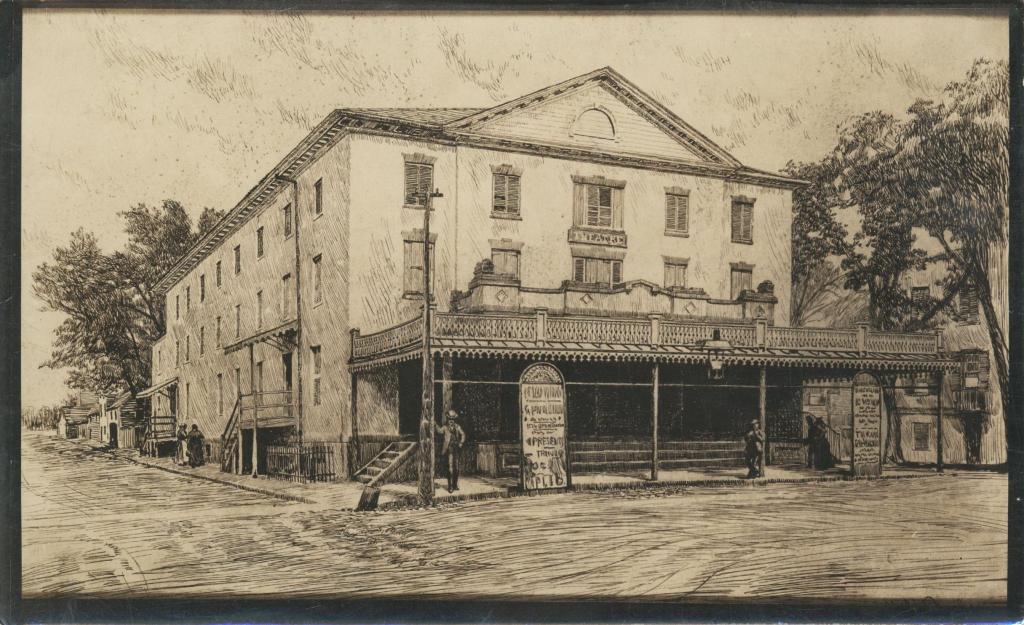
    In Savannah, Georgia, at its Atheneum—a theater for shows and oratory—the vice-president of the Confederacy, Alexander H. Stephens, came to speak about the events leading up to states seceding from the Union and forming the Confederacy. The pace of these events had been swift and sure to cause consternation with questions abound as to what would happen next. To hear Stephens speak that day was to gain a better grasp of what was to come and perhaps a sense of comfort that all would be well.

    (more…)
  • The Civil War: Joseph E. Brown to Alfred H. Colquitt

    December 7, 1860

    A false dichotomy, or false dilemma, is a situation where a person is choosing from two options and believes that there are no other options available. The worst kind of false dichotomy occurs where there are not only other options but false information matriculating into the public discourse and creeping into the minds of people—particularly those people who are easily influenced; the kind of people who can come to believe anything, no matter how outlandish.

    (more…)
  • The Civil War: Benjamin Hill: Speech at Milledgeville

    November 15, 1860

    There is an assumption that people throughout the South were the only ones calling for a dissolution of the Union. This is a faulty assumption; there were people in the North who saw no potential for reconciliation and called for dissolution. Some people even argued that the Constitution’s acknowledgement of slavery was a basis to set it aside and to replace it with a document that reestablished the republic without the institution of slavery—albeit a republic comprised of only those states that would not tolerate slavery.

    (more…)
  • The Hunt for Jefferson Davis

    The president was on the run. He hadn’t just gotten away; he had been evading his pursuers for some time. This man had been the president of the Confederacy, and now he was the most wanted man in the country, overseeing the few remaining people and things that belonged to the breakaway country. By this time, the Civil War had ended for all intents and purposes: there was no army under his control anymore, but there was a loyal group of men who were helping him live on the run. And there was no telling how long he would live this way. Whereas his soldiers had laid down their arms and many had already returned home to begin their post-war lives, this man had been fleeing for some time—perhaps because the consequences of his actions were outside his control and were no longer applied to his soldiers or even his top advisors; those consequences would flow directly to him now. There loomed the possibility that those in power in Washington would see to his imprisonment or even his execution. Confederate president Jefferson Davis could take heart, as a Mississippian, that perhaps President Andrew Johnson—a Tennessean—would see to those federals going easy on Davis, but that was just a hope, a wish. And that would only be a possibility if Davis was captured.

    (more…)
  • Tightening the Cordon

    Tightening the Cordon

    By the end of 1864—with Union General William Tecumseh Sherman having cut his way through Georgia, Union General Ulysses S. Grant having confined Confederate General Robert E. Lee to a defensive position in Virginia, and President Abraham Lincoln having won his bid for re-election—the Confederacy was desperate for any sign of encouragement. While the rhetoric from Confederate President Jefferson Davis and Vice President Alexander Stephens had remained buoyant, and despite newspaper headlines throughout the South continuing to cheer for the cause, the Confederacy was nowhere near the crest it had enjoyed in 1863. Having lost the chance to put the Union on the defensive that year, the rebels now found their western and southern borders closing in on them. If ever there was going to be a negotiated peace, the chances of it occurring were rapidly diminishing as 1865 dawned. (more…)

  • Andersonville Prison

    Andersonville Prison

    Throughout the Civil War, there was no shortage of suffering on the battlefield, but even the newest soldier knew that being taken prisoner was likely to lead to more suffering. While a Confederate prisoner may have reasonably expected that he could obtain improved rations in a northern prison—particularly as the war progressed and rebel supplies had become increasingly stretched—a Union soldier could precisely expect the converse: that if he were taken prisoner, he would receive fewer and poorer rations than that of his starving adversary. While any rebel military prison was expected to be an unwelcome place because of smaller rations and numerous other factors, none has had the enduring reputation of being the site of vileness as the prison situated in Andersonville, Georgia, which operated from the Winter of 1864 to the Spring of 1865. (more…)

  • The March to the Sea

    The March to the Sea

    Throughout the Civil War, soldiers and citizens alike could view the events unfolding before them and question whether there was a better alternative than to prosecute the war to its bitter end. What had started as a spectator’s war—with men and women gathering near the battlefields to picnic and take in the action—had morphed, by mid-1864, into slaughter with the only variables being where the slaughter may occur and what magnitude it may reach. One veteran lieutenant recalled after the war, “As we lay there watching the bright stars, many a soldier asked himself the question: What is this all about? Why is it that 200,000 men of one blood and one tongue, believing as one man in the fatherhood of God and the universal brotherhood of man, should in the nineteenth century of the Christian era be thus armed with all the improved appliances of modern warfare and seeking one another’s lives? We could settle our differences by compromising, and all be at home in ten days.”[i] Of all the soldiers that gazed at the bright stars and asked themselves these questions, the men under the command of Union General William Tecumseh Sherman were not a part of that group when they left Atlanta burning and began a campaign through the heart of Georgia to the Atlantic Ocean. (more…)

  • The Taking of Atlanta

    The Taking of Atlanta

    According to Confederate President Jefferson Davis, the fall of Atlanta into Union hands would “open the way for the Federal Army to the Gulf on the one hand, and to Charleston on the other, and close up those rich granaries from which Lee’s armies are supplied. It would give them control of our network of railways and thus paralyze our efforts.”[i] The strategic location of the city was only one of several reasons for the Confederates to hold it: Atlanta had seen tremendous growth during the war with “foundries, factories, munitions plants, and supply depots” having sprung up on account of the city becoming a railroad hub.[ii] Capturing the city became the primary goal of Union General William Tecumseh Sherman, but, because the rebels had come to see the city as being second only to Richmond as a “symbol of resistance and nationality,” the campaign to Atlanta was almost certain to be easier than taking Atlanta.[iii] (more…)

  • The Atlanta Campaign

    ECWC TOPIC Atlanta Campaign Dalton to Chattahoochee PIC Battle of Kennesaw Mountain
    Battle of Kennesaw Mountain. By: Thure de Thulstrup. Courtesy: U.S. Department of the Interior.

    After over four years of fighting, the North and the South had become increasingly fatigued with the war and anxious for its resolution. Throughout the Confederacy, hope was growing that the Union, rather than continue to tighten its grip at the expense of casualties on both sides, would agree to a negotiated peace. Standing in the way of that result was President Abraham Lincoln who had expected nothing less than a total victory. While the Union generals led by Ulysses S. Grant had achieved progress by taking territory in the west and cutting off resources to the Confederate capital, for each of the past four years, momentum had stalled whenever any general, including Grant, had come within earshot of Richmond. With the election of 1864 approaching, the rebels saw the potential for the northern electorate to oust Lincoln and bring a president to Washington that would negotiate an end to the war. (more…)

  • The Battle of the Wilderness

    The Battle of the Wilderness

    By the spring of 1864, changes were abound on the Union side. Three generals—Ulysses S. Grant, William Tecumseh Sherman, and Philip Sheridan—had become the preeminent leaders of the northern army. With Congress having revived the rank of lieutenant general, a rank last held by George Washington, President Abraham Lincoln promoted Grant to that rank and bestowed on him the title of general in chief.[i] While the North was in the ascendancy, the Confederate army had suffered through the winter. The Confederate Congress had eliminated substitution, which had allowed wealthy southerners to avoid conscription, and “required soldiers whose three-year enlistments were about to expire to remain in the army.”[ii] Even with Congress taking the extraordinary step of adjusting the draft age range to seventeen years old through fifty years old, the rebels still numbered fewer than half their opponents.[iii] Nonetheless, hope was not lost: a camaraderie pervaded the Southern army—particularly amongst the many veteran soldiers—which was perhaps best encapsulated in General Robert E. Lee’s saying that if their campaign was successful, “we have everything to hope for in the future. If defeated, nothing will be left for us to live for.”[iv] (more…)