Divided government, where one branch of government is controlled by a different political party than the other branches, is a familiar concept for most Americans. The midterm elections of 1826 and 1827 brought about the first instance in American history of divided government.
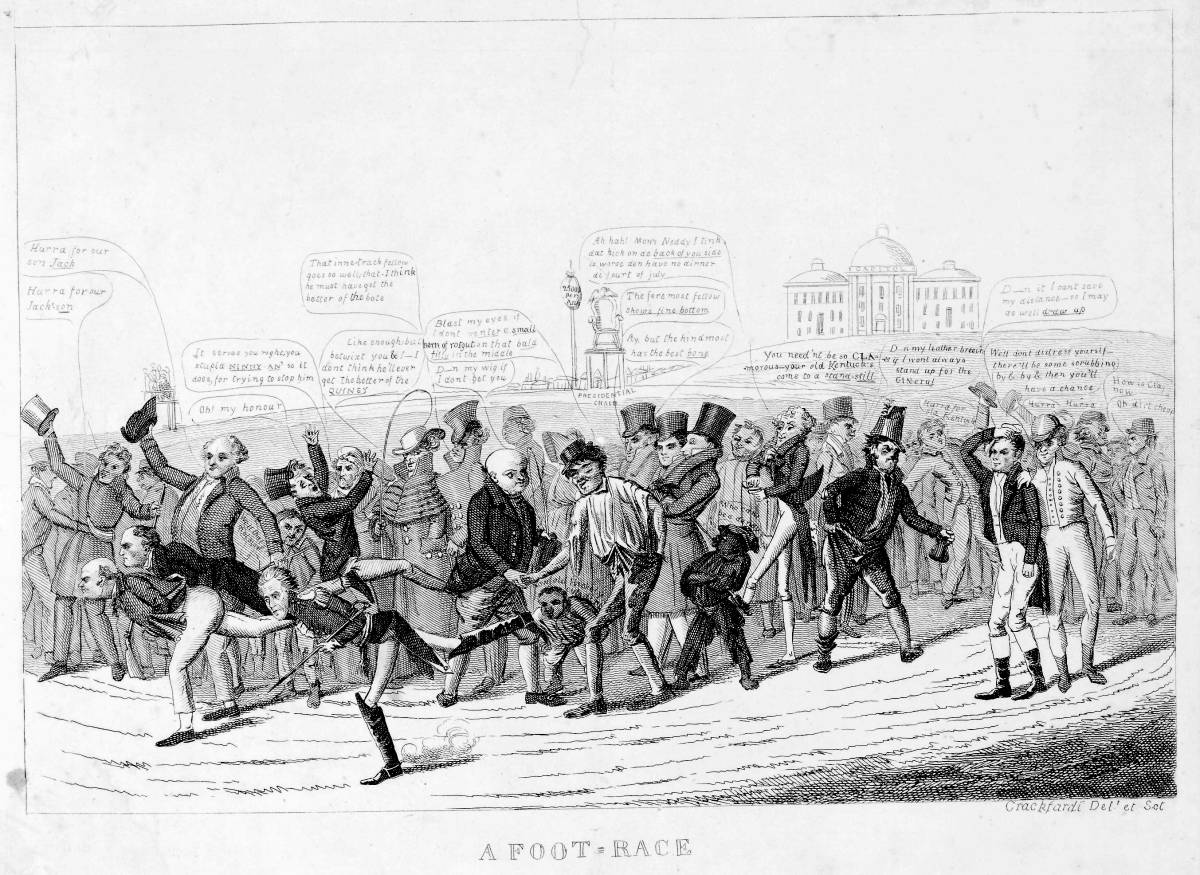
A Foot Race. Political Cartoon of the Election of 1824.
Following the Election of 1824, newly elected President John Quincy Adams went into the White House with a great deal of hope for the future. He was a lifelong student of Cicero and “envisioned the American republic as the culmination of the history of human progress and the realization of the potential of human nature.” Daniel Walker Howe, What Hath God Wrought: Transformation of America, 1815-1848, 245. In fact, historians have remarked that Quincy Adams was the “most learned president between [Thomas] Jefferson and [Woodrow] Wilson.” Id.
Not long after the election of 1820, an essentially uncontested election seeing the re-election of President James Monroe, the campaigning for the election of 1824 began. President Monroe had indicated that he would not seek an unprecedented third term as president, but that did not stop others from posturing for the election. As a journalist observed in the spring of 1822, “electioneering begins to wax hot.” Daniel Walker Howe, What Hath God Wrought: Transformation of America, 1815-1848, 203 quoting James F. Hopkins, “Election of 1824,” in History of American Presidential Elections, ed. Arthur M. Schlesinger Jr. (New York, 1985), 363.
East and West Florida, property of the Spanish Empire, had become coveted land for America in the early 1800s. It could lend a strategic stronghold for America and open up the Pearl, Perdido, and Apalachicola Rivers to commercial trade. Daniel Walker Howe, What Hath God Wrought: Transformation of America, 1815-1848, 97.


 Last Best Hope of Earth