Tag: House of Representatives

  • A Deadlocked and Destructive Congress

    oneofive
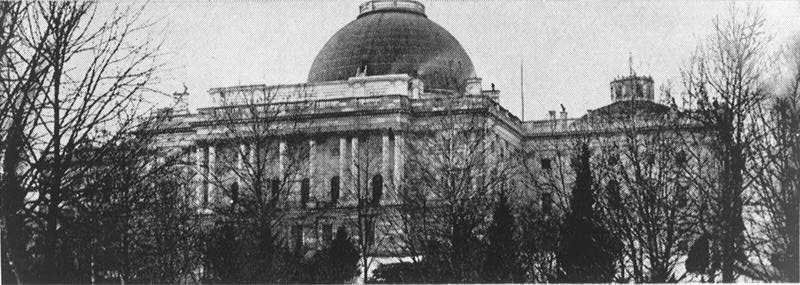
    The United States Capitol in 1848. Unknown Photographer, credit Library of Congress.

    During President James Polk’s administration, Congress grappled with resolving sectional tension arising out of whether slavery would be extended to newly acquired land from Mexico as well as the Oregon territory. Congress did not resolve that sectional tension but exacerbated it in what may have been one of the most deadlocked and destructive Congresses in American history. (more…)

  • The Theories of Slavery

    a89cbad2a1dccb130f3199e02ae7de2c
    Trout Fishing in Sullivan County, New York. By: Henry Inman.

    In the 15 years leading up to the Civil War, a wide variety of theories emerged for how the federal government should deal with slavery expanding, or not expanding, into the territories acquired by the United States.

    (more…)

  • Constitution Sunday: Reply to Mason’s “Objections”: “Civis Rusticus”

    Reply to Mason’s “Objections”: “Civis Rusticus”

    Virginia Independent Chronicle (Richmond), January 30, 1788

    Following are excerpts of an article written in response to George Mason’s article listing the objections to the Constitution:

    “5th. Had the convention left the executive power indivisible, I am free to own it would have been better, than giving the senate a share in it (more…)

  • The Death of John Quincy Adams

    john_quincy_adams_daguerreotype_c1840s
    Daguerrotype of John Quincy Adams.

    One of the most outspoken Representatives in the House of Representatives, John Quincy Adams, had opposed the declaration of war on Mexico and fought President James Polk’s policies for the duration of his presidency.

    (more…)

  • Lincoln’s Spot Resolutions

    hd_ldfootracez-preview
    Political Cartoon Depicting Abraham Lincoln.

    At the end of the Mexican-American War, President James Polk proposed taking as much as Mexico’s land as possible. However, he proposed this plan to a majority Whig House of Representatives.

    (more…)

  • Constitution Sunday: Refutation of the “Federal Farmer”: Timothy Pickering to Charles Tillinghast

    Refutation of the “Federal Farmer”: Timothy Pickering to Charles Tillinghast

    Philadelphia, December 24, 1787

    Following are excerpts from Timothy Pickering’s letter to Charles Tillinghast, refuting the “Federal Farmer”:

    “In respect to the organization of the general government, the federal farmer, as well as other opposers, object to (more…)

  • The Censure of John Quincy Adams

    220px-john_quincy_adams
    John Quincy Adams.

    In 1842, John Quincy Adams presented to the House of Representatives a petition from 42 residents of Haverhill, Massachusetts, requesting that the Union be dissolved. Daniel Walker Howe, What Hath God Wrought: Transformation of America, 1815-1848, 610. Henry Wise, Congressman from Virginia, “demanded the former president be censured.” Id.

    (more…)

  • The Illinois System

    abraham_lincoln_by_nicholas_shepherd2c_1846-crop
    Abraham Lincoln in 1846, then Representative from Illinois. By: Nicholas H. Shepherd.

    Abraham Lincoln, as a Congressman in the House of Representatives, would be “an ardent supporter of internal improvements.” Daniel Walker Howe, What Hath God Wrought: Transformation of America, 1815-1848, 596.

    (more…)

  • The Master of Parliamentary Procedure

    john_q-_adams
    John Quincy Adams.

    The United States Congress was not above adopting its own rules that would silence abolitionist views. While mass mailings to southerners became a regular occurrence for abolitionists, creating significant tension between proslavery and anti-slavery factions, those had occurred outside the purview of government. The House of Representatives, when it used a gag rule to prevent discussion of petitions relating to abolition, was striking a blow to abolitionists all over the country.

    (more…)

  • A First Test for Separation of Church and State

    cholera-1832
    A Depiction of the Cholera Outbreak in New York City in 1832.

    With the communications and transportation revolution came new, unforeseeable consequences. One such consequence was the spread of cholera and other contagious diseases, which would test the mettle of Americans.

    (more…)