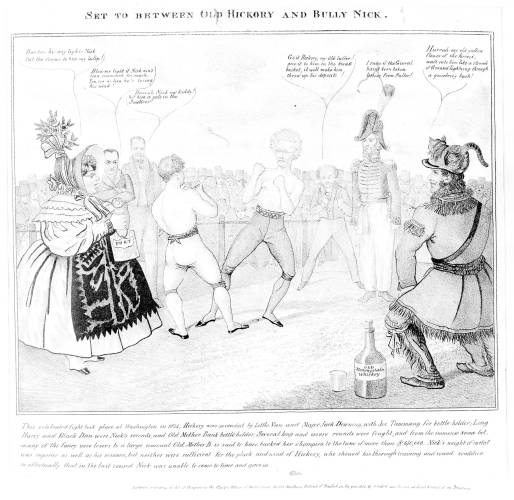
Political Cartoon of Andrew Jackson and Nicholas Biddle. Published in Harpers Weekly in 1834.
President Andrew Jackson did not want banknotes in the American economy, as he was an adherent to the gold standard. Daniel Walker Howe, What Hath God Wrought: Transformation of America, 1815-1848, 376. He would be forced to confront Nicholas Biddle, the President of the Second Bank of the United States.
By 1819, the area west of the Mississippi River, known as the Missouri Territory, had obtained a population qualifying it to be admitted to the Union. Daniel Walker Howe, What Hath God Wrought: Transformation of America, 1819-1848, 147. The only requirement to be admitted was that an enabling act be presented to Congress “authorizing Missouri voters to elect a convention to draft a state constitution.” Id. That bill was proposed, but Representative James Tallmadge proposed an amendment prohibiting further “importation of slavery” and “all children of slaves born after Missouri’s admission to the Union should become free at the age of twenty-five.” Id. This provoked great “consternation in the House of Representatives.” Id. citing Annals of Congress, 15th Cong., 2nd sess., 1170.
East and West Florida, property of the Spanish Empire, had become coveted land for America in the early 1800s. It could lend a strategic stronghold for America and open up the Pearl, Perdido, and Apalachicola Rivers to commercial trade. Daniel Walker Howe, What Hath God Wrought: Transformation of America, 1815-1848, 97.
Following the War of 1812, President James Madison was proudly touting the status of America. It had mobilized its navy to protect trade in the Mediterranean Sea, it had reestablished commercial relations with Britain, and it had pacified the Native Americans. See Daniel Walker Howe, What Hath God Wrought: Transformation of America, 1815-1848, 80.
By 1815, America was already split between those states that were taking steps to eliminate slavery and those states who were fortifying their support of slavery. As the Founding Fathers had predicted, a chasm was beginning to open in the United States.
Looking to the state governments’ creation of their respective senates, as explained in The Birth of the Senate, the creation of the Senate in the Constitution was a given, when the Constitutional Convention began. See Gordon Wood, The Creation of the American Republic: 1776-1787, 553.
In the 1780s, Americans, like John Dickinson, observed that “[p]eople once respected their governors, their senators, their judges and their clergy; they reposed confidence in them; their laws were obeyed, and the states were happy in tranquility.” Dickinson, Letters of Fabius, Ford, ed., Pamphlets, 188. The authority of the government was declining. Gordon Wood, The Creation of the American Republic: 1776-1787, 507. (more…)
While an upper house of state legislatures was desirable to some, as explained in The Birth of the Senate, it also had its detractors. Those detractors argued that it was a mere redundancy, wholly irrelevant to the founding of a stable government. In taking that position, the detractors ignored many of the benefits of having a second house in the legislature.
City Hall of New York City in 1789, where Congress convened during the 1790s.
In the earliest years of the American Republic, theories were abound about the proper structure of government to best balance equality and wise decision-making. John Adams stated, in his Thoughts on Government, that “a people cannot be long free, nor ever happy, whose government is in one assembly.” Gordon Wood, The Creation of the American Republic: 1776-1787, 208-09 quoting John Adams, Thoughts on Government, Adams, ed., Works of John Adams, IV, 194, 196. These theories became tested throughout the young country, in each of the state’s constitutions.
Painting of the Inauguration of President George Washington. By: Jean Leon Gerome Ferris.
For many of the Founding Fathers, the biggest threat to the stability and success of the United States was tyranny. Tyranny was a force that could bring down the most free and just societies. Underlying much of the creation of the institutions that now define the American government, the judiciary, the legislature, and the executive, are precautionary and prophylactic measures to prevent tyranny. (more…)



 Last Best Hope of Earth