
With the Civil War’s end, the United States had put itself back on course to become one of the leading economies in the world. Economic strength begets influence around the world, and America was no exception to this principle; it now was entering an era—an era that, as of the time of this writing, has not come to a close—of taking part in directing the world’s affairs. More than that, America now had the potential to reshape parts of the world in its image. After all, this was the 19th Century, and the era of empires was arguably at its peak—although its sun was setting. For the time, there was an expectation: if you had the opportunity and resources to expand, to take more land and more people into your orbit, you took full use of the opportunity. To abstain from this mode of operation was to concede a wealth of riches, and indulging in the taking of those riches was no cause for shame; every one of the major powers—some for decades, some for centuries—had carved up a part of the world, had made their own empire.
(more…)Tag: Imperialism
-
The Revolution: Cato’s Thoughts on a Question Proposed to the Public (Part III)
Pamphlet by “Cato”: Thoughts on a Question of Importance Proposed to the Public, Whether it is probable that the Immense Extent of Territory acquired by this Nation at the late Peace, will operate towards the Prosperity, or the Ruin of the Island of Great-Britain?
London, 1765.
Part I here.
Spheres of influence as well as empires are difficult to maintain. Maintaining them requires time, money, and sound discretion. The author whose pen name was Cato recognized this when discussing the British colonies, which he labeled as “unweildy Possessions [sic].” In making his arguments, he wrote, he did not base them “upon the Treachery of particular Men, or even the Degeneracy of the present Age, but upon the Mistakes of Human Nature.”
(more…) -
Election of 1848: The Candidates

The Whig Ticket for President, Zachary Taylor, and Vice President, Millard Fillmore. The Election of 1848 was bound to be unique, as President James Polk had made clear that he would serve only one term as president. With that, the Whigs and the Democrats had to put forth candidates that could meet the parties’ respective goals of reversing President Polk’s policies (the Whigs) and expanding on President Polk’s policies (the Democrats).
-
The Treaty of Guadalupe Hidalgo

The Treaty of Guadalupe Hidalgo. With the execution of the Treaty of Guadalupe Hidalgo, the Mexican-American War had come to an end. The territory that Mexico relinquished to America held “some ninety thousand Hispanics and a considerably larger number of tribal Indians,” despite President James Polk characterizing the territory as “almost unoccupied.” Daniel Walker Howe, What Hath God Wrought: Transformation of America, 1815-1848, 809.
-
The Taking of New Mexico
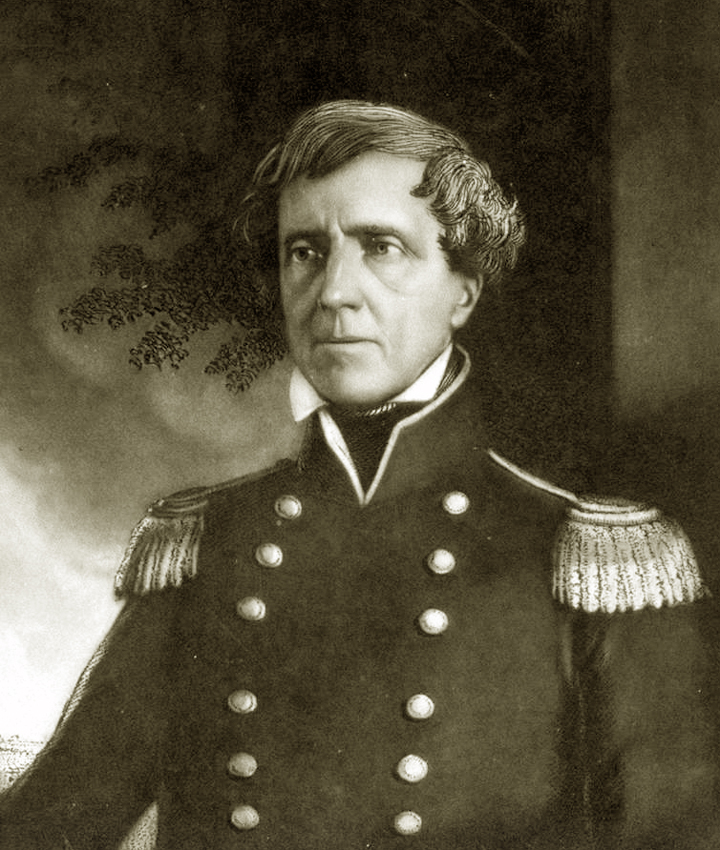
Stephen Watts Kearny. Engraving By: Y.B. Welch. Upon America’s declaring war with Mexico in May 1846, President James Polk sent “the Army of the West” to New Mexico. See Daniel Walker Howe, What Hath God Wrought: Transformation of America, 1815-1848, 758. This army was sent for the sole purpose of conquest, and it was led by Brigadier General Stephen Watts Kearny. Id.
-
The Extermination of Native Americans

Trail of Tears. By: Max D. Stanley. Under President Andrew Jackson, and his successor President Martin Van Buren, there was mass removal of Native Americans westward across America.
 Last Best Hope of Earth