Tag: James Madison

  • The Legacy of the Founding Fathers

    1200
    John Trumbull’s Depiction of the Drafting Committee of the Declaration of Independent Presenting the Draft to Congress.

    The Founding Fathers have a complicated legacy, and that legacy is constantly undergoing change. While the reverence of the Founding Fathers fluctuates generation-by-generation, certain questions emerge about the Founding Fathers’ effectiveness in setting the foundation for the United States.

    Gordon Wood, in Revolutionary Characters: What Made the Founders Different, presented the Founding Fathers’ legacy as: “If it was the intense commitment of this generation of founders to new enlightened values that separates it from other generations, why, it might be asked, and indeed, as it has been asked by recent critical historians, did these so-called enlightened and liberally educated gentlemen not do more to reform their society? Why did they fail to enhance the status of women? Eliminate slavery entirely? Treat the Indians in a more humane manner?” Gordon Wood, Revolutionary Characters: What Made the Founders Different, 26.

    It has become popular, glamorous even, to question the principles and integrity of the Founding Fathers in recent years, for their lack of ridding the country of its most foul traits. The Founding Fathers lived in a much different world than contemporary Americans.

    To be fair to the Founding Fathers, accomplishing any of the goals similar to abolishing slavery, ensuring equality of men and women, and treating Indians in a humane manner, must have come after ensuring the creation of a government that would last ages. As Thomas Jefferson drafted the Declaration of Independence and James Madison drafted the Constitution, and the Founding Fathers came to sign and approve those documents, their priority was creating an environment and a country that would facilitate future successes and ensure equality in for future generations.

    The Founding Fathers were not in a position to contemplate every injustice and inequality, amidst the Revolutionary War, the tumultuous years of the early Republic, and the rapid growth of the country.

    To expect them to have addressed and resolved every issue that was perhaps foreseeable at the time of the Revolution is to ignore their extraordinary accomplishments. The Founding Fathers collectively deliberated what the best form of government should be. They created the most extraordinary government that has thrived for over two centuries and has been a model for successful government.

    While it is popular to question the Founding Fathers’ accomplishments, the context of their work must be remembered. We remember each American icon for their accomplishments, given the circumstances that existed during their respective times. The Founding Fathers’ time was perhaps the most tumultuous and contentious in American history, and yet they devised a system that has allowed one of the most free and just societies known to the world.

  • The War of 1812

    jackson_neworleans
    Painting of the Battle of New Orleans during the War of 1812.

    The War of 1812 is often a forgotten war in modern times. It was a war that tested the Americans’ resolve in staying an independent nation and ultimately a war that brought together Americans in a way that no previous event had. Gordon Wood, Empire of Liberty, 699.

    It was also a war that brought about seemingly unusual events, particularly in retrospect. For example, the Americans, led by William Hull, planned and attempted a three-pronged attack on Canada. Id. at 677. Then, perhaps even stranger, the governor of Massachusetts entered into negotiations “with the British, offering part of Maine in return for an end to the war.” Id. at 693.

    Ultimately, the British invaded the United States and made an unexpected march directly on Washington, burning much of it to the ground. That was the extent of damage in America, however, and both countries entered into negotiations of a peace treaty. President James Madison led the way in negotiating a treaty with Britain, the Treaty of Ghent, which would peacefully end the war. Id. at 697.

    President Madison, a Jeffersonian Republican, conducted himself with the logic that it was better “to allow the country to be invaded and the capital burned than to build up state power in a European monarchical manner.” Id. at 698. Madison’s skillful handling of the war would result in 57 “towns and counties throughout the United States” being named after him, “more than any other president.” Id. at 699 citing Forrest Church, So Help Me God: The Founding Fathers and the First Great Battle Over Church and State (New York, 2007), 350. John Adams told Thomas Jefferson in 1817 that Madison had “acquired more glory, and established more Union than all his three Predecessors, Washington, Adams, Jefferson, put together.” Gordon Wood, Empire of Liberty, 699 quoting John Adams to Thomas Jefferson, 2 Feb. 1817, in Lester J. Cappon, ed., The Adams-Jefferson Letters: The Complete Correspondence Between Thomas Jefferson and Abigail and John Adams (Chapel Hill, 1959), 2: 508.

    Thomas Jefferson concluded in 1818 that “[o]ur government is now so firmly put on its republican tack that it will not be easily monarchised by forms.” Thomas Jefferson to Lafayette, 23 Nov. 1818, in Gilbert Chinard, ed., The Letters of Lafayette and Jefferson (Baltimore, 1929), 396.

    The War of 1812 has many quirks, as discussed above but perhaps most notably was the Battle of New Orleans, which took place after the Treaty of Ghent was signed but before word had reached the whole country. The Battle of New Orleans, led on the American side by Andrew Jackson, inflicted massive casualties to the British. Gordon Wood, Empire of Liberty, 698.

    Of course, the Star Spangled Banner was also a byproduct of the War of 1812 as well.

    As forgotten as the War of 1812 may be, it had significant consequences for the future of the country. America became a unified country, with the collective hardship of fighting the British twice creating a bond between Americans that would be strong, even if short-lived. It also was a war that illustrated the Republican principles of Madison and Jefferson could be successful. This set the stage for Republican dominance in politics, which was already underway by the time the War of 1812 began.

    While the Civil War would eventually come to define the 19th Century for America, with its horrific nature and result of keeping the country united, the War of 1812 ensured that there was an America worth fighting for. Had the War of 1812 not occurred, perhaps the Civil War would have been waged differently and perhaps the course of American history would have had a noticeable absence of patriotism. While it is impossible to predict, the wise decisions of American leaders in those tumultuous years and those who fought for their young country give modern Americans much to be thankful for.

  • The Justifications for Slavery

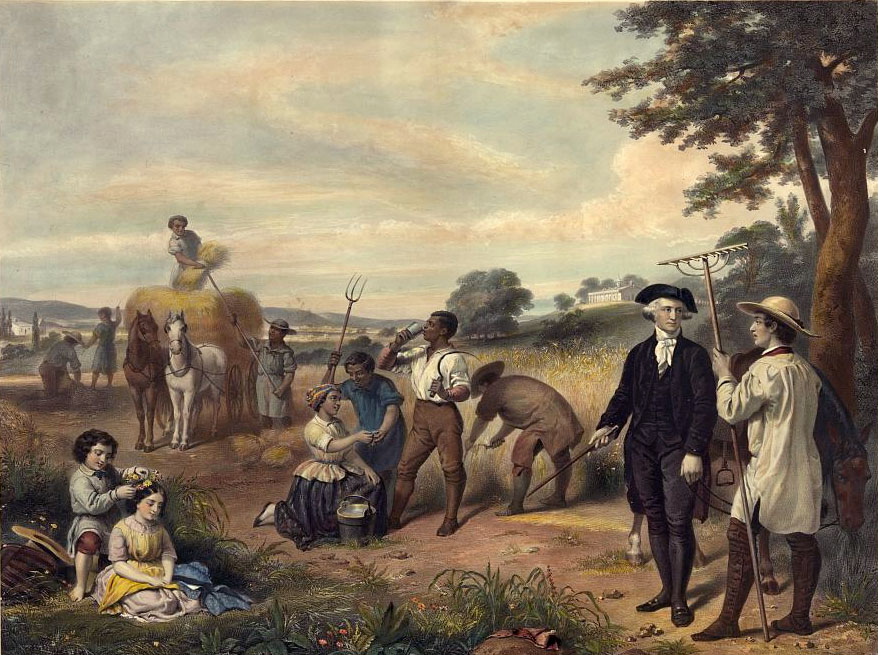
    George Washington on his Plantation.

    Early Americans, both pro-slavery and anti-slavery, explored the potential justifications for slavery in the United States.

    In 1764, James Otis of Massachusetts asked “Can any logical inference in favor of slavery be drawn from a flat nose, a long or short face?” after pondering why only blacks had been enslaved. James Otis, The Rights of the British Colonists Asserted and Proved (1764), in Bernard Bailyn, ed., Pamphlets of the American Revolution, 1750-1776 (Cambridge, MA, 1965), 1: 439.

    Some believed that slavery could not stand against the “relentless march of liberty and progress.” Gordon Wood, Empire of Liberty, 519. For example, James Madison believed that making noise on the issue of slavery would only slow down the march of progress within the United States. Id. at 525. Perhaps those who held this view perpetuated slavery, believing that it was bound to end eventually without action.

    Others had more profoundly prejudiced and racist views toward slavery. Thomas Jefferson believed that “various characteristics of blacks . . . [such as] their tolerance of heat, their need for less sleep, their sexual ardor, their lack of imagination and artistic ability, and their music talent . . . were inherent and not learned.” Id. at 539. Jefferson believed that “blacks’ deficiencies were innate, because when they mixed their blood with whites’, they improved ‘in body and mind,’ which ‘proves that their inferiority is not the effect merely of their condition of life.’” Id. citing Thomas Jefferson, Notes on the State of Virginia, ed. Peden, 138-43.

    Even entire states took action that is hard to fathom in modern times, all with the underlying belief that slavery was justified and must be protected. The state of Kentucky wrote into its 1792 Constitution that “the legislature shall have no power to pass laws for the emancipation of slaves without the consent of their owners.” Robin L. Einhorn, American Taxation, American Slavery (Chicago, 2006), 220, 232, 249, 236; Stanley Elkins and Eric McKitrick, “A New Meaning for Turner’s Frontier: Part II: The Southwest Frontier and New England,” Political Science Quarterly, 69 (1954), 572-76. This language was added to Kentucky’s Constitution despite the fact that only a mere 16% of the state’s population were slaves. Gordon Wood, Empire of Liberty, 531.

    All of these varying views affected American policy, both foreign and domestic. Taking foreign policy as an example, while Haiti had a slave revolution in 1803 that both ended slavery and proclaimed racial equality, and the United States typically was the first country to extend diplomatic relations to a new republic, it would not be until the Civil War that the “United States [would] recognize the Haitian republic.” Id. at 537.

    As early Americans searched for justifications for slavery, many who were thinking critically would come to the same conclusion as James Otis: that there was no justification. However, those whose livelihoods depended on the existence of slavery were predisposed to never coming to that conclusion. Nonetheless, as is obvious from these varying views on justifications for slavery, hypocrisy was prevalent, ignorance was rampant (even amongst one of the greatest intellectuals, Jefferson), and at the very least, progress was slow.

    Regardless of who was right or wrong about the issue of slavery, it is clear that the justifications for slavery ran deep, permeating societal beliefs and policy decisions, foreign and domestic. Not many issues have rivaled the contentious nature of slavery. But analyzing the justifications for slavery shows just how far an issue can reverberate throughout the country, touching even the very threads that hold society together.

  • A Conscientious Path of Moderation

    Painting of John Marshall, Chief Justice of the Supreme Court of the United States from 1801-1835.

    The Constitution, in combination with the Judiciary Act of 1789, created the three-tiered court system that is familiar to modern Americans. However, one of the defining features of the judiciary is the concept of judicial review. Judicial review is the doctrine that permits a court, such as the Supreme Court in Marbury v. Madison, to declare an act of Congress unconstitutional. See Gordon Wood, Empire of Liberty, 442. In 1803, Chief Justice John Marshall was the first to exercise this power of the Supreme Court, setting the precedent for future courts, particularly in the 20th Century, to declare acts of Congress unconstitutional. Id.

    Thomas Jefferson declared the following year, in 1804, that granting the courts the power of judicial review “would make the judiciary a despotic branch.” Malone, Jefferson the President: First Term, 155. James Madison explained that judicial review “makes the Judiciary Department paramount in fact to the Legislature, which was never intended and can never be proper.” Madison’s Observations on Jefferson’s Draft of a Constitution for Virginia, 1788, Papers of Jefferson, 6: 315.

    Even lesser known Americans who believed the legislatures in the 1780s created unjust laws did “not agree that judges ought to have the authority to declare such legislation void.” Gordon Wood, Empire of Liberty, 444. One such American, Richard Dobbs Spaight, delegate to the Constitutional Convention from North Carolina stated that judicial review “operated as an absolute negative on the proceedings of the Legislature, which no judiciary ought ever to possess.” Richard Spaight to James Iredell, August 12, 1787, in Griffith J. McRee, Life and Correspondence of James Iredell (New York, 1857-1858), 2; 169-70.

    Some believed that “the power of the judges alone to declare unconstitutional laws void was too extreme, too exceptional, and too fearful an act to be used against all those ordinary unjust, unwise, and dangerous laws that were nevertheless not ‘so unconstitutional as to justify the Judges in refusing to give them effect.’” Gordon Wood, Empire of Liberty, 446 quoting Farrand, ed., Records of the Federal Convention, 1: 97, 73. Thus, some congressmen in 1792 considering establishing a procedure for federal judges to notify Congress when they would declare a law unconstitutional. Gordon Wood, Empire of Liberty, 446.

    It is notable that so many Americans were comfortable with this increasingly powerful judiciary, with the newly created tool of judicial review. Although judicial review was used in Marbury v. Madison, it would not be used again until the Dred Scott decision in 1857. Nonetheless, Americans began to associate the judiciary with being additional representatives of Americans’ collective interests. The fact that the judiciary began to assert itself in more drastic ways into the tripartite government system, combined with most Americans’ desire to have additional representation, permitted the judiciary to become a permanent part of American life.

    Further, the importance of the creation of the doctrine of judicial review could hardly be understated. While some were uncomfortable with the idea of the future of democracy occasionally being in the hands of a few judges, it provided a more neutral, reasonable filter for legislation and acts of Congress. Undoubtedly, mistakes have been made and continue to be made by the judiciary, but most Americans would take comfort that as the decades and centuries have progressed, one bad court has been counterbalanced by a good court, leaving America to go down a conscientious path of moderation.

  • The Assertive Judiciary

    Depiction of the Old Congressional Building. 1800s.

    In the early years of the Republic, there was an itching for reformation of the systems and processes that had come to define colonial life. This reformation began with “enactment of an increasing number of laws.” Gordon Wood, Empire of Liberty, 405.

    Thomas Jefferson and James Madison led this movement of reformation. While they and their like-minded Republicans had hoped to have comprehensive reform quickly, “[u]nstable, annually elected, and logrolling democratic legislatures broke apart” those plans. Id. One individual in South Carolina complained that “every new law . . . acts as rubbish, under which we bury the former.” Rudiments of Law and Government, Deduced from the Law of Nature (Charleston, SC, 1783), 35-37. Likewise, St. George Tucker, a jurist, explained that in Virginia, the legislature attempted to provide clarity and organization to the state’s laws, but bred “perplexities . . . [by] the re-enaction, omission, or suspension of former acts, whose operation is thus rendered doubtful, even in the most important cases.” St. George Tucker, Blackstone’s Commentaries: With Notes of Reference to the Constitution and Laws of the Federal Government and of the Commonwealth of Virginia (Philadelphia, 1803) I, pt. 1, xiii.

    This confusing, complex jungle of laws had to be sorted out by someone other than the legislatures. The judiciary took up that responsibility, which ironically also happened in England with William Blackstone and Lord Mansfield carving out “a huge interpretive role for British judges as they sought to bring the law into accord with equity, reason, and good sense. David Lieberman, The Province of Legislation Determined: Legal Theory in Eighteenth-Century Britain (Cambridge, UK, 1989), 13, 28.

    Americans craved reasonable, equitable law that only the judiciary could provide through its interpretation, after the legislatures’ numerous, laborious attempts to clarify the laws had failed.

    These early years foreshadow the events in the coming decades and centuries that shape the modern governmental structure. The chaotic and confused work of the early legislatures created an opening for the judiciary that did not exist immediately after the Revolution. The judiciary did not just step into this opening, it seized this opening and drastically expanded it over the course of the next two centuries, as illustrated by the decision of Marbury v. Madison, which is another topic for discussion and analysis.

    At least to some extent, the judiciary cleaned up the laws of the United States and paved the way for clearer, more accessible codes, regulations, and laws. It is difficult to understate the value of the judiciary’s actions and its reverberating consequences for the courts, for the legislatures, and for the wellbeing of the most important subjects of the laws: American citizens.

  • The Zeal for Land

    Thomas Jefferson, portrayed as Vice President.

    Thomas Jefferson, from his earliest years, imagined that all of the North American land known in the 1790s would one day belong to the United States. He imagined that Florida would become part of the United States, that Cuba would join, that Mexico’s provinces would join, and that ultimately, Canada would join as well. Gordon Wood, Empire of Liberty, 376.

    Some may see this as an imperialistic tendency. It was. Jefferson stated that “we should have such an empire for liberty as she has never surveyed since the creation.” Thomas Jefferson to James Madison, April 27, 1809. He strongly believed that “no constitution was ever before so well calculated as ours for extensive empire and self government.” Id.

    Jefferson long had a passion for expansion, pre-dating both his presidency and his vice-presidency. Almost immediately after the Revolutionary War, Jefferson began planning how this vast area of land could benefit the United States and how it could be explored.

    Ultimately, this led to the monumental exploration of the Louisiana Territory by Meriwether Lewis and William Clark, which would captivate the nation and spread the expansion fever.

    Jefferson’s firmly held belief that the Louisiana Purchase and its territory would become America’s is one of the best examples of firm leadership guiding the nation’s people toward a common goal that benefits all. The best presidents did not always have unanimous support in their decisions, but history cherishes and fondly remembers those presidents, like Jefferson.

  • The Somewhat Representative Democracy

    Federal Hall, New York City. The seat of the federal government in 1790.

    William Findley, a man of Irish descent who came to play a powerful role in Pennsylvanian politics, had an idea about what a politician should be. He said that politicians should be able to advocate for their own cause when they take the floor, that politicians should openly support their interests. Gordon Wood, Empire of Liberty, 221. As Gordon Wood explained in Empire of Liberty, this idea challenged “the entire classical tradition of disinterested public leadership and set[] forth a rationale for a competitive interest-laden politics . . . .” id.

    James Madison, in Federalist No. 10, feared such a thing: that politicians may be deciding issues that directly affect their interests.

    Nonetheless, the American system has undoubtedly embraced such a principle. Politicians, perhaps now more than ever, are influenced by their own interests, which are shaped by various donations, gifts, and promises of future favors.

    There is a significant question underlying all of this: Did the Founding Fathers contemplate that a representative democracy could transform itself into a system where the politicians are only representative of their constituencies to the extent those constituencies benefit from the donations, gifts, and promises of future favors?

    Some may argue that the representative nature of the republic was and still is affected by this system. Politicians are elected based on their promises of what they will do for others, but when in office, perhaps their self-interests are the only ones that matter. Then, to the extent those self-interests align with their constituency, their record serves as a platform for re-elections.

    Perhaps it is simply too idealistic to expect politicians to put their self-interests aside and govern with an even hand, representing the best interests of their constituents, not themselves. Regardless, there appears to be no question that Findley’s ideal politician has become the norm for politicians.

    Had Madison known what would happen to politicians, he may not have been surprised, but he would have been disappointed.

  • Economic Sanctions

    George Washington, as portrayed on the $1 note.

    Washington’s writings are replete with revelations about the hopes and aspirations for the country. Often, it is common for modern Americans to think that the Founding Fathers, despite all of their wisdom, could hardly imagine what the United States would become. For instance, now, the world is interconnected in a way as never before. One may be tempted to posit that the world has become a more complicated place, and our recent leaders have created new tactics to deal with geopolitical issues. One such tactic that one may imagine is newly created is the use of economic sanctions.

    In fact, the Founding Fathers not only contemplated the use of economic sanctions, but sought for the implementation of sanctions in lieu of going to war. In George Washington’s letter to Lafayette, dated August 15, 1786, he noted “the probable influence that commerce may hereafter have on human manners and society in general,” hoping that it could lead to the demise of “the devastation and horrors of war.” Fitzpatrick, ed., Writings of Washington, 28: 520. Nor was Washington alone in this belief. Far from it.

    Thomas Jefferson and James Madison had consistently hoped for the same, aspiring for the day where American sanctions would divert wars but preserve American interests. Gordon S. Wood, Empire of Liberty, (New York, 2009), 138.

    As is clear from modern history, economic sanctions have shown their utility, whether they be imposed for ideological differences, such as against Russia and former Soviet Union countries or imposed to discourage nuclear development and proliferation, such as against Iran. The use of economic sanctions is of course premised on America having a fundamental role in the world economy, which has certainly been the case in the last century and continuing until now.

    Presently, the United States accounts for 23% of global gross domestic product and 12% of merchandise trade. The Economist, Vol. 417, No. 8958 (October 3, 2015). Having such a significant role in the world economy gives the United States the “soft power” of influencing other countries to act in accordance with America’s best interests, without America committing significant resources.

    The Founding Fathers, in their wisdom and their grand hopes for the United States, hoped to see this day, where the sheer size and power of the economy would force others to bend to American interests. Their imagined use, or the threat of use, of economic sanctions has come to fruition. Just another instance of the prescience of the Founding Fathers.