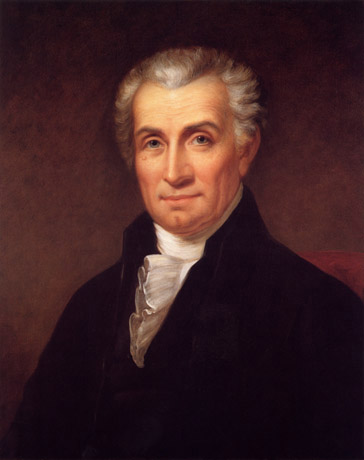
Tag: James Monroe

  • The Election of 1824

    m-9636
    William Harris Crawford.

    Not long after the election of 1820, an essentially uncontested election seeing the re-election of President James Monroe, the campaigning for the election of 1824 began. President Monroe had indicated that he would not seek an unprecedented third term as president, but that did not stop others from posturing for the election. As a journalist observed in the spring of 1822, “electioneering begins to wax hot.” Daniel Walker Howe, What Hath God Wrought: Transformation of America, 1815-1848, 203 quoting James F. Hopkins, “Election of 1824,” in History of American Presidential Elections, ed. Arthur M. Schlesinger Jr. (New York, 1985), 363.

    (more…)

  • The Panic of 1819

    william-jones
    William Jones. Artist Unknown.

    America’s reliance on cotton as an economic staple presented an opportunity for prosperity and an accompanying risk. In late 1818, the value of cotton fell as supply outpaced demand and “London banks decided there was no longer a need to extend more credit.” Daniel Walker Howe, What Hath God Wrought: Transformation of America, 1815-1848, 142. Then, the Second Bank of the United States, just two years into its life, “responded by shifting suddenly away from its own expansionist policy,” by the direction of William Jones, which only exacerbated the credit problem. See id. at 142-43. The Panic of 1819 erupted.

    (more…)

  • The New Republican Nationalism

    tsp-0064-cfa-08-06-09-resizejpg-25ab31ced2e9ad6e_large
    Chief Justice John Marshall of the Supreme Court of the United States. By: Cephas Thompson.

    John Marshall would serve as Chief Justice of the United States Supreme Court from 1801 to 1835 and had a lasting impact on the institution. More broadly, he shaped the development of policy in America.

    (more…)

  • The Transcontinental Treaty of Washington

    gilbert_stuart_-_john_quincy_adams_-_google_art_project
    John Quincy Adams in 1818. By: Gilbert Stuart.

    John Quincy Adams, Secretary of State from 1817 to 1825, was a principled, “tough negotiator.” Daniel Walker Howe, What Hath God Wrought: Transformation of America, 1815-1848, 107.

    (more…)

  • The Monroe Doctrine

    jamesmonroe
    James Monroe.

    President James Monroe has been known for centuries as the architect of a fundamental foreign policy doctrine: the Monroe Doctrine.

    (more…)

  • The Last Founding Father

    james_monroe_02
    James Monroe.

    James Monroe was the last president who was truly part of the American Revolution generation. Daniel Walker Howe, What Hath God Wrought: Transformation of America, 1815-1848, 91. He crossed the Delaware River with George Washington. Id. Obvious to his contemporaries, he dressed the part of the Revolutionary gentleman, wearing knee breeches and buckled shoes, with a powdered wig and three-cornered hat. Id.

    (more…)

  • Wrapping Up the War of 1812

    hith-british-burn-washington-dc-200-years-ago-e
    The Burning of the White House. 1814.

    By the end of the War of 1812, President James Madison had weathered what is likely one of the tumultuous years that any president has had to endure. The British had landed a force, marched on Washington, D.C., and burned the White House. President Madison had trusted his Secretary of War John Armstrong when he doubted the possibility of a British invasion, only to be caught off guard when a scouting party, led by Secretary of State James Monroe, located just how close the British were to Washington. See Daniel Walker Howe, What Hath God Wrought: The Transformation of America, 1815-1848, 63-64.

    (more…)