
President John Quincy Adams, in his First Annual Message to Congress delivered on December 6, 1825, set forth his agenda for developing the American economy. Daniel Walker Howe, What Hath God Wrought: Transformation of America, 1815-1848, 251.
President John Quincy Adams, in his First Annual Message to Congress delivered on December 6, 1825, set forth his agenda for developing the American economy. Daniel Walker Howe, What Hath God Wrought: Transformation of America, 1815-1848, 251.
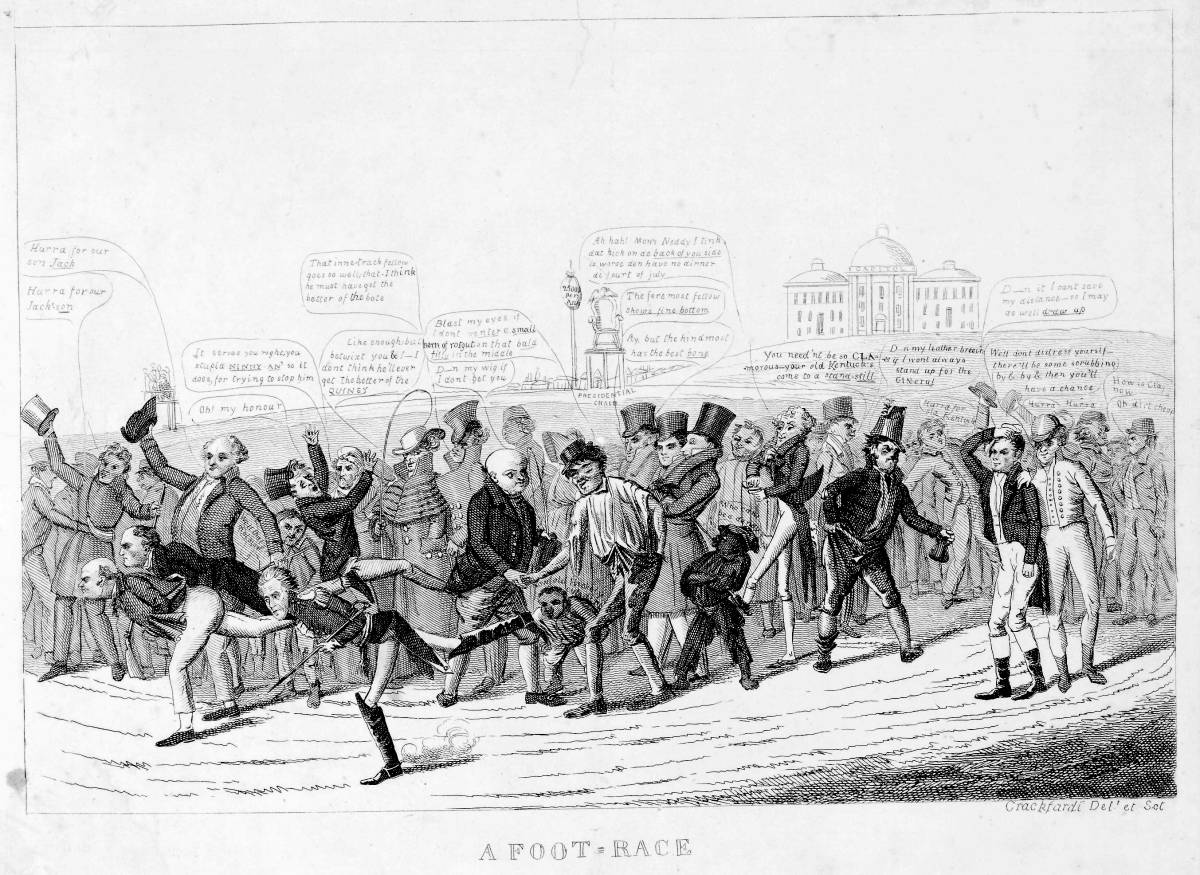
Following the Election of 1824, newly elected President John Quincy Adams went into the White House with a great deal of hope for the future. He was a lifelong student of Cicero and “envisioned the American republic as the culmination of the history of human progress and the realization of the potential of human nature.” Daniel Walker Howe, What Hath God Wrought: Transformation of America, 1815-1848, 245. In fact, historians have remarked that Quincy Adams was the “most learned president between [Thomas] Jefferson and [Woodrow] Wilson.” Id.

On July 4, 1826, during America’s Golden Jubilee, celebrating the 50th anniversary of the Declaration of Independence, Thomas Jefferson and John Adams died. Daniel Walker Howe, What Hath God Wrought: Transformation of America, 1815-1848, 243. The two political rivals were two of the last three surviving signers of the Declaration of Independence, leaving only Charles Carroll of Maryland alive. Id. President John Quincy Adams, learning of his father’s death and Jefferson’s death, remarked that it was a “‘visible and palpable mark of Divine favor,’ to the nation, and most of his countrymen agreed.” Id. quoting James Morton Smith, The Republic of Letters (New York, 1995), II, 1973-74.

Not long after the election of 1820, an essentially uncontested election seeing the re-election of President James Monroe, the campaigning for the election of 1824 began. President Monroe had indicated that he would not seek an unprecedented third term as president, but that did not stop others from posturing for the election. As a journalist observed in the spring of 1822, “electioneering begins to wax hot.” Daniel Walker Howe, What Hath God Wrought: Transformation of America, 1815-1848, 203 quoting James F. Hopkins, “Election of 1824,” in History of American Presidential Elections, ed. Arthur M. Schlesinger Jr. (New York, 1985), 363.

With the creation of the Missouri Compromise came a second controversy for Missouri. Some northerners threatened “not to consent to the Missouri constitution when it came back to Congress for final approval.” Daniel Walker Howe, What Hath God Wrought: Transformation of America, 1815-1848, 156. Henry Clay, then-Speaker of the House of Representatives, led the effort to solving this second controversy.

John Quincy Adams, Secretary of State from 1817 to 1825, was a principled, “tough negotiator.” Daniel Walker Howe, What Hath God Wrought: Transformation of America, 1815-1848, 107.
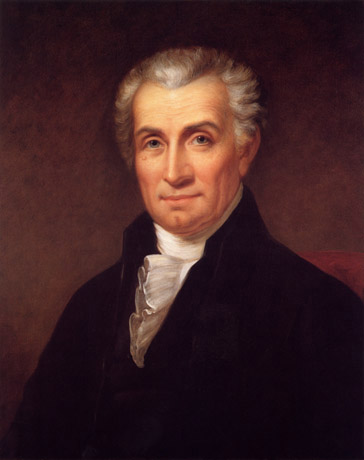
President James Monroe has been known for centuries as the architect of a fundamental foreign policy doctrine: the Monroe Doctrine.

In the 1780s, Americans, like John Dickinson, observed that “[p]eople once respected their governors, their senators, their judges and their clergy; they reposed confidence in them; their laws were obeyed, and the states were happy in tranquility.” Dickinson, Letters of Fabius, Ford, ed., Pamphlets, 188. The authority of the government was declining. Gordon Wood, The Creation of the American Republic: 1776-1787, 507. (more…)

After the American Revolution and after the war with Britain, America was suffering what appeared to be a crisis.
 Last Best Hope of Earth