Tag: Massachusetts

  • The Civil War: George Templeton Strong: Diary, November 20-December 1, 1860

    The Civil War: George Templeton Strong: Diary, November 20-December 1, 1860

    November 20, 1860 to December 1, 1860

    New York City

    State laws often have an outsized influence on discussions of national politics. This is despite the fact that one state’s laws have no binding effect in other states; then, add to that the fact that some states will pass laws with little intent or resources backing the enforcement of those laws. Those are the laws that can be nothing more than pieces of paper as props in the political theater. But, when those laws touch on an inflammatory issue, the practicalities of the laws become irrelevant. The only thing that matters then is that the laws exist and that they could spread to other states, disrupting the status quo and creating concern as to the path that the nation and its states have chosen.

    (more…)
  • Constitution Sunday: David Ramsay to Benjamin Lincoln

    Charleston, South Carolina

    January 29, 1788

    A letter from a South Carolinian to a Massachusettsan—and from a budding historian to a Revolutionary War hero—captured the spirit of the moment as South Carolina was preparing to assemble its convention to consider the Constitution. David Ramsay, who would soon publish a two-volume book about the American Revolution, wrote to Benjamin Lincoln of the recent happenings in South Carolina’s legislature and the tenor of the time as states were analyzing the potential for coexisting with a federal government.

    (more…)
  • Constitution Sunday: Samuel Nasson’s “Pathetick Apostrophe” to Liberty

    Massachusetts Ratifying Convention

    February 1, 1788

    Changing a system—particularly a system about which one is fond—is difficult. For some, the system that the Articles of Confederation created was an ideal one as it permitted states to maintain a level of autonomy that the proposed Constitution would subsume. For Samuel Nasson, at the Massachusetts Ratifying Convention, this was a travesty given that the country had fought so hard to free its member states from Great Britain and its attempts to “enslave us, by declaring her laws supreme.”

    (more…)
  • Constitution Sunday: Abraham Holmes and Christopher Gore on the Possible Abuses of the Federal Judiciary

    Massachusetts Ratifying Convention

    January 30, 1788

    One of the most fundamental concerns when framing a Constitution, or any law for that matter, is the danger of abuse. Those who believe that power will be abused will choose to err on the side of depriving a government of power. And those people would go one step further to posit that where there are ambiguities in a law, that law should not stand. Abraham Holmes and Christopher Gore debated this point at the Massachusetts ratifying convention.

    (more…)
  • The Revolution: Thomas Jefferson on the Draft Articles of Confederation (Part II)

    The Autobiography. By: Thomas Jefferson

    July 30, 1776 – August 1, 1776

    How the colonies would get along with each other was always going to be a monumental challenge. And, when the nation was born, there was tension between delegates and their states in setting up the framework for how the colonies would vote. With states such as Massachusetts and Pennsylvania being much larger in size and population, smaller states such as Rhode Island could justifiably fear that confederating with the colonies would bring more harms than benefits. However, to the chagrin of larger states, in the draft Articles of Confederation, at Article XVII, it stated: “In determining questions each colony shall have one vote.”

    (more…)
  • Constitution Sunday: A Sharp Exchange at the Massachusetts Convention

    Massachusetts Ratifying Convention

    January 17, 1788

    For those debating the Constitution’s ratification, no detail of the draft document was forgotten. To detractors, like the Honorable Mr. Turner who rose on January 17, 1788 at the Massachusetts Ratifying Convention, there were hidden dangers throughout the document. One that he raised was that Congress “may alter the place for chusing representatives in the general Congress.” Turner, before the Convention, said to look to abuses of power: if members of Congress wished to help themselves, as people in power often do, then this is one way in which they may do so; they could alter the place to be inaccessible for three-fourths of the population. “The great law of self preservation will prevail,” Turner said, and it didn’t stop there. There were forces at work in the country that were changing the country and its people: “paper money, and the practice of privateering, have produced a gradual decay of morals—introduced pride—ambition—envy—lust of power—produced a decay of patriotism, and the love of commutative justice.” By giving this Constitution and the members of Congress this power, the Convention was creating the chance for abuse, and where that risk can be prevented, it should, so Turner reasoned.

    (more…)
  • The Election of 1860

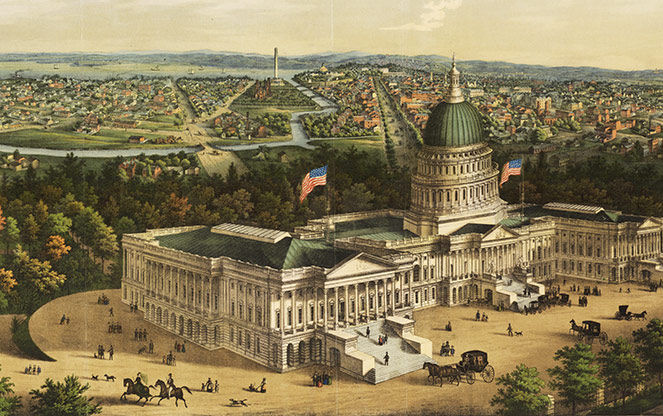
    1860photo_uscapitol_washingtoncanalvisiblie
    The United States Capitol in 1860. Courtesy: Library of Congress

    Every presidential election is consequential, but the Election of 1860 would play a significant role in whether the United States would remain one nation. The division of the North and South on the issue of slavery threatened to cause a secession of the South. The result of the election would determine whether that threat would materialize and cause a Second American Revolution. (more…)

  • The Evolving Political Parties of the 1850s

    panoramic-view-of-washington-city-e-sachse-and-co-1856
    Panoramic View of Washington, DC in 1856. Courtesy: E. Sachse & Co.

    The Democratic Party and Whig Party were the dominant political parties from the early 1830s up until the mid-1850s. Both were institutions in national politics despite not having a coherent national organization by cobbling together a diverse group of states to win elections. While the Democrats had a more populist agenda, the Whigs were more focused on pursuing industrialization and development of the country. See David Potter, The Impending Crisis: America Before the Civil War, 1848-1861, 226. While the Democratic Party would survive to the present day, the Whig Party would not survive the mid-1850s, not as a result of its own ineptness but because of the changing political landscape of that era. (more…)

  • Bleeding Kansas

    6615782369_473115a671_o
    Tallgrass Prairie, Kansas.

    After the passage of the Kansas-Nebraska Act, William Seward proclaimed to the Senate that “[w]e will engage in competition for the virgin soil of Kansas, and God give the victory to the side which is stronger in numbers as it is in right.” Congressional Globe, 33 Cong., 1 sess., appendix, 769. Rather than settling the issue of slavery in Kansas, the Act made Kansas the figurative and literal battleground for the issue of slavery.

    (more…)

  • The Role of Slavery in Splitting America

    underground_railroad
    The Underground Railroad. By: Charles T. Webber.

    Since the outbreak of the Civil War and continuing to the present day, the role of slavery in splitting America has been hotly debated. One may wonder whether there was merely a correlation between slavery and the Civil War or whether slavery was the cause. Investigating the nuances of the issue of slavery reveals that the Civil War resulted from sectionalism and slavery, which were practically synonymous.

    (more…)