
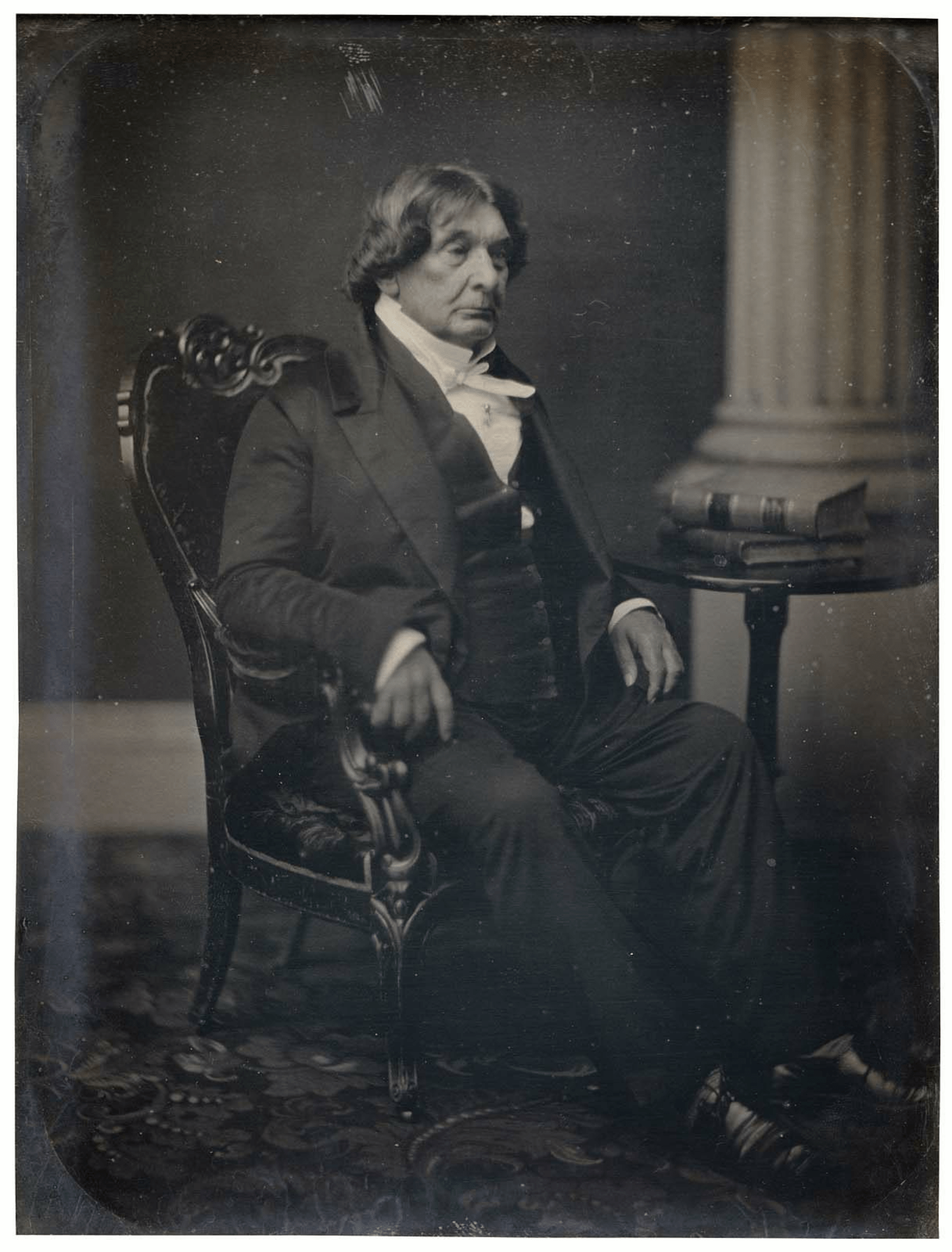
One of the most outspoken Representatives in the House of Representatives, John Quincy Adams, had opposed the declaration of war on Mexico and fought President James Polk’s policies for the duration of his presidency.
One of the most outspoken Representatives in the House of Representatives, John Quincy Adams, had opposed the declaration of war on Mexico and fought President James Polk’s policies for the duration of his presidency.

In 1842, John Quincy Adams presented to the House of Representatives a petition from 42 residents of Haverhill, Massachusetts, requesting that the Union be dissolved. Daniel Walker Howe, What Hath God Wrought: Transformation of America, 1815-1848, 610. Henry Wise, Congressman from Virginia, “demanded the former president be censured.” Id.
The labor movement gained significant momentum during the 1830s and 1840s, paving the way for future generations of Americans to secure extensive workers’ rights.
“Americanus” [John Stevens, Jr.] I
Daily Advertiser (New York), November 2, 1787
Following are excerpts from John Stevens, Jr.’s article in the Daily Advertiser:
“But, so prone is the spirit of man to party and faction, that even this admirable system will not prevent their mischievous efforts, in a state possessing a ‘small territory.’ (more…)

Following the War of 1812, enfranchisement broadened in American society considerably.

Education was not always such a prominent issue in every state and every American community in the way that modern Americans experience. Horace Mann, who was secretary of the Massachusetts State Board of Education in 1837, ensured that all schools would have in common: “tuition-free, tax-supported, meeting statewide standards of curriculum, textbooks, and facilities, staffed with teachers who had been trained in state normal schools, modeled on the French école normale.” Daniel Walker Howe, What Hath God Wrought: Transformation of America, 1815-1848, 453.

In 1830, Daniel Webster, Senator from Massachusetts, engaged in a heated debate with Robert Hayne, Senator from South Carolina, which touched on the political theory of federal and state sovereignty.
“A Political Dialogue”
Massachusetts Centinel (Boston), October 24, 1787
Following are excerpts from an article published in the Massachusetts Centinel, which purported to capture a conversation between “Mr. Grumble” and “Mr. Union”:
“Mr. Union. Well, but neighbour, what are your objections to the new Constitution?”
“Mr. Grumble. Why, as to the matter, I can’t say I have any, but then what vexes (more…)

Not long after the election of 1820, an essentially uncontested election seeing the re-election of President James Monroe, the campaigning for the election of 1824 began. President Monroe had indicated that he would not seek an unprecedented third term as president, but that did not stop others from posturing for the election. As a journalist observed in the spring of 1822, “electioneering begins to wax hot.” Daniel Walker Howe, What Hath God Wrought: Transformation of America, 1815-1848, 203 quoting James F. Hopkins, “Election of 1824,” in History of American Presidential Elections, ed. Arthur M. Schlesinger Jr. (New York, 1985), 363.

The role of religion in Americans’ lives began to change not long after the War of 1812. In fact, the state of Connecticut “disestablished religion in 1818.” Daniel Walker Howe, What Hath God Wrought: Transformation of America, 1815-1848, 165. It should be noted that the First Amendment to the Constitution reads: “Congress shall make no law respecting an establishment of religion or prohibiting the free exercise thereof.” In other words, the First Amendment “restricted the federal government only, not the states.” Id. This would change in the 20th Century when the Supreme Court “incorporated” the freedoms of the Bill of Rights, through the Fourteenth Amendment (not passed until 1868), to the states. Id.
 Last Best Hope of Earth