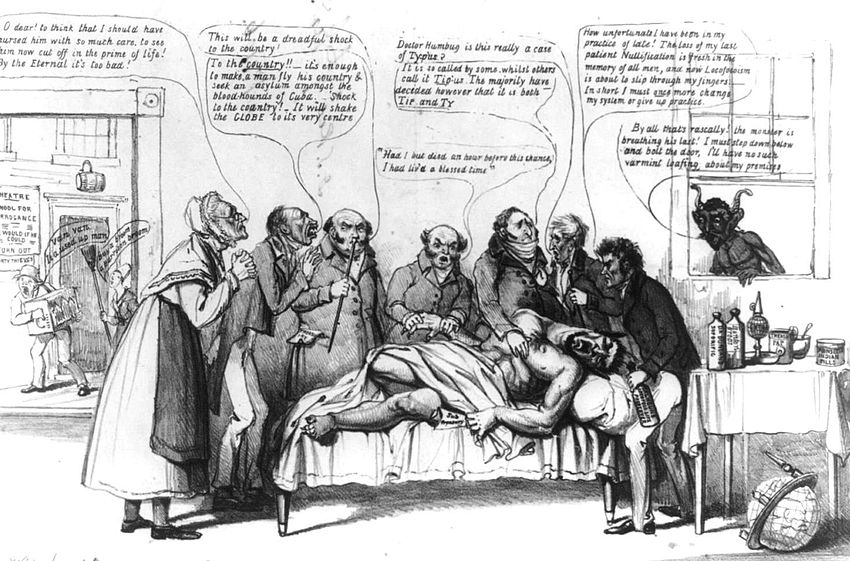
America’s economic development resulted in American workers being classified, creating tension between the classes.
America’s economic development resulted in American workers being classified, creating tension between the classes.

At the beginning of the 1800s, the American economy was becoming an unconventionally successful economy. Domestic commerce was “incalculably more valuable” than foreign commerce and “the home market for productions of the earth and manufactures is of more importance than all foreign ones.” Gordon Wood, Empire of Liberty, 707 quoting Nathan Miller, The Enterprise of a Free People: Aspects of Economic Development in New York State During the Canal Period, 1792-1838 (Ithaca, 1962), 42.
Meanwhile, a middle class was emerging in the United States. In the 1780s, Benjamin Franklin predicted “the almost mediocrity of fortune that prevails in America . . . [made] its people to follow some business for subsistence,” which made the United States “the land of labor.” Gordon Wood, Empire of Liberty, 709 quoting Benjamin Franklin, “Information to Those Who Would Remove to America” (1784), Franklin: Writings, 975-83. This new middle class was gaining “a powerful moral hegemony over the society, especially in the North.” Gordon Wood, Empire of Liberty, 709.
Both Benjamin Franklin and J. Hector St. John de Crevecoeur hoped a society could exist that lacked “both an aristocracy and a lower class.” Id. at 711. As Charles Ingersoll observed in 1810, “Were it not for the slaves of the south, there would be one rank.” Id. quoting Charles Jared Ingersoll, Inchiquin, the Jesuit’s Letters (1810), in Gordon S. Wood, ed., The Rising Glory of America, 1760-1820 (New York, 1971), 387.
These developments would lead to some to conclude that the Americans in the North were “probably the happiest people upon the earth.” J.M. Opal, Beyond the Farm: National Ambitions in Rural New England (Philadelphia, 2008), 135, 136.
These early years of the Republic, where prosperity was so widely spread that a seemingly universal middle class existed is of course a bit of an exaggeration in that there were poor and rich segments of society. But, on the other hand, the fact that so many individuals during that time commented on the subject reflects that it was a phenomenon occurring. A more cohesive, more uniform society was emerging. It was a society free from the highest highs and lowest lows that had come to characterize Europe.
Since those early years, there has been a fluctuation in the strength and size of the middle class. One thing has not changed, however. The notion of a prosperous middle class has come to be an aspiration for all Americans. The early aspirations of Benjamin Franklin and other Founding Fathers transformed this dream into a reality. That reality is one that Americans hope to carry forward for many generations to come.
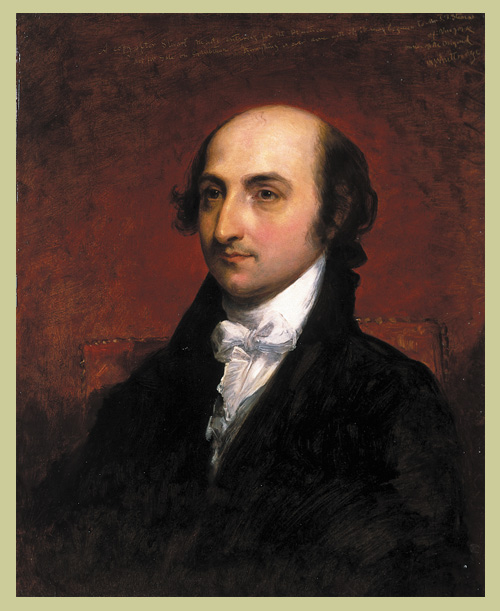
Albert Gallatin knew as early as 1799 that the United States “had become commercially and socially different from the former mother country” England. Gordon Wood, Empire of Liberty, 704. At that time, Gallatin was a Congressman, but he would later serve as Secretary of the Treasury from 1801 to 1814.
In realizing that America was different, he said that Britain had “trades and occupations” that were “so well distinguished that a merchant and a farmer are rarely combined in the same person; a merchant is a merchant and nothing but a merchant; a manufacturer is only a manufacturer; a farmer is merely a farmer; but this is not the case in this country.” Id. at 704-05 quoting Annals of Congress, 5th Congress, 3rd session (Jan. 1799), 9: 2650.
He said that if one were to venture into the middle of America, that individual would “scarcely find a farmer who is not, to some degree, a trader. In a grazing part of the country, you will find them buying and selling cattle; in other parts you will find them distillers, tanners, or brick-makers. So that, from one end of the United States to the other, the people are generally traders.” Annals of Congress, 5th Congress, 3rd session (Jan. 1799), 9: 2650.
This meant that Thomas Jefferson’s dream of Americans being a nation of agriculture and avoiding the industrialization that Europe had experienced was not a dream to be realized, even after the transformative War of 1812.
While this may have been troubling to Jefferson, Gallatin’s observations showed that Americans were developing a collective entrepreneurial spirit. Trading became an integral part of the American economy.
Part of this was inevitably by necessity, where some had to supplement their income by engaging in trading that perhaps they did not have experience in. On the other hand, part of this change from England must have been that there was a wealth of natural resources and a middle class emerging in America.
This early development after the War of 1812 should sound familiar to most modern Americans. First, although the middle class may change in size and wealth generation-by-generation, it has continually existed since the early Republic. Second, and most notably, Americans still carry an entrepreneurial spirit with them. Many would cite that entrepreneurial spirit for the success of America. It is certainly a factor.
 Last Best Hope of Earth