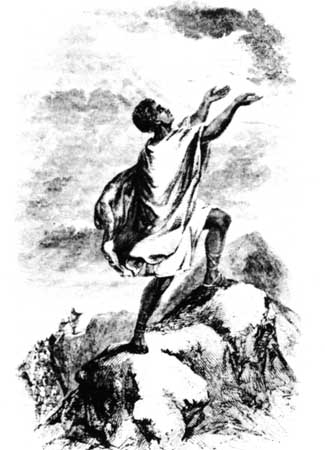
In the midst of President Andrew Jackson’s presidency, white supremacy was becoming a prominent principle in American society, facilitating confrontation between whites and blacks but also between whites and Native Americans. Just months into Jackson’s first term, David Walker published a controversial and incendiary pamphlet: An Appeal to the Colored Citizens of the World, But in Particular, and Very Expressly, to Those of the United States of America. (more…)
New York politics after the War of 1812 had ended “became a microcosm of the future of national politics.” Daniel Walker Howe, What Hath God Wrought: Transformation of America, 1815-1848, 237.
Following the War of 1812, Americans had at their disposal a new 14 million acres that General Andrew Jackson acquired from the Creek tribe in the South. Daniel Walker Howe, What Hath God Wrought: Transformation of America, 1815-1848, 125. The expansion of territory, particularly in the South, would have massive ramifications in the coming decades.
For centuries prior to the War of 1812, the Native Americans were able to manipulate the British, French, Spanish, and Americans to sustain themselves. After the War of 1812, the entirety of the land east of the Mississippi River was owned by America, effectively ended the Native Americans’ strategy. Daniel Walker Howe, What Hath God Wrought: Transformation of America, 1815-1848, 74.
By 1815, the Native Americans had been pushed mostly out of the New England area and into territories just east of the Mississippi River and the entirety of the territory west of the Mississippi River. The Native Americans were a significant obstacle to expanding American territory.
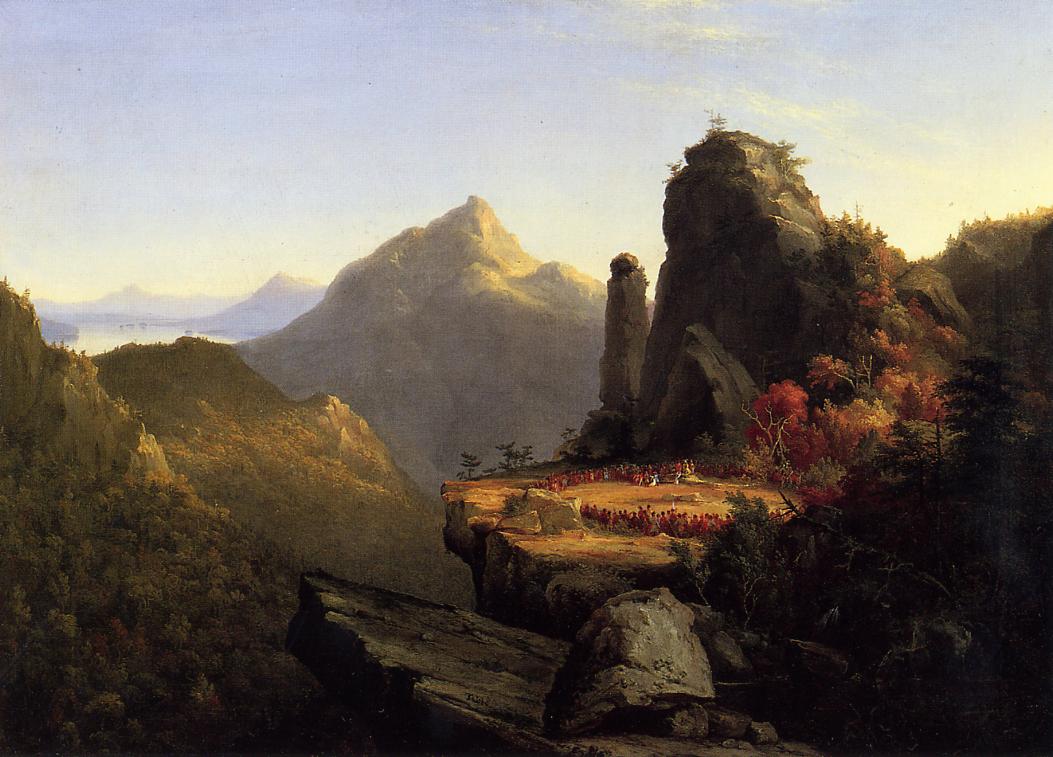
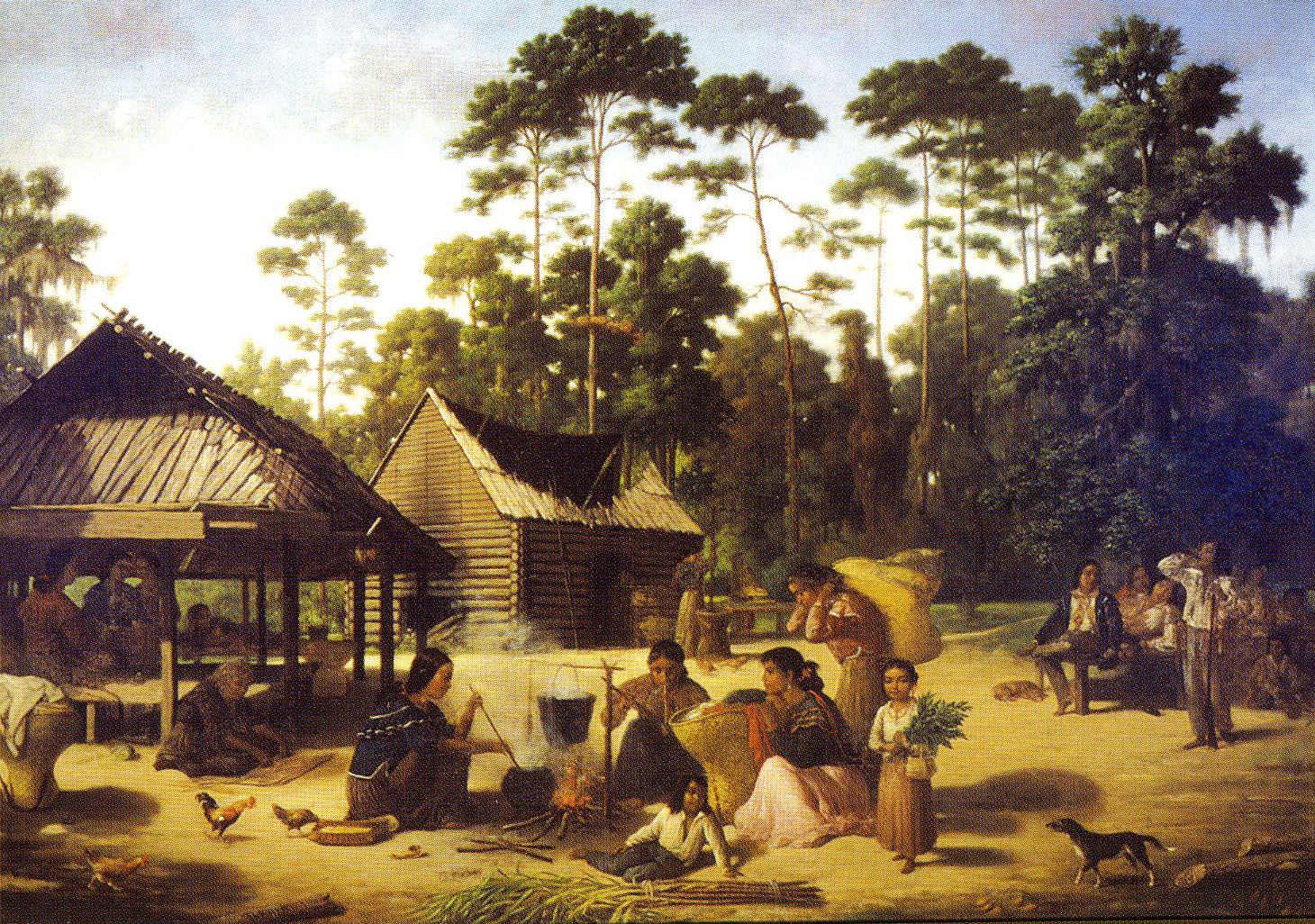
Painting of Choctaw Village. By: Francois Bernard.
The friction between the Native Americans and colonizing settlers is well documented and known. However, the general policy underlying that friction is perhaps best captured by Thomas Jefferson’s perspective on the subject: “let the natural demographic growth and movement of white Americans take their course.” Gordon Wood, Empire of Liberty, 398.
Jefferson believed that this would surround the Native Americans, and ultimately force them to take up farming. Meanwhile, the American government could acquire the hunting grounds of the Native Americans and settle those lands. This strategy, executed by Jefferson and his successor, James Madison, resulted in the negotiation of 53 “treaties of land cession with various tribes.” Id.
Some tribes, like the Cherokees in the Southwest, adapted to the new way of life (living in houses and relying on agriculture for food), but mostly, Jefferson’s plan ended in tragedy for the Native Americans. Id.
The early Americans did not comprehend that tragedy would be the result of forcing a civilization to change its ways. These acts by the early Americans undoubtedly weakened and fragmented the Native American tribes, which enabled later presidents, like Andrew Jackson, to implement removal and relocation policies. Those policies would be the death knell for Native American society.
Often, the sheer harshness of the early Americans toward the Native American societies is forgotten or downplayed. But the early Americans truly were ruthless both in their quest for land and for their lack of belief that the Native American way of life should have continued in any recognizable manner.
Some may posit that these actions by the early Americans were the first examples of how the United States would routinely impose its beliefs on others, to push its interests forward. There are certainly times in American history where this has been the case, and the treatment of the Native Americans is unquestionably one of those times.
As much as Americans have to be thankful for, it is worth taking a moment to reflect on the great tragedies that the early Americans forced on the Native Americans. While those actions enabled the American engine of growth to begin, it came at a great cost to human life and dignity, which should not be forgotten.



 Last Best Hope of Earth