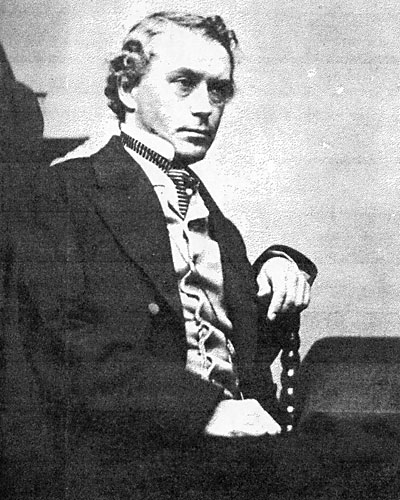
Throughout the months leading up to the firing on Fort Sumter, there was widespread wonder about how the country would react to such a provocation; it was bound to be a cleave dividing the country and also its communities. Generations later—with the accordion of events neatly folded and the result of the war known—it would seem obvious that a swell of patriotism came rose when the rebels fired the first shot in Charleston’s harbor. But in New York, an attorney and diarist, George Templeton Strong, documented that the swell of patriotism in his city was not immediate nor universal—but it was pronounced.
(more…)Tag: New York
-
The Civil War: New-York Daily Tribune: The Right of Secession
December 17, 1860
Thurlow Weed, the editor of the Albany Evening Journal and one of the leaders of the Republican Party in New York, had criticized another newspaper editor, Horace Greeley of the New-York Daily Tribune. Weed’s criticism was on the issue of secession and Greeley’s apparent support for it.
(more…) -
The Civil War: New York Daily News: The Right of States to Secede
November 16, 1860
With the idea of secession permeating the public discourse, there were questions of whether states even had the right to secede. These questions were not confined to academics and lawyers; even the newspapers of New York City explored these questions—one of which, the New York Daily News, was a conservative newspaper that had supported John C. Breckinridge in the election of 1860.
(more…) -

Constitution Sunday: On The Likely Failure Of Liberty, Robert Yates and John Lansing, Jr., to Governor George Clinton
January 14, 1788
Daily Advertiser (New York)
Revising the Articles of Confederation was always going to be a difficult task. The system that the Articles erected was one where the states pulled the strings of a marionette puppet of a federal government; without the states, the federal government was nothing: for instance, although the Confederation Congress could impose a tax, it lacked any independent power of enforcement and would need unanimous approval of the state legislatures. Nonetheless, when delegates met in Philadelphia in a convention that resulted in the draft Constitution, they had originally set out to revise those Articles of Confederation, and, by amendment, to refine the existing system into a more functional, more effective government.
(more…) -

The Election of 1884
The Democratic Party was in turmoil. Its candidates were not winning, and many of its ideas had fallen out of favor. It was a long way from the days of the Party’s founding: Andrew Jackson and his disciple, Martin Van Buren, held power for the twelve years spanning 1829 to 1841 and—into the 1840s and 1850s—James Polk, Franklin Pierce, and James Buchanan continued to lead the Party into the White House albeit against candidates from the newly-formed and then soon-to-be-disbanded Whig Party. Then, following the emergence of the Republican Party—an emergence which culminated in its candidate, Abraham Lincoln, prevailing in the elections of 1860 and 1864—Andrew Johnson, Lincoln’s Vice President and then successor as President, oversaw a one-term presidency which came to an end in 1869. Johnson, partly because he was serving between two titans of the century (Lincoln and Civil War hero Ulysses S. Grant), was always going to struggle to earn admiration but, unlike Lincoln and Grant, Johnson was technically a Democrat, and perhaps because he was so thoroughly shamed for his actions as President, the Party would scarcely recognize him as a member. Whether a result of Johnson’s malfeasance or not, following Johnson’s presidency came an era of Republican dominance: Republican Grant won two consecutive terms, Republican Rutherford B. Hayes secured a succeeding term, Republican James Garfield then was victorious, and following his assassination, Republican Chester Arthur served out the remainder of that term. That brought the parties and the country to 1884. As the election of 1884 approached, it had been decades since a strong, effective Democrat—a Democrat who embodied the Party’s principles and would be a standard bearer for the Party, unlike the postbellum Democratic President, Johnson, or the last antebellum one, Buchanan—held office, and for Democrats to win this election, it would take someone special; someone who would be transformative even if only in a way that was possible at the time. As fortune would have it, it could not be a wartime presidency or a presidency that birthed fundamental change in American government, but that was because the circumstances of the era did not call for such a President; it could, however, be a presidency that tackled one of the biggest issues of the time: corruption.
(more…) -

A Fee-Based Government
Rutherford B. Hayes, from the moment that he “won” the Election of 1876, had many opponents. And, because he believed that having opponents meant you must be doing something right, he relished the fight with his opposition. One issue that Hayes prioritized was reforming the fee-based governance system, the system that empowered government officials to use “fees, bounties, subsidies, and contracts with private individuals or corporations to enforce laws and implement public policy.”[i] With the federal government having significantly grown from the antebellum era, those officials had accrued and would continue to accrue power in novel ways. Reforming that system—if, in fact, Hayes sought to do that—would not be something he could have hoped to do during his time as President.
(more…) -

The Election of 1876
In celebrating America’s first centennial, on July 4, 1876, one must have recalled the tumult of that century: a war to secure independence, a second war to defend newly-obtained independence, and then a civil war the consequences of which the country was still grappling with eleven years after its end. But there also had been extraordinary success in that century, albeit not without cost; by the 100-year mark, the country had shown itself and the world that its Constitution—that centerpiece of democracy—was holding strong (with 18 Presidents, 44 Congresses, and 43 Supreme Court justices already having served their government by that time), and the country had expanded several times over in geographic size, putting it in command of a wealth of resources as its cities, industries, and agriculture prospered. Several months after the centennial celebration was the next presidential election, and during the life of the country, while most elections had gone smoothly, some had not—the elections of 1800 and 1824 were resolved by the House of Representatives choosing the victor as no candidate secured a majority of Electoral College votes and the election of 1860 was soon followed by the secession of Southern states. And yet, even with those anomalous elections in view, the upcoming election of 1876 was to become one unlike any other in American history.
(more…) -

The Rise of Wage Labor
During the Gilded Age, millions of Americans saw their work lives transform: no longer would it be so common for the working man or woman to survive based on what he or she produced; rather, that worker would receive payment—from an employer or a contractor—for the time worked. That change allowed for the possibility during the Gilded Age for the older generation to reflect on their younger years, before the Civil War, and how they had sold most of what they had grown or made (and how they had then needed a wide variety of skills to not only grow or make those goods but to bring those goods to market and actually sell them). During the Gilded Age, that same generation could have been working the last years of their working lives reporting to a factory for work; work that likely had a significant element of danger and that may have required them to use a fraction of the skills that had served as their saving grace during their younger years. For the generations of Americans that have come after the Gilded Age, the system of wage labor has been no oddity. It became a substantial part of the modern way of life and not only in America. What would have struck and should strike subsequent generations, however, were the mechanics of the American economy in which wage labor was born and how the wage labor system in its rawest form did not extend even some of the most basic protections to workers.
(more…) -

The Anaconda Plan
Although George McClellan succeeded Winfield Scott as general in chief of the Union army in late 1861, Scott had already set a plan in motion that would, in one form or another, last the duration of the war. It was a plan that would be a factor in constricting the Confederate economy, choking the Confederacy into a defensive posture from which it would be impossible to escape. (more…)
-

On to Richmond
Although the Confederacy had awakened the North’s spirit by initiating hostilities at Fort Sumter, both sides could have still hoped for reconciliation. While some advocated for immediate peace, others wished for a full prosecution of war against the South, viewing its expanding secession as nothing short of treason. By the end of spring 1861, there was a decisive answer to the question of whether there would soon be peace. (more…)
 Last Best Hope of Earth