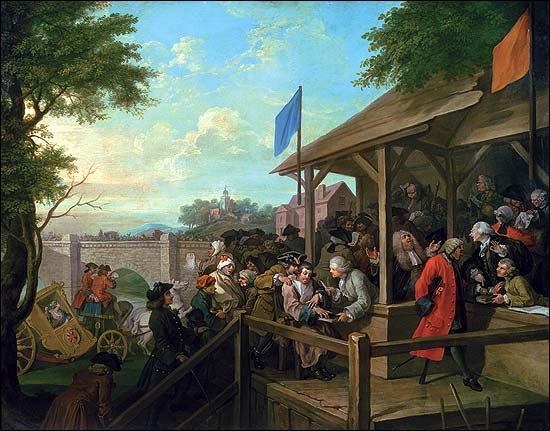
Involvement in government is crucial to the success of government as a whole. During the American Revolution, it was clear that participation in the political process would continue to be valued. Since those years, much has changed.
Involvement in government is crucial to the success of government as a whole. During the American Revolution, it was clear that participation in the political process would continue to be valued. Since those years, much has changed.

The political discourse in the years of the American Revolution parallels with the discourse of today. Just as commentators and analysts opine about trends in society, pamphleteers did the same in the Revolutionary years.
For example, pamphleteers believed that American society during the American Revolution was unique, as there was a perception that “wealth does not obtain the same degree of influence here, which it does in old countries.” John F. Roche, Joseph Reed: A Moderate in the American Revolution (N.Y. 1957), 187.

As the American Revolution became more and more inevitable, states began contemplating the role and responsibilities of their legislatures. Those contemplations centered around curing the perceived ills and shortcomings of the English constitution.

In the months leading up to the Declaration of Independence, the states began the process of adopting their own constitutions. These constitutions, being drafted in 1776, approximately 13 years before the United States Constitution would be ratified, had to confront many of the same issues as the United States Constitution, with various approaches being taken. (more…)
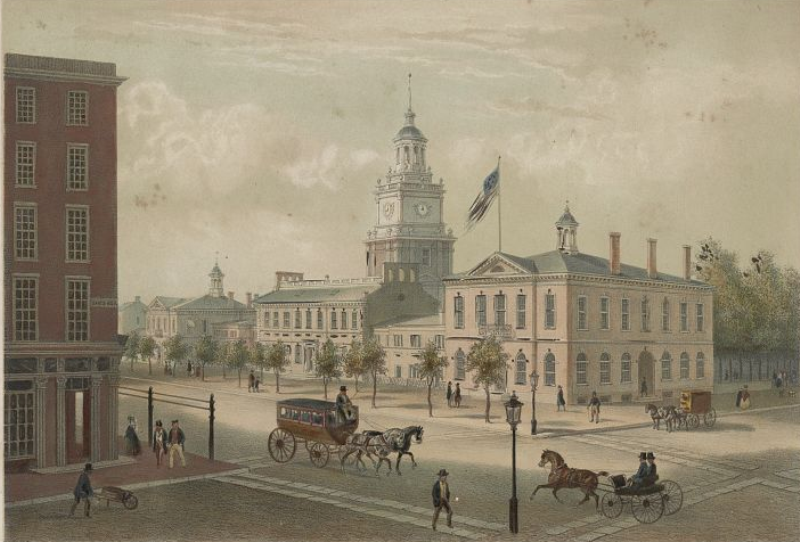
Throughout the development of early civil society in America, the familiar infrastructure to contemporary Americans rapidly developed. For example, as a result of new postal roads and turnpikes throughout the country, the postal system was able to achieve remarkable speeds for the time. For example, in 1790, “it had taken more than a month for news to travel from Pittsburgh to Philadelphia . . . .” Gordon Wood, Empire of Liberty, 479. Just four years later, the time was reduced to ten days. Id.
This improvement in the postal system would have a resulting effect on the proliferation of newspapers throughout America. Congress’s Post Office Act of 1792 ensured low rates for the mailing of newspapers, by virtue of letter-writers effectively subsidizing the postage for newspapers. Id.
This proliferation of newspapers created a widespread access to information, from small towns to big cities, and it did so rather quickly. For example, “[i]n 1800 the postal system transmitted 1.9 million newspapers a year; by 1820 it was transmitting 6 million a year.” Id. citing Richard R. John, Spreading the News: The American Postal System from Franklin to Morse (Cambridge, MA, 1995), 36-42.
Newspapers became an American obsession. During George Washington’s presidency, the entire country had 92 newspapers, but by 1810, there were sales in excess of 22 million copies of 376 newspapers annually, the “largest aggregate circulation of newspapers of any country in the world.” Gordon Wood, Empire of Liberty, 479 citing Alfred M. Lee, The Daily Newspaper in America (New York, 1937), 715-17; Frank Luther Mott, American Journalism: A History of American Newspapers in the United States Through 250 Years, 1690-1940 (New York, 1941), 159, 167; Merle Curti, The Growth of American Thought, 3rd ed. (New York, 1964), 209; Donald H. Stewart, The Opposition Press of the Federalist Period (Albany, 1969), 15, 624.
The fear that many of the Founding Fathers held that Americans would become as ignorant as their English counterparts, leading to all of the plaguing problems of government and society that ignorance brings, quickly proved to be an unfounded fear. Americans had a thirst for knowledge and were eager to get access to the crucial medium of the newspaper.
This thirst for knowledge has continued to today. As discussed in The Newspaper Revolution, Americans now enjoy the privilege of accessing many forms of media, all of which contain a volume of information that cannot all be feasibly read and understood. Setting aside the allegations of bias that many have about modern media, which surely has always permeated media to varying extents, this access to knowledge is undoubtedly crucial for the continuation of the Republic and the health of the democracy of America.
It allows any individual to learn what is happening in the world and to adopt positions regarding both domestic and foreign policy, which presumably will lead to a more informed decision in elections and more active participation in politics and discourse of issues.
The thirst of the early Americans for knowledge and information about what was happening in the world, combined with the early government’s understanding that a robust infrastructure was necessary for the dissemination of information (and travel), allowed for the development of the society we recognize today. As is clear from modern society, Americans are certainly obsessed with media, whether they enjoy it, attack it, or just simply listen to it.

By the time the United States declared its independence, capital punishment was common for murder, robbery, forgery, housebreaking, and counterfeiting. Gordon Wood, Empire of Liberty, 492. Some states had as many as two dozen crimes designated for capital punishment. Id. Further, “[e]xecution of the condemned criminals were conducted in public, and they drew thousands of spectators.” Id.
The early Republicans, including Thomas Jefferson, formulated a new approach to punishment that was more proportionate to the crimes. There were some who looked at capital punishment and believed it was too harsh for the crimes being committed, however, these early Americans would hardly be seen as compassionate, by today’s terms. Jefferson proposed the law of retaliation, lex talionis, meaning “the state would poison the criminal who poisoned the victim and would castrate men guilty of rape, polygamy, or sodomy.” Id. at 493 citing Thomas Jefferson, A Bill for Proportioning Crime and Punishments in Cases Heretofore Capital (1776-1786), Papers of Jefferson, 2: 492-507.
Pennsylvania was one state that led the way in more humane forms of punishment, sure not to violate the Constitution’s prohibition against cruel and unusual punishment. Pennsylvania, throughout the 1780s and 1790s enacted laws that “abolished all bodily punishments such as burning in the hand and cutting off the ears and ended the death penalty for all crimes except murder.” Gordon Wood, Empire of Liberty, 493 (internal quotations omitted).
Ultimately, these developments led to the development of the penitentiary, a uniquely American concept that is ubiquitous in contemporary American society. A British traveler in 1806, observing an American penitentiary commented that the penitentiary is “happily adapted to the genius of the government of the country, mild, just, and merciful.” Id. at 495.
Nonetheless, these early years of the development of the criminal justice system carry many legacies forward to today. The federal government and 31 states still allow capital punishment, however, it is considerably more rare than the earliest days of the Republic, as described. The movement toward more lenient punishment has been embraced by parts of Europe and other parts of the world, who have seemed to conclude that capital punishment does not serve as a strong enough deterrent to be relied on and is too humane to be justified.
Americans have strong views on the subject, which are divisive and often debated. Even in the campaign for 2016, Hillary Clinton has made comments about capital punishment, which has divided Democratic supporters. New York Times, Death Penalty Could Provide Debate Fodder for Hillary Clinton and Bernie Sanders, Oct. 30, 2015, available at http://www.nytimes.com/politics/first-draft/2015/10/30/death-penalty-could-provide-debate-fodder-for-hillary-clinton-and-bernie-sanders/?_r=0.
One thing is clear, however: America has deep roots in using capital punishment. Some will always believe that reforming criminals is impossible, whether that is because of mental illness, environmental factors, or otherwise. Others believe that reformation is possible for anybody, citing the numerous examples of criminals who reformed themselves while in prison to go on and do extraordinary things with their lives.
Regardless of where most individuals fall on that spectrum of justification, capital punishment continues to exist in a limited set of circumstances. Other punishments have been abandoned in favor of imprisoning criminals. As policymakers grapple with these issues, remembering the beginnings of punishment in America and the ineffective nature of those harsh punishments would likely be valuable.
 Last Best Hope of Earth