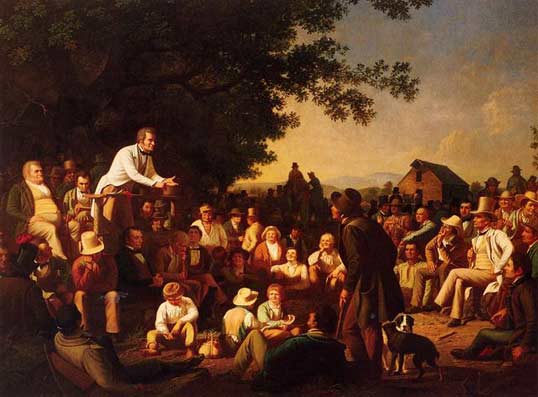
Andrew Jackson Stump Speaking. By: George Caleb Bingham.
Over the course of President John Quincy Adams’ term from 1824 to 1828, defenders of his administration began calling themselves National Republicans while opponents called themselves Democratic Republicans. Daniel Walker Howe, What Hath God Wrought: Transformation of America, 1815-1848, 275. The Election of 1828 served as a culmination of the changing politics of the country.
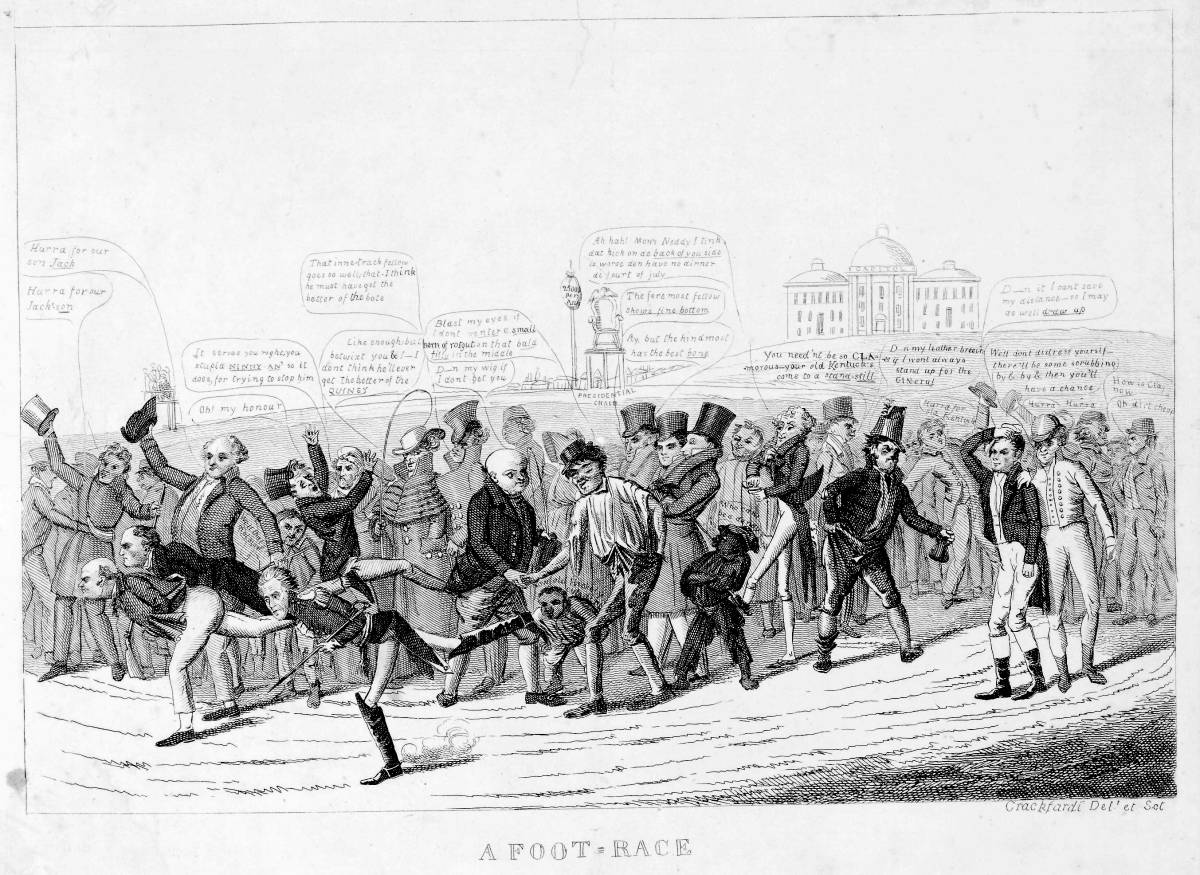
A Foot Race. Political Cartoon of the Election of 1824.
Following the Election of 1824, newly elected President John Quincy Adams went into the White House with a great deal of hope for the future. He was a lifelong student of Cicero and “envisioned the American republic as the culmination of the history of human progress and the realization of the potential of human nature.” Daniel Walker Howe, What Hath God Wrought: Transformation of America, 1815-1848, 245. In fact, historians have remarked that Quincy Adams was the “most learned president between [Thomas] Jefferson and [Woodrow] Wilson.” Id.
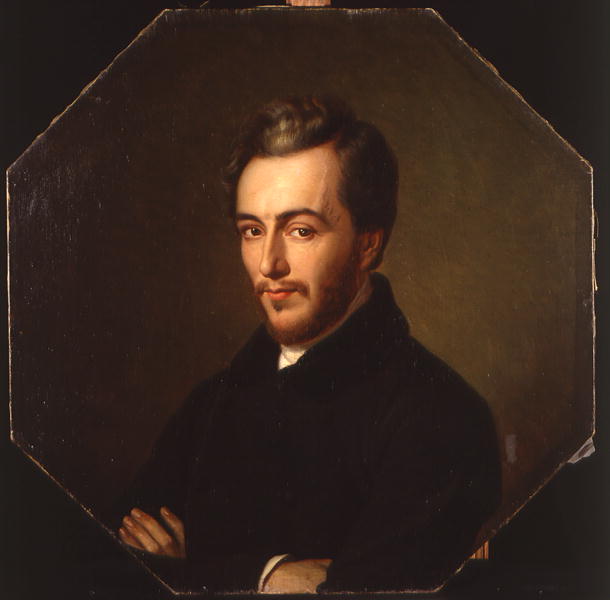
In 1833, a French engineer, Michel Chevalier, arrived in America and was fascinated by the infrastructure that surrounded him. Daniel Walker Howe, What Hath God Wrought: Transformation of America, 1815-1848, 241.
Many expected that the American Revolution would lead to some “bloody noses” as “almost all revolutions are founded in blood.” Samuel A. Otis to Theodore Sedgwick, July 30, 1782, Theodore Sedgwick Papers, A. 55, Massachusetts Historical Society, Boston. The British had made predictions that separating from Britain would lead to quarrels and the Americans splitting into parties. Gordon Wood, The Creation of the American Republic: 1776-1787, 397. As the Revolutionary years went on, it looked that the British were right, which appeared to put America on a path toward destruction.
The election of 1800 ushered in a new era of American politics. Thomas Jefferson won the election to become America’s third president, but also, it was a defeat for the Federalists, who had dominated politics in the first few decades of the country’s life. This was not just any defeat, however. This would mark the beginning of the end for the once powerful Federalist party.
By this point, Gordon Wood explains in Empire of Liberty, the Federalists had come to believe that ordinary people did not have “a direct role to play in ruling the society. They were so confident that the future belonged to them, that the society would become less egalitarian and more hierarchical, that they treated the people with condescension and lost touch with them.” Gordon Wood, Empire of Liberty, 276. Wood concludes by stating that the Federalists “were so out of touch with the developing popular realities of American life . . . .” Id. Noah Webster, at the time, concluded that the Federalists had led to their own demise by resisting “the force of public opinion . . . .” David Hackett Fischer, The Revolution of American Conservatism: The Federalist Party in the Era of Jeffersonian Democracy, (New York 1965), 151-52.
The fall of the Federalist party in the early Republic provides lessons to the modern political parties of the Republicans and the Democrats. The most obvious lesson is: Avoid public opinion at your own risk. The Federalists held onto the traditions of the monarchical republic, despite public opinion becoming increasingly more Republican-minded (the old Republican, that is). Public opinion undoubtedly can be illogical, unreasonable, and misinformed, but the social compact that the government only is as legitimate as its people allow it to be highlights the importance of public opinion, whether it is right or wrong on any given issue.
Looking at recent news, the resignation of Speaker of the House John Boehner, and the subsequent announcement by his presumptive replacement, Representative Kevin McCarthy, that he will not be seeking the Speaker’s chair, draws an interesting parallel between the modern Republican party and the Federalist party of centuries ago. The Republican party is currently fractured between its most conservative segment and the relatively moderate segment, both of which agree on some fundamental ideals, but the conservatives holding tightly to traditional beliefs socially, legally, and fiscally.
Recently, some of those positions held by the most conservative political figures have begun to be behind the curve of public opinion. While this is only a segment of the Republican party, it is also a vocal, active segment that has considerable sway in the party. Most analysts agree that John Boehner’s resignation is due to that vocal, active segment of the party.
Regardless, it is food for thought how the Republican party’s future may be shaped by its proclivity to maintain the traditional nature of the party, despite the changes in public opinion, socially and otherwise. While some have speculated the end of the Republican party may be nearing, this is unlikely barring significantly more turmoil and further clinging to traditional beliefs that have become outdated and antiquated from decades past. It is unlikely the Republicans will split, considering the party has been in existence for approximately 160 years. But it is possible.
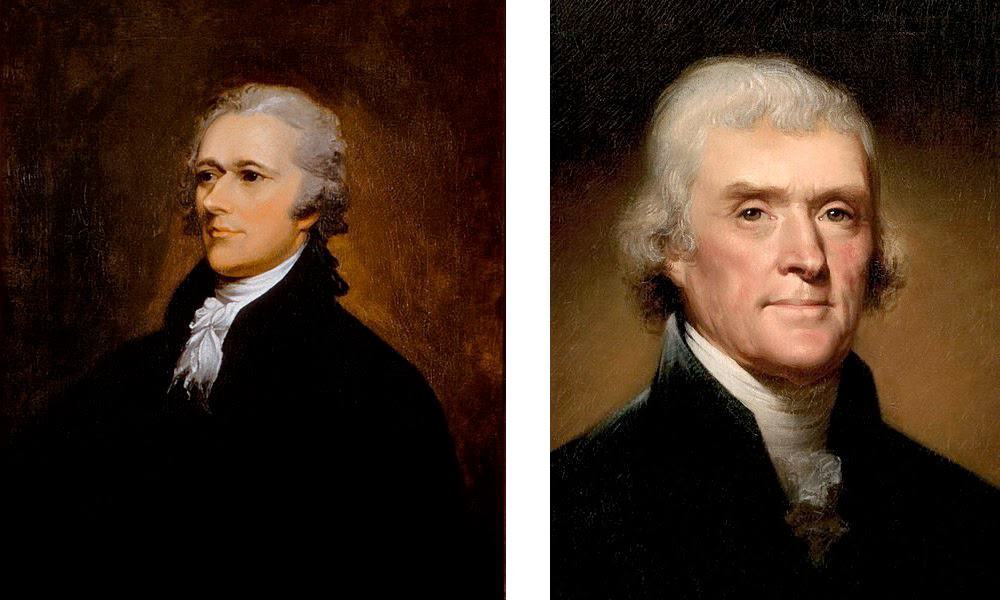
Alexander Hamilton and Thomas Jefferson had a contentious relationship, from their time serving as Secretaries in Washington’s administration forward. That contentious relationship manifested itself, at least partially, in the fact that they had crucial ideological differences. At first, those ideological differences were not reflected by different memberships in political parties. During the time they were Secretaries in Washington’s administration, there were no political parties.
When the two political parties, the Federalists and the Republicans, were created, Hamilton and Jefferson both had overblown ideas of what would each other’s party intended. Jefferson feared that Hamilton wished to implement a monarchy, and Hamilton feared that Jefferson intended to overthrow the government of the United States. As a general matter, the Federalist government feared that any Republicans or individuals with different views were determined to undermine the existence of the government and determined to bring an end to the system that the majority of Americans had worked so hard to create.
In fact, however, the Republican party did not see itself as a political party, and the Federalists did not view themselves as members of a political party in those early years. For example, the Federalists saw themselves as the vast majority of people who were concerned about the state of the country. Those in the Republican party ultimately began making Democratic-Republican Societies throughout the country, which demanded changes from the status quo of the predominantly Federalist government.
What a change the political party system has undergone since the late 1790s. Many would attribute the success of America’s political system to the fact that two main parties, now the Democrats and Republicans, have consistently vied against each other, generally agreeing to move the country forward by meeting in the middle. As Hamilton and Jefferson exaggerated the intentions and beliefs of the opposing party, modern Democrats and Republicans tend to do the same, at least to an extent.
That healthy debate between two adversaries has sustained not only the court system from ancient days to modern days but also the American system of politics. An adversarial contest between two parties prevents a cacophony of voices that tend to overwhelm multi-party political systems. Rather, it places two parties against each other, creating competition, encouraging debate, and having the net effect of putting the country on a moderate path, with gradual changes coming over the course of decades. Perhaps that gradual, conservative nature of progress has been the cause of America’s prolonged success.



 Last Best Hope of Earth