By the time of the Revolution, the states had begun to take steps toward sustaining themselves after independence from Britain was effectuated. One of those steps was the drafting of constitutions. Constitutions, while understood generally in Britain and elsewhere, had a unique meaning for Americans.
By 1776, the states were debating their respective constitutions and the Declaration of Independence was becoming a reality, all of which was fostering an environment of great debate. One part of that debate was what the role of governor should be for each state, and many of the conclusions and decisions made during that debate carry forth to modern America.
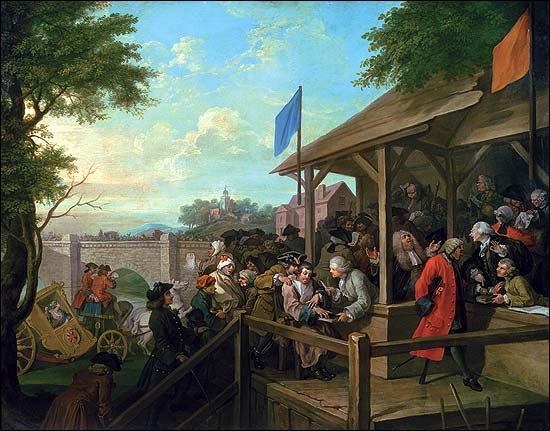
Involvement in government is crucial to the success of government as a whole. During the American Revolution, it was clear that participation in the political process would continue to be valued. Since those years, much has changed.
As explained in The Birth of the Senate, the states’ creation of an upper house of Congress set the precedent for a fully functioning, bicameral legislature in most states and the federal government. However, the selection process of who should be a senator was another subject for debate.
Throughout American history, there has always been a question about the nature of representation: do representatives represent only their constituents in their district or do they represent the entire people, as their actions impact the entire people? This debate played out in the years surrounding the American Revolution and continues today.
Thomas Paine’s Common Sense was a hugely influential pamphlet that has been cherished by several generations of Americans. However, it had its detractors who did not believe that “republicanism for America was a matter of common sense.” Gordon Wood, The Creation of the American Republic: 1776-1787, 94.
The American Revolution was a consequence of more than just The Stamp Act of 1765 or the frustration that Americans felt with the British imperial system. But in fact, the “American Revolution was actually many revolutions at once.” Gordon Wood, The Creation of the American Republic: 1776-1787, 75.
Sacrificing private interest for the public good is a noble virtue. It was an idea widely revered in the years surrounding the American Revolution. But despite the pervasiveness of that idea, some believed it was leading America down a path toward destruction. (more…)
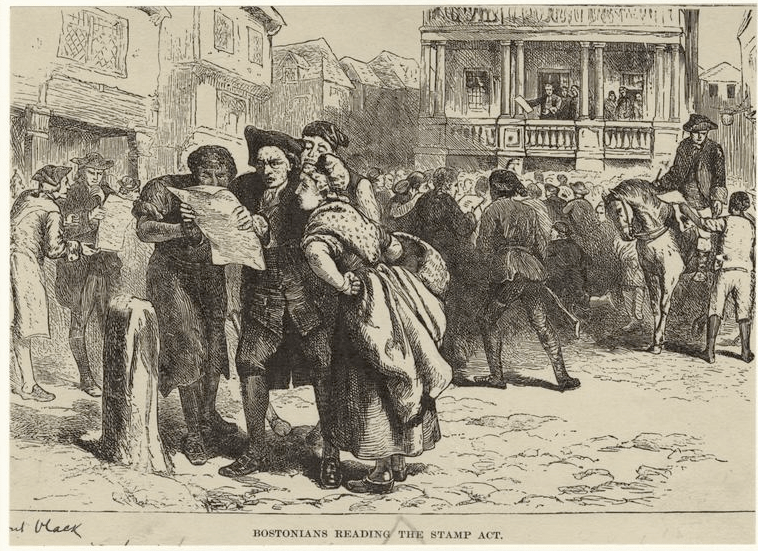
Depiction of Bostonians Reading the Stamp Act of 1765. Courtesy of New York Public Library Digital Image Gallery.
While one could find numerous causes of the American Revolution, perhaps none was a more proximate cause than the Stamp Act of 1765. The Stamp Act was the English Parliament’s taxation on every American’s use of paper, and this was perhaps the greatest manifestation of the idea of virtual representation.
City Hall of New York City in 1789, where Congress convened during the 1790s.
In the earliest years of the American Republic, theories were abound about the proper structure of government to best balance equality and wise decision-making. John Adams stated, in his Thoughts on Government, that “a people cannot be long free, nor ever happy, whose government is in one assembly.” Gordon Wood, The Creation of the American Republic: 1776-1787, 208-09 quoting John Adams, Thoughts on Government, Adams, ed., Works of John Adams, IV, 194, 196. These theories became tested throughout the young country, in each of the state’s constitutions.






 Last Best Hope of Earth