Tag: Populism

  • The Evolving Political Parties of the 1850s

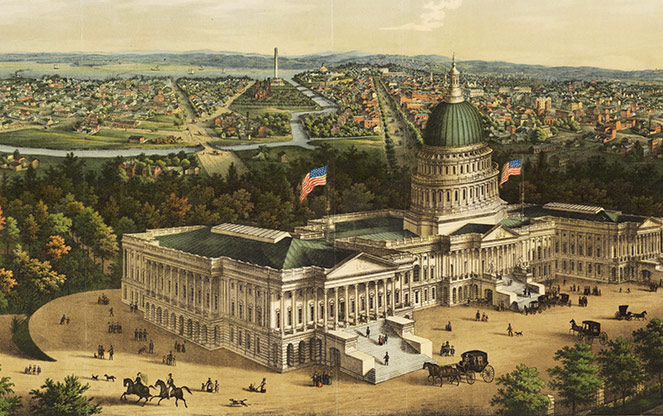
    panoramic-view-of-washington-city-e-sachse-and-co-1856
    Panoramic View of Washington, DC in 1856. Courtesy: E. Sachse & Co.

    The Democratic Party and Whig Party were the dominant political parties from the early 1830s up until the mid-1850s. Both were institutions in national politics despite not having a coherent national organization by cobbling together a diverse group of states to win elections. While the Democrats had a more populist agenda, the Whigs were more focused on pursuing industrialization and development of the country. See David Potter, The Impending Crisis: America Before the Civil War, 1848-1861, 226. While the Democratic Party would survive to the present day, the Whig Party would not survive the mid-1850s, not as a result of its own ineptness but because of the changing political landscape of that era. (more…)
  • Constitution Sunday: Answers to Mason’s “Objections”: “Marcus” [James Iredell] I

    Answers to Mason’s “Objections”: “Marcus” [James Iredell] I

    Norfolk and Portsmouth Journal (Virginia), February 20, 1788

    Following are excerpts from James Iredell’s responses to George Mason’s “Objections” to the Constitution:

    IIId. [George Mason’s] Objection. ‘The Senate have the power of altering all money bills, and of originating appropriations of money, and the salaries of the officers of their own appointment, in conjunction with the President of the United States (more…)

  • Constitution Sunday: “Publius,” The Federalist I [Alexander Hamilton]

    “Publius,” The Federalist I [Alexander Hamilton]

    Independent Journal (New York), October 27, 1787

    Following are excerpts from the Federalist I, written by Alexander Hamilton:

    “The subject speaks its own importance; comprehending in its consequences, nothing less than the existence of the union, (more…)

  • The Most Important Veto

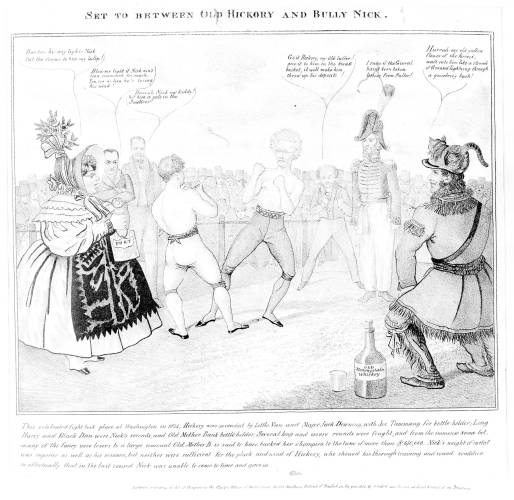
    old_hickory_and_bully_nick
    Political Cartoon of Andrew Jackson and Nicholas Biddle. Published in Harpers Weekly in 1834.

    President Andrew Jackson did not want banknotes in the American economy, as he was an adherent to the gold standard. Daniel Walker Howe, What Hath God Wrought: Transformation of America, 1815-1848, 376. He would be forced to confront Nicholas Biddle, the President of the Second Bank of the United States.

    (more…)

  • Constitution Sunday: Letter from James Madison to Thomas Jefferson

    Letter from James Madison to Thomas Jefferson

    New York, October 24, 1787

    Following are excerpts from James Madison’s letter to Thomas Jefferson, dated October 24, 1787:

    “It remains then to be enquired whether a majority having any common interest, or feeling any common passion, will find sufficient motives to restrain them from oppressing the minority. (more…)