By 1819, the area west of the Mississippi River, known as the Missouri Territory, had obtained a population qualifying it to be admitted to the Union. Daniel Walker Howe, What Hath God Wrought: Transformation of America, 1819-1848, 147. The only requirement to be admitted was that an enabling act be presented to Congress “authorizing Missouri voters to elect a convention to draft a state constitution.” Id. That bill was proposed, but Representative James Tallmadge proposed an amendment prohibiting further “importation of slavery” and “all children of slaves born after Missouri’s admission to the Union should become free at the age of twenty-five.” Id. This provoked great “consternation in the House of Representatives.” Id. citing Annals of Congress, 15th Cong., 2nd sess., 1170.
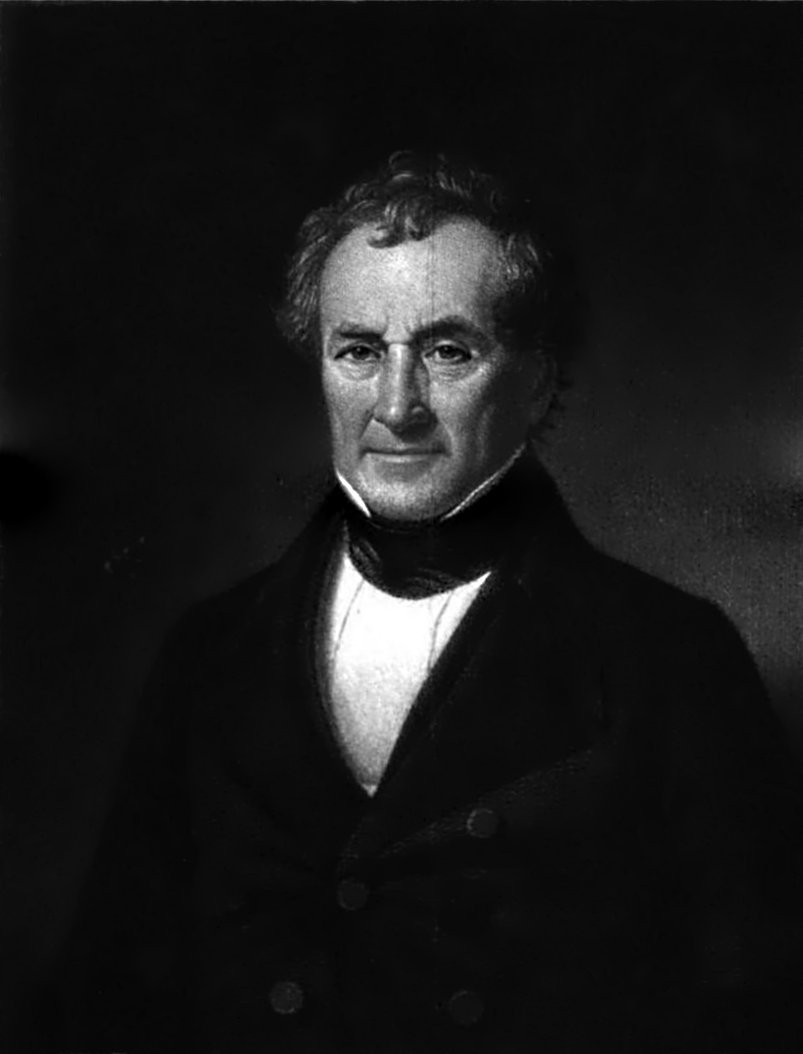
Chief Justice John Marshall of the Supreme Court of the United States. By: Cephas Thompson.
John Marshall would serve as Chief Justice of the United States Supreme Court from 1801 to 1835 and had a lasting impact on the institution. More broadly, he shaped the development of policy in America.
As nationalism was growing in the years following the War of 1812, achievements became more common and innovation was running rampant. In this environment, the Erie Canal was born.
James Monroe was the last president who was truly part of the American Revolution generation. Daniel Walker Howe, What Hath God Wrought: Transformation of America, 1815-1848, 91. He crossed the Delaware River with George Washington. Id. Obvious to his contemporaries, he dressed the part of the Revolutionary gentleman, wearing knee breeches and buckled shoes, with a powdered wig and three-cornered hat. Id.
By the end of the War of 1812, President James Madison had weathered what is likely one of the tumultuous years that any president has had to endure. The British had landed a force, marched on Washington, D.C., and burned the White House. President Madison had trusted his Secretary of War John Armstrong when he doubted the possibility of a British invasion, only to be caught off guard when a scouting party, led by Secretary of State James Monroe, located just how close the British were to Washington. See Daniel Walker Howe, What Hath God Wrought: The Transformation of America, 1815-1848, 63-64.
The culmination of beliefs and events that led to the drafting of the Constitution were varied but also generally in agreement about the necessity of having the Constitution.
Signing of the Constitution. By: Louis S. Glanzman.
John Adams had strong opinions about federalism. He believed that the government should be structured similarly to the British Empire, given the British Empire’s extraordinary success.
At the time of the signing of the Constitution, Adams firmly believed that the Constitution had secured a national government, as opposed to a government dividing its sovereignty into states and a federal government. Gordon Wood, Revolutionary Characters: What Made the Founders Different, 191. (more…)
The English Whigs were an influential, even revered, group for many of the colonists in America. Their beliefs resonated with ordinary, common people.
The Whigs believed that “the promotion of the people’s happiness was the sole purpose of government.” Gordon Wood, The Creation of the American Republic: 1776-1787, 20. Further, government was “a wise, a necessary, and a sacred thing,” which restrained the “lusts and passions that drove all men.” Id. quoting Samuel Williams, A Discourse on the Love of our Country (Salem, 1775), 28; John Joachim Zubly, The Law of Liberty (Philadelphia, 1775), 6-7.
The basics of the social contract were fundamental to Whig beliefs. The government officials “agreed to use their superior power to protect the rights of the people,” who “pledged their obedience, but only . . . as long as the rulers promoted the public interest.” Gordon Wood, The Creation of the American Republic: 1776-1787, 20 citing Dan Foster, A Short Essay on Civil Government (Hartford, 1775).
Many Whig leaders in England became idols for American liberty. William Pitt, the First Earl of Chatham, developed an almost cult-like following amongst a segment of colonists in America. In Bristol County, Massachusetts, one colonist explained: “Our toast in general is,—Magna Charta [sic], the British Constitution,—Pitt and Liberty forever!” Clinton Rossiter, Seedtime of the Republic. The Origin of the American Tradition of Political Liberty (New York: Harcourt, Bruce and Company, 1953), 145, 359-60.
This early American obsession with the Whig ideology would frame the revolutionaries’ beliefs and priorities. Those beliefs and priorities have carried forward to modern Americans.
The social contract certainly has not been forgotten, as many modern Americans are fully aware of the fact that their elected officials can be voted out just as easily as they were voted in.
However, the political theory surrounding the purpose of government perhaps has been lost over the years. The Whig belief that the sole purpose of government is to promote the happiness of the people is an optimistic, hopeful perspective. Many contemporary Republicans, particularly of the Ronald Reagan era, would not be able to disagree loud and fast enough to this Whig belief. Even some modern Democrats may take issue with it, as it is perhaps not nuanced enough to apply to a nuanced society.
While we were quick to import the Whig belief that government’s sole purpose is to promote happiness, should we, as modern Americans be so quick to dismiss it? If the purpose of government is not happiness for all, then what is it?
In the early 1800s, America underwent a campaign of infrastructure building. The building of new roads, bridges, and canals were done in a spirit of “national grandeur and individual convenience.” Gordon Wood, Empire of Liberty, 730 quoting Charles G. Haines, Considerations on the Great Western Canal (Brooklyn, 1818), 11.
In 1806, Samuel Blodgett, an economist and architect, concluded that commerce held together the Americans. Gordon Wood, Empire of Liberty, 730. Blodgett believed that commerce was “the most sublime gift of heaven, wherewith to harmonize and enlarge society.” Id.quoting Samuel Blodgett, Economica: A Statistical Manual for the United States of America (Washington, DC, 1806), 102.
Blodgett believed that if America were to surpass Europe, it could not be done with the policies of Alexander Hamilton and the Federalists. Id. Instead, it had to be done with the Republicans, led by Thomas Jefferson. Id. Blodgett believed that only the Republican policies had the “capacity to further the material welfare of” America’s citizens. Id. citing Samuel Blodgett, Economica: A Statistical Manual for the United States of America (Washington, DC, 1806), 102.
If commerce is the “most sublime gift of heaven,” as Blodgett said, then the manifestation of commerce in the United States as being carried out with the spirit of “national grandeur and individual convenience” is the reason that America has economically surpassed the individual states of Europe. Since the days of the early Republic, Americans have taken actions that both contributed to their individual benefit and have had the aggregate effect of creating national grandeur.
In this sense, America has distinguished itself both historically and currently from other countries. Many countries, for example the Soviet Union in the past and China currently, have attempted to create national grandeur not through individual innovation but through government involvement. In doing so, those other countries have created the facade of success and grandeur that they hope to achieve. That is not to say that those countries have not developed sophisticated, successful economies. But the sustainability of those countries’ economies is debatable.
One of America’s best qualities is that it has had prolonged economic success. Of course, there have been tumultuous times, like the Great Depression, and the so-called “Great Recession” and the panics and scares that are all but forgotten in modern times.
However, America from the earliest days has encouraged individual success through its institutions, its culture, and its laws. The American people have believed in that opportunity and have taken risks, worked hard, and created an economy characterized by its national grandeur. Preserving the institutions, culture, and laws that foster such grandeur is crucial for America’s continued success.




 Last Best Hope of Earth